Trying to plan a Greek island getaway but stuck choosing between Crete and Corfu? Both islands pack in stunning beauty, though their vibes couldn’t be more different. Crete, the largest of all the Greek islands, is a place of wild landscapes, ancient history, and public transport that works pretty well, so you don’t need a car.
Corfu, tucked away in the Ionian Sea and closer to Italy than Athens, lures people in with its lush greenery and a kind of romantic energy that’s hard to pin down.
Your choice really comes down to what kind of Greek adventure you’re after. Crete is all about variety—mountains, beaches, ruins, you name it.
Corfu feels easier to get around and gives you that unique blend of cultures thanks to its position on the edge of Greece. Even the food, music, and accents set these islands apart.
Maybe you’re after something more compact and green—then Corfu sounds like your spot. But if you want to roam through ruins, hike mountains, and hop on a bus without stress, Crete’s calling your name.
Key Takeaways
- Crete brings more diverse landscapes, a rich history, and solid public transportation for travelers without cars.
- Corfu stands out for its lush scenery, romantic corners, and cool mix of cultures, thanks to its location near Italy.
- Each island has its own personality—food, architecture, and local culture all feel different, making both worth a visit.
Location and Geography

Crete and Corfu sit on almost opposite ends of Greece. That gives them two different flavors, from the weather to the scenery.
Where Is Crete?

Crete sits in the far south, in the Aegean Sea between Europe and Africa. It’s the biggest Greek island by a long shot, stretching about 160 miles east to west—almost its own little country. Being closer to North Africa than Athens, Crete gets more sun and less rain.
The island buzzes with life in major cities like Heraklion, Chania, and Rethymno. Over the centuries, Minoans, Venetians, and Ottomans have all left their mark, and you can see it everywhere.
Crete’s southern coast faces Libya across the sea, while the north looks toward mainland Greece. That bit of isolation has helped the island keep its fiercely independent spirit.
Where Is Corfu?

Corfu hangs out in the northwest corner of Greece, floating in the Ionian Sea. Funny enough, it’s closer to Italy’s Puglia region than to Athens. You can feel the Italian influence in Corfu’s buildings and culture.
Just a stone’s throw from Albania—only 1.5 miles at the closest point—you can spot Albania from many northern Corfu beaches.
Corfu feels much more connected to mainland Europe than the remote Greek islands. Its spot between east and west has made it a key player in history. Corfu Town faces east toward Greece, while the west side gets those jaw-dropping sunsets over the Ionian Sea.
Landscape Differences

Put these two islands side by side, and the contrast jumps out. Corfu is ridiculously green, thanks to all the rain it gets. Olive groves, cypress trees, and rolling hills are everywhere—no wonder people call it the “Emerald Isle” of Greece.
Crete’s landscape is way more dramatic and varied. Four big mountain ranges, including Mount Ida at over 8,000 feet, slice through the island and create all sorts of mini-climates.
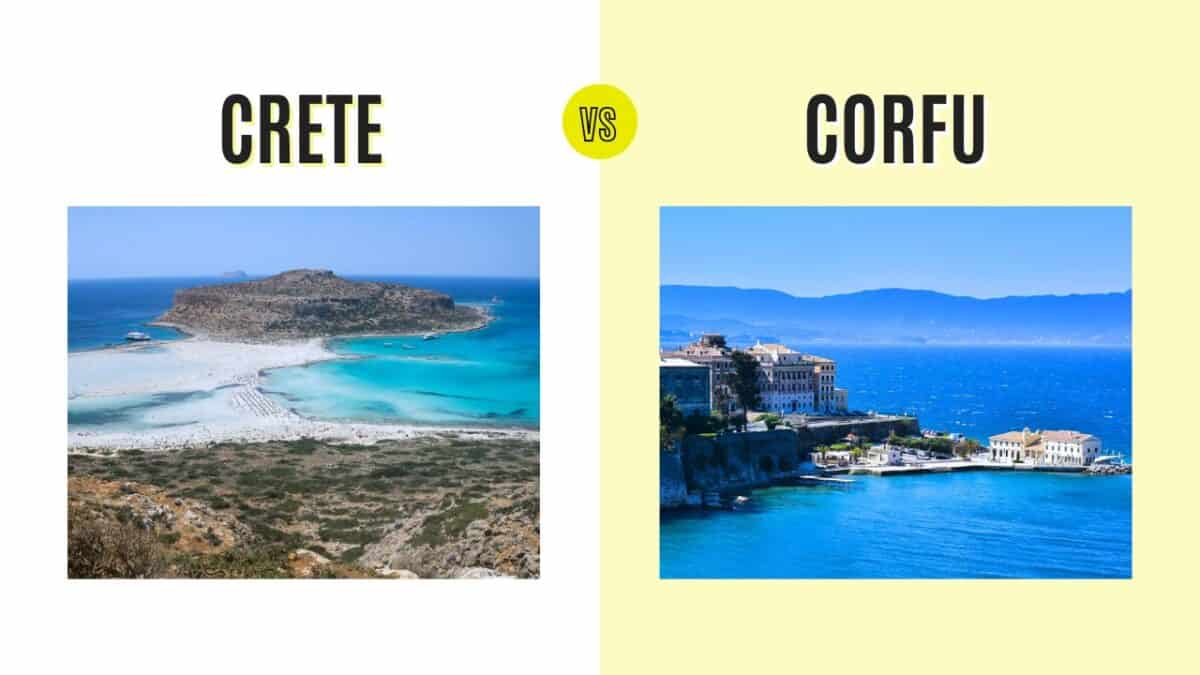
Northern Crete has developed beaches and lively towns, but head south and things get wilder and less touched by tourism. Palm forests, like at Vai Beach, and even desert-like stretches near Balos Lagoon keep things interesting.
Corfu’s hills roll gently, never really climbing into true mountains. Its coastline flips between hidden coves and long sandy stretches, nearly always backed by thick green forest.
Best Time to Visit

Picking the right time for your trip can change your experience. Crete and Corfu each have their rhythms regarding weather and crowds.
Weather Patterns by Month

In Crete, May feels just right—temperatures hover around 20-24°C (68-75°F), and it’s not sticky yet. Great for hiking or poking around ruins.
August gets downright hot on both islands. Oddly, Corfu sometimes feels hotter than Crete, even though it’s further north. Crete usually peaks at 28-30°C (82-86°F), but Corfu can push up to 33°C (91°F) with a good dose of humidity.
October in Crete is a favorite—sea temps still hit 22-24°C (72-75°F), and the air stays comfy. Corfu cools down faster and sees more rain, but you can still luck into some warm, sunny days.
Peak and Shoulder Seasons
July and August? That’s when everyone shows up. Prices shoot up, beaches fill up, and you’ll want to book ahead for just about anything. It’s lively, but maybe a bit much for some.
May and October are the sweet spots. You’ll get:
- Cheaper rates (30-40% less than summer)
- Fewer tourists at the big sights
- More of a local vibe
- Weather that’s just right for exploring
Corfu’s season wraps up a bit sooner than Crete’s. By late October, many places in Corfu shut down, while Crete keeps going thanks to its size and southern location. May in Crete is already warm enough for swimming, while Corfu might still be warming up.
Beaches and Coastlines

Both islands have some of the best beaches in Greece, but the feel is different. Crete mixes golden sands with rocky coves, while Corfu’s beaches look dramatic against all that greenery.
Best Beaches in Crete

Crete’s coastline stretches 650 miles, so you’re spoiled for choice. Elafonisi Beach stands out in Chania with its pink-tinged sand and shallow, clear water. I have to admit, the sand does look pink in the right light—pretty wild.
Balos Beach near Kissamos is also a stunner, with its lagoon vibes and layers of blue water. It’s a bit of a trek, but worth it.
Vai Beach in the east has Europe’s biggest palm forest right behind it. Golden sand, blue water, and a wall of green—it’s a crazy combo.
Preveli Beach in Rethymnon gives you a palm grove and a river running into the sea. You can swim in both, which is kind of surreal.
Best Beaches in Corfu

Corfu’s beaches lean greener and more dramatic. Paleokastritsa is probably the island’s most famous spot, with little coves tucked under olive-clad cliffs. The water glows a crazy shade of emerald.
Canal d’Amour near Sidari has sandstone formations that carve out natural swimming channels. There’s a local legend: swim through it with your partner, and you’ll stay together forever. Who knows, right?
Glyfada Beach mixes golden sand with deep blue water. It gets busy, but you can usually find your own space.
Porto Timoni is two beaches back-to-back on a skinny peninsula. You’ll have to hike about 20 minutes to get there, but the views are unreal.
Hidden Beach Gems
If you want to escape the crowds, both islands have their secrets. In Crete, Kedrodasos Beach near Elafonisi is where a cedar forest meets perfect sand, and hardly anyone finds it.
Sweetwater Beach near Loutro (Crete) is only reachable by boat or a tough hike. If you make it, freshwater will be bubbling up through the pebbles.
In Corfu, Rovinia Beach hides behind olive groves. A 15-minute walk takes you to a perfect crescent of white pebbles under limestone cliffs. I stumbled onto it by accident and spent the whole day there.
Myrtiotissa Beach, which Lawrence Durrell once called “perhaps the loveliest beach in the world,” is a tiny, partly clothing-optional cove surrounded by thick greenery.
See Related:Best Place To Stay In Crete for Older Couples
Culture and Attractions

Crete and Corfu offer cultural experiences and historic sites that will stay with you. The islands showcase their different influences in everything from architecture to music.
Famous Sights in Crete

Knossos Palace sits just outside Heraklion and draws crowds for good reason. You can wander through the ruins of the ancient Minoan civilization—frescoes, giant columns, the whole deal. It’s Europe’s oldest advanced society, and it feels surreal to walk where they did.
The old towns of Chania and Rethymnon blend Venetian and Ottoman touches. The harbor and lighthouse are perfect for a stroll in Chania, and the little shopping streets are fun to get lost in. Rethymnon’s fortress towers over winding lanes packed with shops and tavernas.
The Archaeological Museum in Heraklion holds the world’s top collection of Minoan artifacts. If you’re up for a hike, the Samaria Gorge mixes natural beauty with a sense of history—locals call it “the giant gate.”
Noteworthy Attractions in Corfu

Corfu Town (Kerkyra) stands out with its Venetian vibe. The UNESCO-listed old town has two big fortresses—the Old Fortress sticks out into the sea, and the New Fortress gives you sweeping views.
Achilleion Palace, built for Empress Elisabeth of Austria, feels straight out of a fairy tale with its gardens and Greek statues. Walking through the rooms, you get flashes of Greek mythology everywhere.
Mon Repos Palace, where Prince Philip was born, sits surrounded by gardens near Kerkyra. The Kanoni peninsula gives you that classic view of Mouse Island (Pontikonisi) and its tiny church.
The Liston, a covered arcade inspired by Paris’s Rue de Rivoli, is a great place to grab a coffee and people-watch. Corfu’s Italian influence also pops up in its music—you might catch an opera or classical concert on a summer evening.
Accommodation Options

You’ll find plenty of places to stay on Crete and Corfu, whether after a splashy resort or a quiet private villa hidden in the hills.
Luxury and Spa Resorts

Crete is home to several high-end resorts, especially around Elounda and Agios Nikolaos. These spots have some of Greece’s fanciest hotels, many with private beaches and top-notch spas. The island’s size means these resorts can spread out—think big pools and many amenities.
Corfu’s luxury scene clusters mostly in the northeast, sometimes called “Kensington-on-Sea.” You’ll find elegant spa hotels with knockout sea views, though they tend to be more intimate than Crete’s sprawling complexes.
Prices in Corfu’s fanciest hotels usually run higher, especially in summer. If you want luxury without blowing your budget, Crete often gives you more space and newer facilities for less.
Private Villas

Renting a private villa has exploded in popularity, and honestly, it’s my favorite way to visit the Greek islands. Crete’s villas run the gamut—from rustic stone cottages in mountain villages to sleek, modern homes perched over the sea. The Chania area, in particular, has some real gems tucked among olive trees.
Corfu’s villas feel more traditional. They are often converted from historic homes with Venetian flair. Many have those classic Ionian Sea views you see on postcards.
Both islands offer solid value compared to other Mediterranean hotspots. For families or groups, villas usually beat hotels on price and give you more space and privacy. Most come with private pools and outdoor lounging areas—perfect for soaking up those warm Greek nights.
Unique Stays and Boutique Hotels

If you’re after something different, both islands have many boutique spots packed with local character.
Crete stands out for its historic buildings in the old town of Chania and Rethymno. People have turned former Turkish mansions and Venetian townhouses into stylish boutique hotels. You’ll also stumble upon cave hotels and eco-retreats tucked away in Crete’s quieter corners.
Corfu has its distinctive heritage properties. Its unique accommodations show the mix of British, French, and Italian influences. Some favorites are the old olive presses and restored Venetian mansions in Corfu Town.
These smaller hotels usually offer a more personal touch and an authentic vibe than the big resorts. These spots are a great choice if you want to feel connected to local culture and stay somewhere that tells a story.
See Related:Best Greek Islands for Families
Local Experiences and Activities

Both islands let you dive into Greek life in their ways, but each one has special activities to try. Crete’s rich history and wide-open landscapes feel different from Corfu’s lush greenery and Venetian flair, but honestly, you can’t go wrong with either.
Outdoor Adventures

Crete’s landscape is a dream for outdoor lovers. You can hike the famous Samaria Gorge—at 16 km, it’s Europe’s longest.
The cliffs are massive, and the views are dramatic. Not everyone realizes Crete also has fantastic mountain biking trails through olive groves and old villages.
Corfu is all about the water. The clear Ionian Sea is perfect for kayaking, especially around Paleokastritsa, where you can paddle into hidden caves. Inland, hiking paths wind through cypress forests and olive groves, with some pretty epic views.
Both islands have beautiful beaches for swimming and snorkeling. Corfu’s Paleokastritsa and Crete’s Elafonisi (with that wild pink-tinged sand) stand out.
Food & Wine

Crete’s food is legendary—some say it’s one of the healthiest diets on the planet. Farm-to-table dining is the norm, and you’ll find local dishes like dakos (rustic bread with tomato and cheese) and gamopilafo (wedding rice) everywhere. The olive oil is top-notch, and you can taste wines from grapes like Vidiano that don’t grow elsewhere.
Food experiences worth trying:
- Take a cooking class in a village home
- Join a traditional Cretan glendi (feast)
- Drop by a family-run winery in the Heraklion area
Corfu’s food leans Italian, thanks to the Venetians. You’ve got to try pastitsada (spiced meat with pasta) and sofrito (veal in wine sauce). And don’t skip the kumquat liqueur—it’s pure Corfu and makes a fun souvenir.
Wellness and Relaxation

Both islands offer great spa options, but each has its own wellness experiences.
In Crete, many luxury resorts around Elounda blend ancient Minoan wellness traditions into their spa menus. Using local clay from natural springs, you can soak in a therapeutic mud bath. Some retreats even offer yoga in olive groves or with sea views.
Corfu’s spa scene focuses more on thalassotherapy—treatments with seawater and marine goodies. The cypress and eucalyptus trees everywhere give the island a naturally soothing scent.
Both islands have thermal springs. Crete’s Edipsos hot springs are especially famous for their healing qualities. And, fun fact, you’ll find natural clay deposits on some beaches that locals swear by for skin treatments.
Ease of Travel and Accessibility

Getting around the Greek islands takes a little planning. Crete and Corfu each have their quirks regarding transportation and exploring the islands and nearby spots.
Getting to Crete and Corfu

Both islands have international airports with plenty of flights from Europe, especially in summer. Crete has three airports (Heraklion, Chania, Sitia), so you get more flight choices than Corfu’s single airport. Year-round, you’ll find regular flights from Athens to both islands.
Corfu is more compact, so it’s a breeze to get around. You can drive from one end to the other in about two hours. The main town is super walkable—great if you love exploring on foot.
Crete is much bigger, so you’ll need to plan more. Renting a car helps you see more of the island. Public buses connect the main towns, but you won’t reach every attraction that way. Expect longer drives between places.
Island Hopping to Nearby Destinations

Corfu sits in the Ionian Sea, near several other islands. You can hop on a ferry for day trips to Paxos and Antipaxos. It’s also pretty close to Albania—the ferry to Sarandë takes only about 30 minutes!
Crete offers island-hopping opportunities too. Ferries run to Santorini (about 2 hours by high-speed ferry) or Rhodes, but these trips work better as overnights than quick day trips. You can also reach smaller islands like Gavdos by ferry.
Both islands connect to mainland Greece with regular ferries. Corfu’s route to Igoumenitsa is much shorter than Crete’s journey to Athens or other ports.
Which Island Is Right for You?

Crete and Corfu both deliver amazing Greek island vibes, but they attract different travelers depending on what you’re after. Picking the right one comes down to your interests, travel style, and what you want from your trip.
Crete: Who Will Love It

Crete is perfect for travelers who want variety and are willing to cover some ground. If you geek over ancient history, Crete’s Minoan ruins and archaeological sites will blow your mind. The Palace of Knossos is worth a visit.
Adventurers will love Crete’s epic landscapes—from rugged mountains to show-stopping gorges like Samaria. You can hike in the morning, then chill on a pink-sand beach by the afternoon.
Food lovers should put Crete on their list. The island’s cuisine is famous all over Greece for its fresh ingredients and unique dishes. Don’t miss dakos (barley rusks with tomato and cheese) and kalitsounia (sweet cheese pastries).
Crete works best if you have at least a week, since it’s huge and there’s so much to see.
Corfu: Who Will Love It

Corfu is great for travelers who want lush, green scenery and a smaller-scale experience. If Italy and Greece had a baby, it’d be Corfu—Venetian architecture, a distinct cultural vibe, and a different feel from the other Greek islands.
Beach fans will love Corfu’s coastline. The island has some of the most photogenic beaches in Greece, like Canal d’Amour (those rock formations!) and Paleokastritsa’s emerald water.
If you’re into books, you might know Corfu from Gerald Durrell’s “My Family and Other Animals.” Artists and writers have flocked here for ages.
Anyone who likes a relaxed pace and easy navigation will appreciate Corfu’s size. You can see the highlights in four or five days without rushing around.
Key Factors for Choosing

Time Available:
- 3-5 days? Go to Corfu (easy to get around)
- 7+ days? Pick Crete (so much to explore)
Transportation Preferences:
- Crete: You’ll need to drive more between sights
- Corfu: Shorter distances, less hassle
Weather Considerations:
- Corfu: Greener, but it rains more, especially in spring
- Crete: Drier, with a longer summer
Budget also matters. Crete has more places to stay at every price point, while Corfu can get pricey, especially in peak season.
Your travel style matters. Crete is ideal for independent explorers who like planning their adventures. Corfu works for package holidays and DIY travel, with many organized tours if you want them.
See Related:Best Time to Visit Santorini
Frequently Asked Questions

Travelers comparing Crete and Corfu usually want to know about budget, weather, family activities, etc. Here are some answers to the most common questions.
Which island offers better value for money, Crete or Corfu?
Crete usually gives you better value for money because it’s bigger and has more places to stay, from hostels to luxury resorts.
Food is cheaper in Crete, especially if you skip the touristy spots. Mountain villages have local tavernas that serve big portions of Cretan dishes for a bargain.
Corfu can cost more, especially in popular spots like Paleokastritsa or Corfu Town. But if you stay in quieter villages like Sidari or Roda, you’ll find good deals on hotels and food.
What are the differences in weather patterns between Crete and Corfu throughout the year?
Crete enjoys one of Greece’s longest summers, with warm weather often stretching from April to October. Its southern spot means winters are milder than Corfu’s.
Crete can get pretty hot in July and August—sometimes hitting 35°C or more, especially down south. The sea stays warm enough for swims well into November in some places.
Corfu sits farther north in the Ionian Sea and gets more rain, especially in winter. That’s why it’s so lush and green. Summers are hot but less intense than Crete, usually ranging from 25-32°C.
Corfu’s swimming season is shorter, running from May to September. Winters there are wetter and cooler, with temperatures between 5-15°C from December to February.
Which island is more suitable for a family vacation, Crete or Corfu?
Crete is fantastic for families, thanks to its many family-friendly resorts, especially around Hersonissos, Rethymno, and Chania. Lots of hotels have kids’ clubs and activities.
Northern Crete’s beaches often have shallow, calm water for kids. Attractions like Aquaworld Aquarium, Dinosauria Park, and the Knossos Palace ruins keep everyone busy.
Corfu is great for families who want a more compact experience. Less time in the car means more time having fun. Aqualand water park is a big hit.
Beaches like Agios Georgios and Glyfada are safe for swimming. Exploring Corfu Town’s fortress feels like a real-life treasure hunt for kids.
Can you compare the nightlife in Crete versus Corfu?
Crete has a lively nightlife, with Malia being the go-to party spot—some even compare it to Ibiza in summer. Hersonissos and parts of Chania have buzzing club scenes, too.
You’ll find everything from wild beach parties to cozy cocktail bars and live music venues. Most of the nightlife happens in certain areas, so finding peace elsewhere is easy.
Corfu’s nightlife centers on Kavos, which draws younger crowds looking for budget-friendly parties. Corfu Town offers more upscale bars and the occasional live music night.
Sidari and Ipsos get lively in high season. Overall, Corfu’s nightlife feels more contained in a few areas than Crete’s.
In terms of beach quality and variety, how do Crete and Corfu stack up against each other?
Crete wins for sheer variety, with over 300 beaches—think pink sand at Elafonisi or the palm forest at Vai. The south coast has more wild, remote spots, while the north offers organized beaches with plenty of amenities.
You’ll find places like Balos Lagoon with shallow turquoise water or Preveli, where a palm grove and river meet the sea. On Crete, you could hit a different beach every day for weeks.
Corfu has about 120 beaches, many with pebbles instead of sand. The west coast is dramatic, with cliffs and clear water at places like Paleokastritsa.
Canal d’Amour’s rock formations and Glyfada’s golden sand are real highlights. Corfu’s beaches aren’t as numerous, but they tend to be less crowded than Crete’s busiest spots.
Are Crete or Corfu more recommended as romantic getaways for couples?
Crete offers couples all kinds of romantic moments—think sunset dinners by the old Venetian harbors in Chania and Rethymno, or escaping to quiet beaches like Seitan Limania. Some boutique hotels sit inside old historic buildings, so you get that cozy, intimate vibe.
You can wander through Cretan vineyards for wine tasting or grab dinner in a mountain village—honestly, those memories tend to stick with you. And since Crete is pretty big, you can mix up lazy days at the beach by exploring the island’s cultural spots.
Corfu, on the other hand, just nails those postcard-perfect scenes. You see the Venetian touches everywhere, and the whole place feels lush and green. The old town has these winding little streets and tucked-away squares—ideal for a quiet stroll with your partner.
Watching the sunset from Pelekas Hill or Kaiser’s Throne feels almost unreal, and it’s easy to find boutique places to stay, like converted olive presses or stone mansions in villages such as Paleokastritsa or Kassiopi. If you want peace and privacy, those spots are hard to beat.