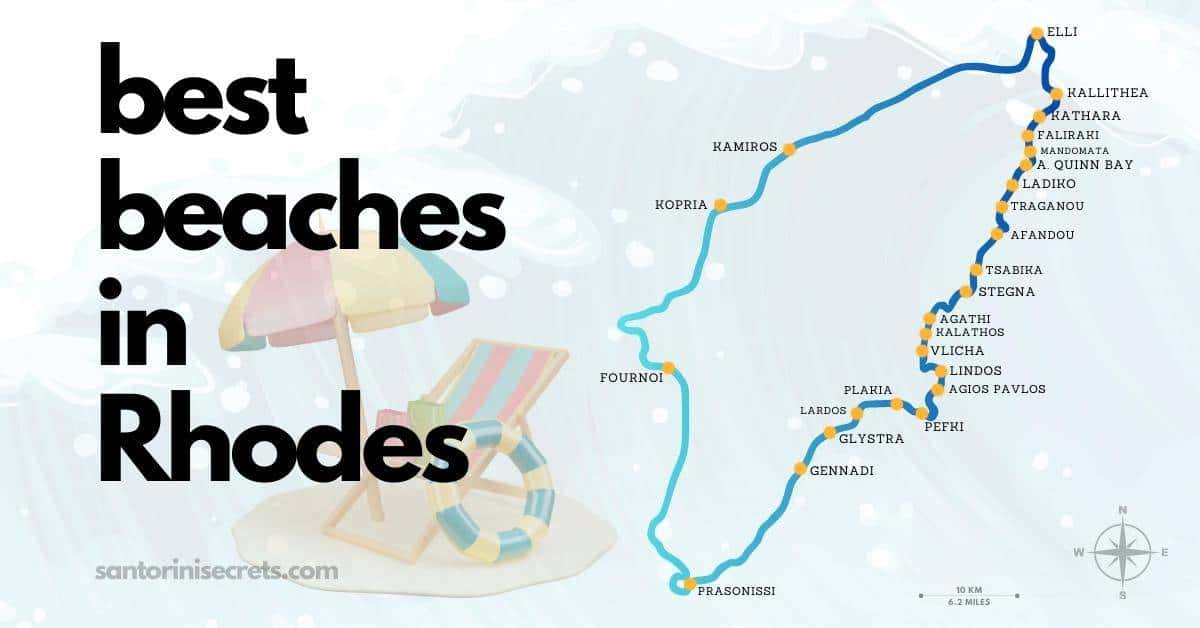
Rhodes has more than a hundred beaches, and the honest short answer is that four cover almost every need: Tsambika for wide golden sand and shallow water, Agios Pavlos (St Paul’s Bay) for the clearest water and the Lindos acropolis overhead, Prasonisi for wind sports and the sand bridge where two seas meet, and Elli if you are staying in Rhodes Town and want to walk to the sea. The east coast holds the calm, sandy, bus-served beaches; the west coast is windier and mostly pebble. Below are 25 beaches with the two things most guides leave out: what the bus actually costs from Rhodes Town in 2026, and which beaches have no bus at all.

Which Rhodes beach should you pick?
Pick by the constraint that actually decides your day: do you have a car, do you need shallow water, and how much wind will you tolerate. This table answers that in one look.
| If you want | Go to | Coast | Bus from Rhodes Town |
|---|---|---|---|
| Wide golden sand, easiest all-rounder | Tsambika | East | Yes, €4.00 |
| Clearest water, dramatic setting | Agios Pavlos (St Paul’s Bay) | East, below Lindos | Yes, via Lindos €6.00 |
| Shallow water for small children | Tsambika or Afantou | East | Yes, €4.00 / €2.50 |
| Wind, kitesurfing, the two-seas effect | Prasonisi | Southern tip | Yes, €11.00 |
| No car, staying in Rhodes Town | Elli | Town | Walkable |
| Nightlife and watersports on tap | Faliraki | East | Yes |
| Quiet pebble, few people | Kalathos or Gennadi | East / south-east | Gennadi €7.50 |
| A cove you have to drive to | Traganou, Glystra, Fourni or Kopria | East and west | No bus stop |
Which side of Rhodes has the best beaches?
The east coast has the best swimming beaches, and it is not close. Rhodes sits in the path of the summer meltemi, which blows down the Aegean from the north-west. The west coast takes that wind head-on, which is why Ixia and Ialyssos became windsurfing centres rather than family beaches, and why the west shoreline is mostly grey pebble and shore-break. The eastern part of the island lies in its own wind shadow: calmer water, more sand, and every beach that appears on a postcard. It is the reason Rhodes reads so differently from the wind-exposed Greek islands further west in the Aegean.
The exception is the southern tip. At Prasonisi the two coasts meet, so you can stand on one strip of sand with flat water on your left and a wind-driven chop on your right. That is the whole reason to make the drive.
The practical consequence: if you have one beach day and no strong preference, go east. If the forecast shows a hard northerly, go further south along the east coast rather than switching sides.
What does the bus to each beach cost in 2026?
Between €2.50 and €11.00 one way from Rhodes Town, depending on how far south you go. The intercity operator is KTEL Rodou, based at 17 Megalou Konstantinou in Rhodes Town. These fares are transcribed from KTEL Rodou’s own route timetables, which carry the validity window 6 July 2026 to 10 September 2026 printed on every sheet.
| Destination | One way from Rhodes Town | Useful connection |
|---|---|---|
| Afantou | €2.50 | Lindos €4.00 |
| Mandomata | €2.50 | Anthony Quinn Bay €2.20, Lindos €4.50 |
| Tsambika Beach | €4.00 | Kolymbia Beach €2.30 |
| Stegna | €4.40 | Sheet dated 30 April to 30 September 2026 |
| Lindos | €6.00 | Archangelos €2.50, Afantou €4.00 |
| Vlicha | €6.00 | Lindos €2.20 |
| Lardos | €6.20 | Lindos €2.20, Kiotari €2.20 |
| Pefki | €6.60 | Lindos €2.20 |
| Gennadi | €7.50 | Lindos €3.00, Lardos €2.20 |
| Prasonisi | €11.00 | Two departures back, 13:00 and 16:00 |
| Ladiko / Anthony Quinn Bay | Via Faliraki €2.00 | From Mandomata €2.20 |
| Airport to Faliraki (line 25) | €3.50 | Roughly hourly, 07:00 to 23:00 |
Two discounts apply across the network: 25% off for students, military and uniformed personnel, and 50% off for people with disabilities and for families with three or more children. Tickets can be bought online through KTEL Rodou’s e-ticketing site or from the driver.
Check before you travel after 10 September 2026. Every beach-route sheet on KTEL Rodou’s site expires on that date, and the autumn timetable thins out sharply once the resorts close. One sheet already shows the problem: the St Paul’s Bay stop page carries the summer validity banner but links a winter timetable file, so the printed window and the attached document do not agree. Read the date on the sheet itself, not the banner above it.
Which Rhodes beaches have a Blue Flag in 2026?
Twenty-eight stretches on Rhodes hold a 2026 Blue Flag, and not one of them is a famous public beach. Every single Rhodes award in the 2026 register belongs to a named hotel or resort frontage: Lindos Grand, Lindos Mare and Lindos Blu at Vlicha; Elysium, Rodos Palladium and Mitsis Selection Alila at Ammoudes-Faliraki; Amada Colossos at Faliraki; Irene Palace and Port Royal at Afantou; Atlantica Imperial, Mythos Beach and Mikri Poli at Kolymbia; Lindos Princess and Lindian Village at Lardos; Gennadi Grand Resort; Atrium Prestige at Lachania; Sunwing Kallithea Beach; and so on down the list.
Tsambika does not have one. Neither does Anthony Quinn Bay, Elli, Agathi, Traganou, Prasonisi, or the main beach at Lindos.
That is not a verdict on the water. The Blue Flag is applied for and maintained by whoever holds the concession, and the criteria include lifeguard cover, first aid, posted water-quality results, waste separation and accessibility. A resort with a beach club can fund all of that and apply every year. An unstaffed public cove has nobody to apply on its behalf, so it can have flawless water and no flag. If you are choosing a beach by Blue Flag on Rhodes, what you are really choosing is a hotel frontage.
For scale: Greece was awarded 624 Blue Flag beaches in 2026, second in the world, so Rhodes accounts for roughly 4.5% of the national total.
How much do sunbeds cost, and what does the law allow?
Two sunbeds and an umbrella run about €10 to €20 at an organised east-coast beach, and the sand itself is always free. Under Greek law the shoreline is public everywhere, and you cannot be charged to walk on it, sit on it or swim from it. What you pay for is the furniture, and since Law 5092/2024 the rules around that are far stricter than most visitors realise.
- Seventy per cent of a beach must stay free of sunbeds, rising to 85% inside Natura 2000 protected zones.
- A clear strip of at least four metres from the waterline must be kept free, so the first row of loungers cannot sit at the sea’s edge.
- Protected beaches carry no concession at all. The national register of these has grown to 251 beaches, where sunbeds, umbrellas and commercial watersports are banned outright.
- Fines run from €2,000 to €60,000, with suspension of the concession and bans of up to ten years for repeat breaches.
Enforcement runs through an app. MyCoast shows the exact leased footprint for a given beach, the purpose it was leased for and the concession contract itself, and lets anyone report a breach to the authorities. More than 2,000 complaints were filed through it in 2025. If a beach bar tells you the whole sand is theirs, the app will show you the polygon that says otherwise.
A beach club with table service will charge considerably more. Prices are set per concession and change year to year, so treat any figure you read as a range rather than a quote.
One clarification, because it is widely repeated wrongly: Kallithea is not a beach that charges entry. Kallithea Springs is a restored 1920s thermal spa complex with gardens, mosaics and a small swimming bay inside its walls, and the ticket buys you the monument, not the sea. The operator lists €5 for adults and €2.50 for children under 12; some ticket resellers instead list €5 adult, €3 for ages 12 to 18 and free under 12, so check at the gate. It sits 9 km from Rhodes Town and 40 km from Lindos, and the water inside the bay averages about 25°C in summer.
When can you swim in Rhodes?
Comfortably from May to late October, and the sea stays at or above 20°C (68°F) from May right through to December. Rhodes water runs from about 17°C (63°F) at its March low to about 27°C (81°F) in August, which is warmer for longer than most of the Aegean because the island sits so far south-east.
| Period | Sea temperature | What it means in practice |
|---|---|---|
| March | About 17°C / 63°F | The annual low. Swimmable only if you are hardy |
| May to June | Above 20°C / 68°F and climbing | Comfortable, quiet beaches, mild air |
| July to August | Peaks near 27°C / 81°F | Warmest water, busiest sand, strongest meltemi |
| September to October | Around 24 to 25°C / 75 to 77°F | The sweet spot: warm sea, thinner crowds |
| November to December | Still at or above 20°C / 68°F | Swimmable, but most beach services have closed |
Note the mismatch that catches people out: the water is still 20°C in November, but the sunbeds, showers, lifeguards and beach tavernas are not. The bus timetable thins out at the same time. Warm sea and open facilities only overlap from roughly May to early October.
Nine of these beaches have no bus at all
KTEL Rodou’s own bus-stop index has no stop for Agathi, Traganou, Plakia, Glystra, Kathara, Kamiros, Fourni or Kopria. Elli is the ninth, and only because it is in Rhodes Town and you walk. Those eight are car or taxi only, and that single fact reshuffles the ranking for anyone who has not booked a hire car. It is also the reason the quiet beaches stay quiet.
The beaches KTEL does serve with a dedicated stop are Kallithea, Faliraki, Ladiko and Anthony Quinn Bay, Mandomata, Kolymbia, Tsambika, Stegna, Afantou, Kalathos, Vlicha, Lindos, St. Paul’s Bay, Pefki, Lardos, Kiotari, Gennadi, Plimmiri and Prasonisi. The network also reaches inland attractions that pair well with a beach day, including a dedicated stop for Seven Springs (Epta Piges) in the hills above Kolymbia.
The 25 best beaches in Rhodes

| Beach | KTEL bus stop | Go for |
|---|---|---|
| Anthony Quinn Bay | Yes (Ladiko / Anthony Quinn) | Rocky cove, snorkelling, clear water |
| Tsambika | Yes (Tsambika Beach) | Long golden sand, families, watersports |
| Agios Pavlos (St Paul’s Bay) | Yes (Lindos St Paul) | Clearest water, acropolis overhead |
| Faliraki | Yes (Faliraki Center) | Everything organised, nightlife |
| Agathi | No | Sheltered sandy bay near Haraki |
| Traganou | No | Sea caves, no development |
| Prasonisi | Yes (Prasonisi) | Two seas, kitesurfing, the sand bridge |
| Afandou | Yes (Afantou) | Long open beach, golf course behind |
| Plakia | No | Small and quiet |
| Ladiko | Yes (Ladiko / Anthony Quinn) | Sheltered horseshoe next to Anthony Quinn |
| Lindos | Yes (Lindos) | The classic Lindos bay view |
| Kallithea | Yes (Kallithea) | 1920s spa architecture, swimming inside the complex |
| Elli | Walkable from Rhodes Town | Town beach, no car needed |
| Glystra | No | Small sheltered cove south of Lardos |
| Pefki | Yes (Pefki) | Resort beach with shade and tavernas |
| Vlicha | Yes (Vlicha) | Calm bay, hotel frontage, Blue Flag stretches |
| Kathara | No | Quiet bay near Faliraki |
| Kamiros | No | West-coast pebble by the ancient site |
| Stegna | Yes (Stegna) | Fishing-village beach below Archangelos |
| Mandomata | Yes (Mantomata) | Rhodes’ naturist beach |
| Fourni | No | Remote west-coast cove with cave-cut rock |
| Gennadi | Yes (Gennadi) | Long quiet pebble, horse riding |
| Lardos | Yes (Lardos Beach) | Family bay, hotel frontage |
| Kalathos | Yes (Kalathos) | Wide, quiet, clear water |
| Kopria | No | Wind-protected, free sunbeds early |
Anthony Quinn Bay

Technically a small rocky bay rather than a beach, and one of the most visited spots on the island. The water is exceptionally clear and the entry is over rock and shingle, so bring water shoes. The name is not an official toponym: the actor Anthony Quinn bought land here while filming The Guns of Navarone in 1961 and spoke of turning the bay into an international centre, but the Greek state reclaimed the land in 1984 following a change in property law. The name stuck anyway. Reachable on the KTEL Ladiko / Anthony Quinn service, €2.00 from Faliraki or €2.20 from Mandomata.
Tsambika Beach

The most family-friendly beach on Rhodes: long, wide, golden sand with shallow water and a full run of watersports. It is also the best-value bus trip on the island at €4.00 one way from Rhodes Town.
Above it sits the Monastery of Panagia Tsambika, roughly 28 km from Rhodes Town and reached by 350 steps from the car park. Rebuilt in 1770, it is a fertility shrine, and women making the pilgrimage traditionally climb barefoot. Its feast day is 8 September, the Nativity of the Theotokos, when thousands of pilgrims arrive: if you are heading for the beach that day, expect the access road and the car park to be full from early morning.
Agios Pavlos Beach (St Paul’s Bay)

Known in English as St Paul’s Bay, and worth knowing both names because signage and bus stops use each. It is an almost enclosed circular bay under the Lindos acropolis, with some of the clearest water on Rhodes and very little wind. Arrive before 11:00 in high season if you want a sunbed. KTEL serves it from the Lindos St Paul stop; Lindos itself is €6.00 from Rhodes Town.
Faliraki Beach

The island’s biggest resort beach and the one with the most infrastructure: sunbeds end to end, watersports, bars and the shortest walk between sea and a cold drink. It is also where several 2026 Blue Flag frontages sit, including Amada Colossos and the Ammoudes-Faliraki cluster. If you are flying in and staying here, the airport bus (line 25) runs to Faliraki for €3.50 one way, roughly hourly from 07:00 to 23:00.
Agathi Beach

A sheltered sandy bay near Haraki, shallow enough for small children and popular with families staying around Lindos. There is no KTEL stop at the beach: the nearest listed stop is Haraki, so in practice this is a drive.
Traganou Beach

Undeveloped, with sea caves cut into the rock at the northern end that you can swim into on a calm day. No bus stop, limited shade and no facilities worth the name, which is exactly why it stays empty compared with Afandou next door.
Prasonisi Beach

The southern tip, and the single most distinctive beach on Rhodes. What joins Prasonisi to the island is a tombolo, not an isthmus: a sand bridge built by opposing wave trains. In summer it is exposed and you walk across in 10 to 30 cm of water with no current; in winter and after meltemi storms it floods and Prasonisi becomes a true island. That seasonal switch is documented in the peer-reviewed literature, in a 2022 study of the tombolo’s morphological changes published in the journal Water.
The practical effect is that you get two different seas either side of one strip of sand: the Aegean side gets the wind, with gusts regularly over 30 knots from May to September, and the eastern side stays comparatively flat. It is one of Greece’s most reliable water sports beaches for that reason, and windsurfers and kitesurfers plan trips around it. The bus is €11.00 from Rhodes Town, the most expensive beach fare on the network, and the return departures are limited, so check the sheet before committing to a day there.
Afandou Beach

Several kilometres of open shoreline with the island’s golf course behind it, which keeps development off the back of the beach. Big enough that you can always find space, even in August. At €2.50 one way it is the cheapest beach fare from Rhodes Town on this list, and it connects onward to Lindos for €4.00.
Plakia Beach

Small, quiet and easy to miss. No bus stop and no organised facilities, so it suits an afternoon between other stops rather than a full beach day.
Ladiko Beach

A sheltered horseshoe immediately next to Anthony Quinn Bay and served by the same KTEL stop, which makes it the obvious fallback when the bay is full. Calmer water, more actual sand, fewer people photographing it.
Lindos Beach

The main bay below Lindos village, sheltered, shallow and busy, with the acropolis on the headland above. Buses run frequently: €6.00 from Rhodes Town, with departures back to town through to late evening in the summer timetable. If the main bay is crowded, St Paul’s Bay is a short walk around the headland.
Kallithea Beach

Not a conventional beach: a restored 1920s thermal spa with domed pavilions, pebble mosaics and terraced platforms cut into a small bay. Swimming happens inside the complex, off the rocks and platforms rather than off sand. The operator’s ticket is €5.00 for adults and €2.50 for under-12s. It is 9 km from Rhodes Town on the Kallithea bus corridor, and the surrounding coast holds several 2026 Blue Flag hotel frontages including Sunwing Kallithea Beach.
Elli Beach

Rhodes Town’s own beach, on the northern tip where the Aegean and the Mediterranean sides of the island meet. Pebble rather than sand, deep close in, with a diving platform offshore and the old town ten minutes behind you. The only beach on this list you can reach without a bus or a car, which makes it the default for anyone on a city break. Despite being the most photographed beach on the island, it holds no 2026 Blue Flag of its own.
Glystra Beach

A compact sheltered cove on the road south of Lardos, with calm shallow water and a single beach bar. It fills quickly because it is small. No dedicated bus stop, so it is a car stop between Lardos and Kiotari.
Pefki Beach

A resort beach just south of Lindos with actual tree shade behind the sand, which is rarer on Rhodes than it sounds. Well served by bus at €6.60 from Rhodes Town, or €2.20 from Lindos, with departures roughly hourly through the day.
Vlicha Beach

A calm, deep bay between Kalathos and Lindos, largely fronted by hotels. Three of the island’s 2026 Blue Flags sit here, at Lindos Grand Resort and at Lindos Mare and Lindos Blu. The bus is €6.00 from Rhodes Town but only twice a day each way, so Lindos at €2.20 away is the more practical hop.
Kathara Beach

A quiet bay in the Faliraki headland area with notably clear water and far fewer people than the main strip a few minutes away. No dedicated KTEL stop.
Kamiros Beach

West coast, below the ancient city of Kamiros, and a useful pairing with the archaeological site rather than a beach day in its own right. Being on the windward side it is pebble, open to the meltemi and often choppy. No beach bus stop.
Stegna Beach

The beach below Archangelos, still recognisably a fishing settlement, with tavernas along the shore. The bus is €4.40 from Rhodes Town, but note the service is thin: KTEL’s Stegna sheet lists a single morning departure and a single afternoon return, neither running on Sundays, and it carries a different validity window from the other beach routes, 30 April to 30 September 2026.
Mandomata Beach

Rhodes’ naturist beach, tucked below the coast road north of Faliraki. Better served than its reputation suggests: KTEL runs a dedicated Mantomata line at €2.50 from Rhodes Town with departures through the day, and it connects on to Anthony Quinn Bay for €2.20 and Lindos for €4.50.
Fourni Beach

Remote, on the quieter south-west side, backed by a rock face cut with early Christian cave chambers. There is no bus and the approach road is slow, which is the price of having it almost to yourself.
Gennadi Beach

Long, wide and pebbly, well away from the crowds, and known for horse riding along the shore. The bus is €7.50 from Rhodes Town, or €3.00 from Lindos. Gennadi Grand Resort holds one of the island’s 2026 Blue Flags.
Lardos Beach

A broad bay used mostly by the hotels behind it, which means good facilities and a calm, family-scale beach. Buses are frequent at €6.20 from Rhodes Town and €2.20 from Lindos. Two 2026 Blue Flags sit here, at Lindos Princess Beach and Lindian Village.
Kalathos Beach

Wide, pebbly, with crystal clear water and one of the quietest stretches on the east coast despite being minutes from the village of Lindos. KTEL lists four stops along it plus two more at the Lindos Mare end, so it is easy to reach without a car.
Kopria Beach

Well protected from the wind, which is its main claim on a blowy day on the north coast. Arrive early and there are usually free sunbeds. No bus stop.
Four mistakes people make on Rhodes beaches
- Reading the Blue Flag as a water-quality ranking. On Rhodes it tells you a resort applied and paid for it: every one of the island’s 28 awards in 2026 is a hotel frontage.
- Planning a bus day to a beach with no bus. Eight of the beaches here have no KTEL stop at all, so check the operator’s stop index before you build a day around one.
- Booking a late-season trip on summer information. The sea is still above 20°C in November, but the beach services and most of the bus frequency have gone, and the summer beach timetables expire on 10 September 2026.
- Paying without knowing the rules. The shoreline is free by law, 70% of any beach must be kept clear of sunbeds and the first four metres from the water must stay empty. If that is not what you are looking at, the MyCoast app shows the actual concession footprint.
Are Rhodes beaches still affected by the 2023 wildfire?
No. The beaches are operating normally. The fire started in the hills above Kiotari on the evening of 18 July 2023 and was contained eleven days later, having burned 17,773 hectares and forced the evacuation of around 19,000 people, the largest such evacuation in Greek history. What burned was inland pine forest in south-central Rhodes.
Rhodes Town, Faliraki, Lindos, Ixia, Ialyssos, Pefki and the east-coast beaches were not in the fire’s path, and the south-eastern resort beaches at Kiotari, Lardos and Gennadi have run normally through the seasons since. If you drive inland behind Gennadi you will still see burned hillside; on the beaches you will not.
How we checked this
Bus fares and the validity window come from KTEL Rodou’s own published route timetables and its ticket and discount page. Blue Flag awards come from the 2026 Greek Blue Flag register. The sunbed rules come from Law 5092/2024 and the MyCoast reporting scheme. Kallithea’s ticket price is the figure published by the site’s own operator; where a third-party seller disagreed we have said so rather than picking one. Sea temperatures are monthly averages, not guarantees for a given week.
Prices, timetables and concession arrangements on Greek beaches change every season and sometimes mid-season. Every figure here carries the date it was valid; treat anything older than the current summer as a starting point to verify, not an answer.
Rhodes beaches: frequently asked questions
What is the best beach in Rhodes?
Tsambika is the best all-round beach in Rhodes: a long, wide stretch of golden sand with shallow water, full facilities and a €4.00 bus from Rhodes Town. For the clearest water go to Agios Pavlos (St Paul’s Bay) below Lindos, and for something genuinely unusual go to Prasonisi at the southern tip, where a sand bridge separates two different seas.
Which part of Rhodes has the best beaches?
The east coast. Rhodes sits in the path of the summer meltemi, which hits the west coast head-on and leaves it windy and mostly pebble, while the east coast lies in the island’s wind shadow with calmer water and far more sand. The one exception is the southern tip at Prasonisi, where both coasts meet.
Do you have to pay to go to the beach in Rhodes?
No. The shoreline is public under Greek law and you cannot be charged to walk on it, sit on it or swim from it. You pay only for a sunbed and umbrella, typically €10 to €20 for two loungers at an organised east-coast beach. Since Law 5092/2024, 70% of any beach must be kept free of sunbeds, rising to 85% in Natura 2000 zones, and a four-metre strip from the waterline must stay clear.
Is there a sandy beach in Rhodes?
Yes, and most of them are on the east coast. Tsambika, Afandou and Agathi are sand; Elli, Kalathos, Gennadi and the west-coast beaches are pebble. If sand is the priority, head south-east from Faliraki rather than west from Rhodes Town.
How much is the bus to the beach in Rhodes?
Between €2.50 and €11.00 one way from Rhodes Town on KTEL Rodou. Afandou and Mandomata are €2.50, Tsambika Beach €4.00, Stegna €4.40, Lindos and Vlicha €6.00, Lardos €6.20, Pefki €6.60, Gennadi €7.50 and Prasonisi €11.00. Students and military get 25% off; people with disabilities and families with three or more children get 50%. These fares are from timetables valid 6 July to 10 September 2026.
Which Rhodes beaches have a Blue Flag?
Twenty-eight stretches on Rhodes hold a 2026 Blue Flag, and every one of them is a hotel or resort frontage rather than a public beach. Tsambika, Anthony Quinn Bay, Elli, Agathi, Prasonisi and the main Lindos beach have no flag of their own. The award is applied for and funded by whoever holds the concession, so it reflects who runs the beach, not how good the water is.
More Greek beach guides
- Best Hotels in Rhodes, including the resorts whose frontages hold the island’s Blue Flags
- Best Beaches in Corfu
- Best Beaches in Crete
- Best Beaches in Chania
- Best Beaches in Milos
- Best Beaches Near Athens
- Best Things to Do in Athens
Last updated 29 August 2026. This update re-transcribed every KTEL Rodou beach fare from the operator’s own timetables (valid 6 July to 10 September 2026), checked all 28 Rhodes entries in the 2026 Greek Blue Flag register, added the Law 5092/2024 sunbed rules and the MyCoast reporting scheme, corrected the claim that beach access is charged at Kallithea, and identified the eight beaches on this list that KTEL does not serve. The next KTEL timetable change is due on 10 September 2026.