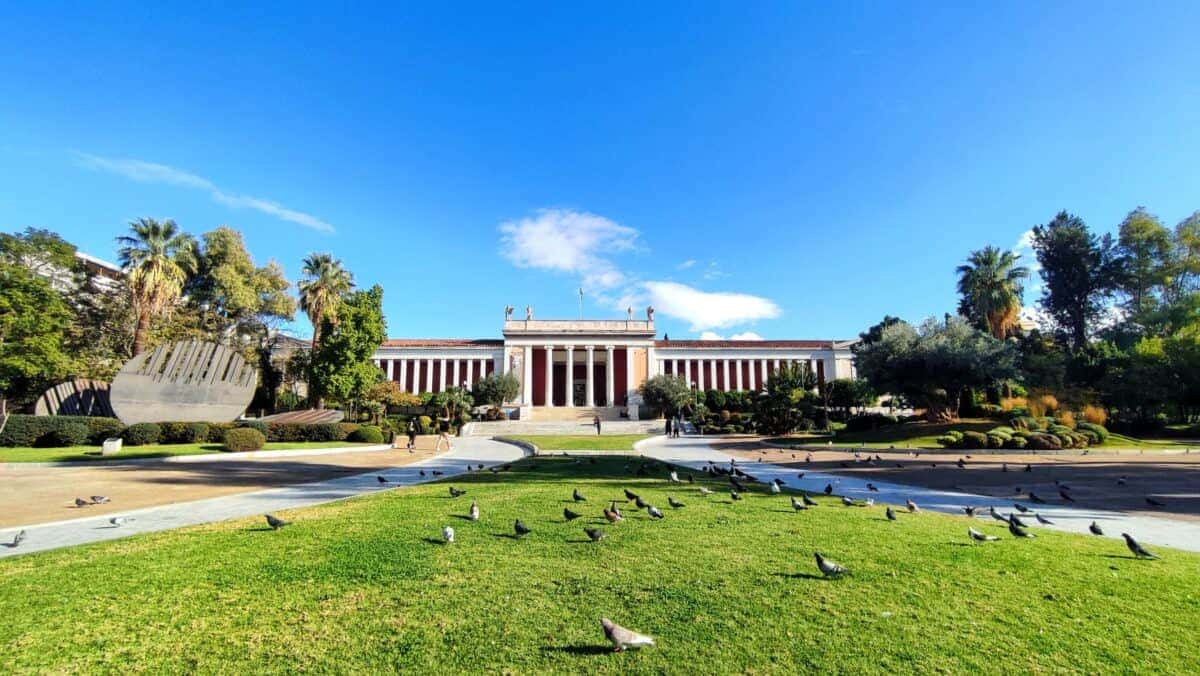
The National Archaeological Museum in Athens is the largest museum in Greece and holds the most important collection of ancient Greek art and antiquities in the world. Housed in a neoclassical building on 28th of October (Patission) Street that first opened its doors in 1889, it displays more than 11,000 exhibits across five permanent collections — Prehistoric, Sculpture, Vases & Minor Arts, Metalwork, and Egyptian & Near Eastern antiquities — spanning from the Neolithic era to late antiquity. General admission is €20 (the same price year-round), and you should plan on at least two to three hours to see it properly.
It is, quite simply, one of the best museums in Greece and Europe and a real gem for any history buff. I recently visited, took hundreds of photos, and put together this complete guide to help you plan your visit.
Not sure how they relate? Here is the simple difference between the Acropolis and the Parthenon.
Along with a visit to the Acropolis Temple, the Acropolis Museum, and the National Historical Museum, this is one of the best things to do in Athens. Here is everything you need to know before you go.

BEST TOUR OF THE NATIONAL ARCHAEOLOGICAL MUSEUM:
Private Tour of the National Archaeological Museum of Athens
Visitor Information at a Glance (2026)
- Address: 44, 28th of October (Patission) Street, Athens 106 82.
- Nearest metro: Victoria Station (Line 1 – green) or Omonia Station (Lines 1 & 2), followed by a 5–10 minute walk.
- General admission: €20 — the same price all year round.
- Free entry: EU citizens under 25 and non-EU visitors under 18 (with ID/passport); plus every first and third Sunday from November 1 to March 31, and on March 6, April 18, May 18, the last weekend of September, and October 28.
- Opening hours (summer, May 4–Nov 15): Wednesday–Monday 08:00–20:00, Tuesday 13:00–20:00.
- Opening hours (winter, Nov 16–May 3): Wednesday–Monday 08:30–15:30, Tuesday 13:00–20:00. Last admission is 30 minutes before closing.
- Closed: January 1, March 25, May 1, Orthodox Easter Sunday, and December 25–26.
- Time needed: 2–3 hours minimum; half a day to see the highlights without rushing.
- Security: bags are searched and X-rayed at the entrance, and large bags (over 30 × 30 × 15 cm) must be left in the cloakroom.
- Photography: allowed for free without flash.
The museum’s neoclassical building was completed in the late 1800s and opened in 1889 with just a handful of prehistoric and permanent exhibitions (still on display today). It now welcomes hundreds of thousands of visitors a year, offering a fascinating glimpse into Greece’s glorious past.
READ ALSO:
- Where to Stay in Athens
- Best Hotels in Athens
- Acropolis Tickets: best tips and options
- Best Greek Islands Near Athens
- Best Greek Island Tours From Athens

Is the National Archaeological Museum worth visiting? Yes — if you only have time for one museum in Athens, make it this one. It holds the single most important collection of artifacts from ancient Greece anywhere on the planet, from the golden Mask of Agamemnon to the Antikythera Mechanism. Give yourself at least two to three hours and you will not regret it.


How to Get to the National Archaeological Museum & Ticket Tips

- By metro: The easiest way is the underground metro. Take Line 1 (green) to “Victoria Station,” or Line 1/Line 2 to “Omonia Station,” then walk about 5 minutes along Patission Street. For getting around the city, the best value ticket is the ATH.ENA Card for Athens public transport.
- On foot: If you are staying near the centre — Kolonaki, Koukaki, Syntagma Square, Monastiraki, Plaka, or Thission — it is a 15–20 minute walk to the museum (I don’t recommend staying in the Omonia or Victoria areas).
- Ticket price: General admission is €20 and the price stays the same all year round. EU citizens under 25 enter free, and there are several free-entry days each year (see the FAQ below). You can read the full ticket rules here or skip the queue with the museum’s online e-ticket.
- Guided tours: The best website to book a guided tour of the Museum is Get Your Guide, with hundreds of available tours you can book online instantly.
Useful links:Official website · Google Maps · Instagram
What It’s Like to Visit the National Archaeological Museum
Being one of Europe’s most important museums, it feels surprisingly uncrowded, even in August. The building is large, and I can guarantee you will never find big queues waiting to enter, even in July or August (the peak of high season).

The Permanent Exhibitions and What to See First
The museum is organised into five permanent collections spread across two floors. If you are short on time, head straight for the Mycenaean gold, the Bronze Collection (home to the Antikythera Mechanism and the Artemision statue), and the prehistoric Thera frescoes. Here is what each collection holds and the star exhibits you should not miss.
The Prehistoric & Cycladic Collection
This collection covers the great civilizations that developed in the Aegean from the Neolithic era through the Bronze Age. Highlights include the marble Cycladic figurines and the vivid wall paintings from Akrotiri on Santorini (ancient Thera) — a direct link to the island itself.
- Cycladic figurines: minimalist marble figures from the Cyclades, dating to the 3rd millennium BC, whose clean lines famously inspired modern artists.
- Thera (Akrotiri) frescoes: colourful frescoes preserved by the volcanic eruption of Santorini around 1600 BC, including the well-known “Spring” and boxing-boys scenes.


The Mycenaean Antiquities (Ground Floor)
The Mycenaean gallery is the museum’s crown jewel — a dazzling display of gold funerary masks, jewellery, and weapons from the Bronze Age citadels of Mycenae, Tiryns, and Pylos.
The Mask of Agamemnon
Discovered by Heinrich Schliemann at Mycenae in 1876, this gold funeral mask is one of the most famous artifacts in the world.
- Location: Mycenaean Antiquities Collection (ground floor)
- Date: 16th century BC
- Material: Beaten sheet gold
- Good to know: Schliemann named it after Agamemnon, though it actually predates the legendary king of the Trojan War by around 300 years.


The Sculpture Collection
The Sculpture Collection traces the evolution of ancient Greek sculpture from roughly 700 BC to the 5th century AD. You will walk past rows of Archaic kouroi (young male statues), carved grave stelai, and classical marble masterpieces that show how Greek artists slowly mastered the human form.


The Bronze Collection
The Bronze Collection is home to some of the most extraordinary objects in the entire museum, including two masterpieces pulled from ancient shipwrecks and the device that rewrote the history of technology.
The Antikythera Mechanism
Often called the world’s first analog computer, this corroded bronze device used a complex system of gears to predict astronomical positions and eclipses.
- Location: Bronze Collection (Room 38)
- Date: Around the 2nd–1st century BC
- Discovered: 1901, in a shipwreck off the island of Antikythera
The Artemision Bronze (Zeus or Poseidon)
A commanding, over-life-size bronze of a bearded god poised to hurl a thunderbolt (Zeus) or trident (Poseidon), and one of the finest surviving original Greek bronzes.
- Date: Around 460 BC (Early Classical period)
- Recovered: From the sea off Cape Artemision in northern Euboea
The Jockey of Artemision
A dynamic bronze of a young boy riding a galloping racehorse, found in the same shipwreck as the Artemision god.
- Date: Around 140 BC (Hellenistic period)


The Vases & Minor Arts Collection
With around 2,500 exhibits, this collection follows the unbroken evolution of Greek pottery and vase painting from the 11th to the 4th century BC — Geometric, black-figure, and red-figure vases — alongside gold jewellery, glass, and other minor objects.


The Egyptian & Cypriot Collections
Beyond the Greek world, the museum holds one of the most important Egyptian collections outside Egypt, with artifacts spanning from around 5000 BC to the Roman era, plus a Cypriot collection of roughly 850 works covering the whole span of Cypriot history and art.


Conclusion
So, do I recommend this museum to anyone visiting Athens? 1,000,000%. This is arguably the most important museum in Athens, in Greece, and perhaps in all of Europe — a complete testament to Western civilization as we know it today.
It would be a real miss not to visit and spend at least a couple of hours indulging in Greece’s rich history. This is a genuine treat for history buffs and every curious traveller.
FAQs
Where Is The National Archaeological Museum Located?
The museum is located in central Athens at 44, 28th of October (Patission) Street, on the edge of the Exarcheia neighborhood. The most efficient way to reach the entrance is by taking the Metro to Victoria Station on Line 1 (green), followed by a straightforward five-to-ten-minute walk. We recommend using the Metro rather than taking a taxi, as heavy central Athens traffic during peak hours can significantly delay your arrival.
How Much Does It Cost To Visit The National Archaeological Museum?
General admission is €20, and the price stays the same all year round. Entry is free for EU citizens under 25 and for non-EU visitors under 18 with valid ID, and free for everyone on several dates each year — including the first and third Sunday of every month from November 1 to March 31, plus March 6, April 18, May 18, the last weekend of September, and October 28. You can buy a ticket at the door or skip the queue by booking online through the museum’s official e-ticketing system.
What Are The Opening Hours Of The National Archaeological Museum?
In the summer season (May 4 to November 15, 2026) the museum is open Wednesday to Monday from 08:00 to 20:00, and on Tuesday from 13:00 to 20:00. In the winter season (November 16 to May 3) it is open Wednesday to Monday from 08:30 to 15:30, and Tuesday from 13:00 to 20:00. Last admission is 30 minutes before closing, and the museum is closed on January 1, March 25, May 1, Orthodox Easter Sunday, and December 25 and 26.
How Much Time Do You Need To Visit The Museum?
You should allocate an absolute minimum of two to three hours for your visit. As the largest archaeological museum in Greece, the facility houses over 11,000 exhibits spanning from prehistory to late antiquity. If you plan to read the detailed placards and view complex artifacts like the Antikythera Mechanism without rushing, blocking out a full half-day is the most practical approach.
What Are The Most Important Exhibits To See?
If you are on a tight schedule, you must prioritize three specific artifacts. First, locate the Antikythera Mechanism, widely considered the world’s oldest analog computer. Next, view the gold Mask of Agamemnon located in the Mycenaean antiquities section. Finally, observe the massive bronze statue of the Poseidon of Artemision. We suggest grabbing a floor plan upon entry and mapping out these specific rooms to ensure you do not miss them.
When Is The Best Time To Visit To Avoid Crowds?
To avoid the heaviest tour group traffic, plan your visit for the late afternoon, ideally after 3:00 PM. Most large bus tours and cruise ship excursions visit the museum in the mid-morning, immediately following their early tours of the Acropolis. Alternatively, arriving exactly at opening time allows you to navigate the most popular ground-floor exhibits before the crowds peak around 11:00 AM.
Is The National Archaeological Museum The Same As The Acropolis Museum?
No, they are two entirely different institutions located in different parts of central Athens. The Acropolis Museum sits directly at the base of the Acropolis and exclusively houses artifacts, statues, and friezes found on that specific rock. The National Archaeological Museum is located further north in the city center and serves as a master repository, containing antiquities excavated from archaeological sites across all of Greece.