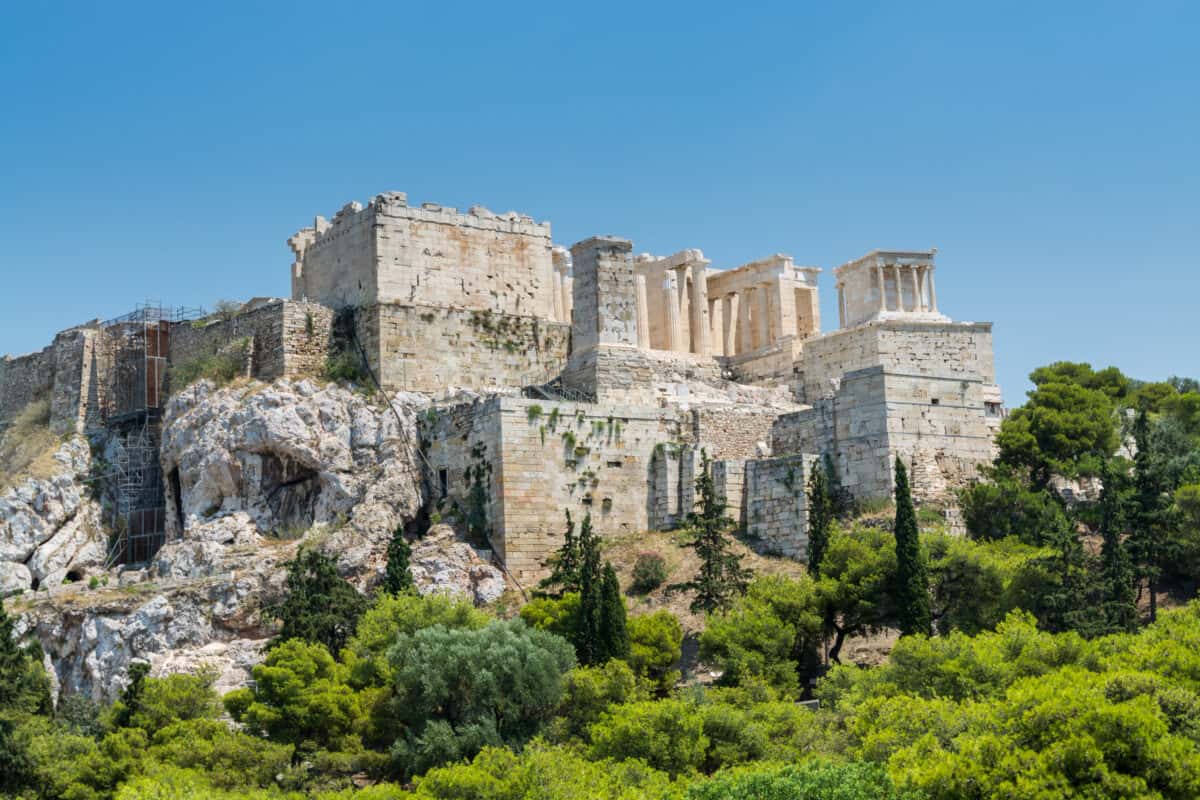
The Acropolis is the ancient hilltop citadel in Athens; the Parthenon is the largest temple built on top of it. The Parthenon sits inside the Acropolis, so the famous columned temple you see in photos is the Parthenon, while “Acropolis” refers to the whole rocky site and every monument on it. One Acropolis ticket (€30 April–October 2026, €15 November–March, with a mandatory timed-entry slot) covers the Parthenon and all the other monuments — you never buy a separate “Parthenon ticket.”
If you are comparing Acropolis vs Parthenon, the difference is simple: the Acropolis is the rocky, fortified hill in central Athens, Greece, and the Parthenon is the famous ancient Greek temple built on top of it. The Acropolis is the place. The Parthenon is one building inside that place.
The two names are often used interchangeably, which is why so many visitors get confused before their first trip to Athens. I was born in Athens and lived there for most of my life, and my parents were born only a few hundred meters from the sacred rock. This guide explains the difference clearly — what each one is, what else you will see, a brief history, and how to visit the Acropolis and Parthenon in 2026 — so you know exactly what you are looking at.
Last updated July 29, 2026: verified the €30 summer / €15 winter 2026 ticket prices and timed-entry rules on the official hhticket.gr system, noted the April 2025 discontinuation of the seven-site combined ticket, and added the Parthenon’s construction dates and dimensions.

Acropolis vs Parthenon: Quick Comparison
In one line: the Acropolis is the site and the Parthenon is the building. The table below breaks down the difference between the Acropolis and the Parthenon at a glance.
| Feature | Acropolis | Parthenon |
|---|---|---|
| What it is | A rocky hill and archaeological site | A marble temple |
| Location | In the center of Athens, Greece | On top of the Acropolis hill |
| Main purpose | Religious, cultural, defensive, and civic center | Temple dedicated to the goddess Athena |
| Age | Used since prehistoric and Mycenaean times | Built in the 5th century BC |
| Built by | Many generations of Athenians | Architects Iktinos & Kallikrates, sculptor Pheidias, under Pericles |
| What you see there | Several ancient monuments and ruins | One major ancient Greek temple |
| Ticket | One site ticket covers everything: €30 April–October, €15 November–March (2026) | No separate ticket — included with Acropolis entry |
| Best simple explanation | The site | The building |
What Is the Acropolis?
The Acropolis of Athens is the rocky, fortified hill that rises above the center of the city and holds its most important ancient monuments. The word “Acropolis” comes from the ancient Greek words akron, meaning highest point or edge, and polis, meaning city. In simple terms, an acropolis is a “high city” — a fortified high point.
There were many acropoleis across ancient Greece, but the Athenian Acropolis is by far the most famous. The limestone rock rises about 156 meters (512 feet) above central Athens, and its flat top and steep sides made it a natural fortification: first a defensive stronghold, then a sacred place of worship, and finally the home of some of the greatest monuments in ancient Greek architecture.
Today the Acropolis is a UNESCO World Heritage Site and one of the most important archaeological sites in the world. It includes the Parthenon, the Erechtheion, the Propylaea, and the Temple of Athena Nike at the top, plus several ancient ruins and theatres on the slopes below. An ongoing restoration project, run by the Acropolis Restoration Service under the Greek Ministry of Culture, continues to conserve and partially rebuild the monuments.
If you are planning more time in the city, my guide to the best things to do in Athens is a good next stop after you understand the Acropolis.

What Is the Parthenon?
The Parthenon is the large Doric marble temple that stands on top of the Acropolis, dedicated to Athena, the Greek goddess of wisdom and the patron goddess of Athens. Built from gleaming Pentelic marble, it is the most famous example of ancient Greek architecture in the world.
The Parthenon was built between 447 and 438 BC, during the classical period and golden age of ancient Athens, with the sculptural decoration finished by 432 BC. It was the centerpiece of the great building program led by the Athenian statesman Pericles, designed by the architects Iktinos and Kallikrates, with the sculptural work — including the famous Parthenon frieze — overseen by Pheidias. Inside once stood the colossal gold and ivory statue of Athena Parthenos, also by Pheidias; the original statue does not survive today. The name itself comes from the Greek word parthenos, meaning maiden or virgin, one of the titles of Athena.
The scale still surprises first-time visitors. The temple measures about 69.5 by 30.9 meters (228 by 101 feet) at the top step, ringed by 46 outer Doric columns (8 per end, 17 per side), each about 10.4 meters (34 feet) tall. Roughly 22,000 tons of Pentelic marble went into the building, more than any Greek temple before it, and the traces of iron in that marble are why the Parthenon glows a soft honey color at sunrise and sunset.
| Parthenon fact | Figure |
|---|---|
| Built | 447–438 BC (sculpture finished 432 BC) |
| Footprint | About 69.5 by 30.9 m (228 by 101 ft) |
| Columns | 46 outer Doric columns (8 per end, 17 per side), each about 10.4 m (34 ft) tall |
| Material | Roughly 22,000 tons of Pentelic marble |
| Architects | Iktinos and Kallikrates, sculpture by Pheidias, under Pericles |
| Dedicated to | Athena Parthenos, patron goddess of Athens |
When people picture Athens, they usually picture the Parthenon. But the Parthenon is not the whole Acropolis — it is the single most famous building within the Acropolis archaeological site.
The Main Difference Between the Acropolis and the Parthenon
The main difference is that the Acropolis is the hill and archaeological site, while the Parthenon is one temple located on that hill. The Acropolis is the “where”; the Parthenon is the “what.”
So when someone says they are “going to the Acropolis,” they mean the whole site. When someone says they are “seeing the Parthenon,” they mean the famous temple inside that site.
- The Acropolis includes multiple monuments, temples, gateways, walls, and ruins.
- The Parthenon is one temple within the Acropolis complex.
- The Acropolis is far older as a sacred and fortified hill, used since Mycenaean times.
- The Parthenon was built later, during the golden age of classical Athens in the 5th century BC.

Are the Acropolis and the Parthenon in the Same Place?
Yes — the Parthenon is on top of the Acropolis, so they are the same location, not two separate places. You do not travel between them. Once you climb the Acropolis hill and pass through the Propylaea gateway, the Parthenon is right there, dominating the top of the rock. You will see it within minutes of reaching the summit.
This is why a single Acropolis visit lets you experience both. There is no separate “Parthenon site” elsewhere in Athens, and no separate Parthenon entrance — the temple is simply the highlight of the wider Acropolis archaeological site.
What Else Is on the Acropolis Besides the Parthenon?
Besides the Parthenon, the Acropolis holds the Erechtheion, the Temple of Athena Nike, the Propylaea gateway, and theatres on the slopes below. The Parthenon gets most of the attention, but it is not the only ancient monument on the hill. When you visit the site, you will also see several other masterpieces of ancient Greek architecture.
- The Erechtheion: A sacred temple best known for the Caryatids, the six sculpted female figures used as columns on its porch.
- The Temple of Athena Nike: A small, elegant temple near the entrance, dedicated to Athena as the goddess of victory.
- The Propylaea: The monumental gateway that forms the main entrance to the top of the Acropolis.
- The Theatre of Dionysus: An ancient theatre on the southern slope, considered the birthplace of Greek drama.
- The Odeon of Herodes Atticus: A dramatic Roman-era stone theatre below the hill, still used for performances today.
This is why the Acropolis is far more than a single photo stop. It is a full archaeological site with layers of history, architecture, religion, politics, and art.
Acropolis vs Pantheon: Don’t Confuse the Two
The Pantheon is a different building in Rome, Italy — it is not the same as the Parthenon or the Acropolis. Because the names sound alike, “Acropolis vs Pantheon” is a common mix-up. The Parthenon is the temple on the Acropolis in Athens, Greece. The Pantheon is a domed Roman temple, later a church, in Rome. If you are reading about Athens, the word you want is Parthenon, not Pantheon.
Brief History of the Acropolis and Parthenon
The Acropolis hill was important long before the Parthenon was built. Its flat top and steep sides made it a natural fortress, and the area was used as a Mycenaean stronghold from prehistoric times. Over the centuries it became closely linked with the worship of Athena and the identity of the ancient Greek city of Athens. An earlier temple on the same spot, known as the Older Parthenon, was still under construction when Persian forces sacked the Acropolis in 480 BC during the Greco-Persian Wars; the temple you see today rose on and around its platform.
In the 5th century BC, Athens entered its classical period and golden age, and the Acropolis was transformed by the building program of Pericles. This is when the Parthenon, the Propylaea, the Erechtheion, and the Temple of Athena Nike became the defining monuments of the site, built in gleaming Pentelic marble.
The Parthenon’s history did not stop in ancient Greece. Over the centuries it was used as a temple, a Christian church dedicated to the Virgin Mary, and an Ottoman mosque. In 1687, during the Venetian siege of Athens, the Ottomans were storing gunpowder inside the Parthenon. A Venetian shell hit the building, causing a massive explosion that destroyed a large part of the temple. Later, in the early 1800s, agents of Lord Elgin removed many of its sculptures — the Parthenon Marbles, most of them still held at the British Museum in London — and their return to Athens remains a live debate today.


Acropolis Tickets, Hours & How to Visit in 2026
A single Acropolis ticket costs €30 from April through October 2026 and €15 from November through March, includes the Parthenon and every other monument on the hill, and requires a timed entry slot booked through the official Hellenic Heritage ticketing site (hhticket.gr). There is no separate Parthenon ticket. The reduced €15 rate also applies year-round to non-EU visitors aged 6 to 25 and EU citizens over 65, while EU citizens under 25 enter free. One planning trap to avoid: the old €30 combined ticket that bundled the Acropolis with six other Athens sites was discontinued in April 2025, so places like the Ancient Agora and the Temple of Olympian Zeus now need their own tickets.
- Hours: In summer (around April 1 to August 31) the Acropolis is generally open 8:00 a.m. to 8:00 p.m., with last entry near 7:30 p.m. Winter hours are shorter.
- Timed slots: A mandatory time-slot system caps daily visitors at around 20,000. Book at least a week ahead in summer (the 8:00 a.m. slot sells out first), and arrive within your slot: entry is tied to the hour you choose, with a short grace window.
- Free days: March 6, April 18, May 18, the last weekend of September, October 28, and the first Sunday of each month from November through March.
- Entrance: Use the South Slope Entrance near Dionysiou Areopagitou Street (about 2 minutes from Akropoli metro station). It also lets you see the Theatre of Dionysus on a more gradual route up.
- Go early or late for fewer crowds and softer light — crowds peak between 11:00 and 14:00.
- Wear shoes with grip, because the ancient stone and marble are smooth and can be slippery.
- Allow 1.5 to 2 hours for the Acropolis itself, and longer if you also visit the Acropolis Museum.
The fastest way to skip lines and understand what you are seeing is a guided tour that bundles your timed entry. You can book a Parthenon & Acropolis guided tour here, which pairs the archaeological site with the Acropolis Museum.
For a smoother Athens trip, it also helps to choose the right neighborhood. I recommend reading where to stay in Athens and my guide to the best hotels in Athens before booking your accommodation.
Disclosure: Some links above are affiliate links. If you book through them, we may earn a small commission at no extra cost to you. We only recommend tours and tickets we would use ourselves.
READ ALSO:
- Where to Stay in Athens
- Best Hotels in Athens
- Best Things to Do in Athens
- Best Greek Island Tours From Athens
- National Archaeological Museum in Athens
Should You Visit the Acropolis Museum Too?
Yes — the Acropolis Museum is worth visiting because it explains and displays the original sculptures, friezes, and artifacts you cannot fully see on the hill. The museum sits near the base of the Acropolis and houses pieces connected to the site and its slopes, including parts of the Parthenon frieze.
The museum and the archaeological site are not the same place. The Acropolis is the hill and its ruins; the Acropolis Museum is the modern museum that explains the history, art, and original finds from the site. Many visitors do both on the same day.
If you enjoy archaeology, you may also want to read my guide to the National Archaeological Museum in Athens, a separate museum with a much wider collection from across ancient Greece.
FAQs
What is the difference between the Acropolis and the Parthenon?
The Acropolis is the rocky hill and archaeological site in Athens. The Parthenon is the famous ancient temple dedicated to Athena that stands on top of the Acropolis. In simple terms, the Acropolis is the location and the Parthenon is the building.
Is the Parthenon the same as the Acropolis?
No, the Parthenon and the Acropolis are not the same thing. The Acropolis is the full hilltop site, while the Parthenon is one temple within that site.
Is the Parthenon inside the Acropolis?
Yes. The Parthenon stands on top of the Acropolis, so it is inside the Acropolis archaeological site. It is the largest and most prominent of the monuments on the hill, alongside the Erechtheion, the Propylaea, and the Temple of Athena Nike.
Are the Acropolis and the Parthenon close together?
They are in the exact same place, not two separate sites. The Parthenon sits on top of the Acropolis hill, so you reach it within minutes of climbing up and passing through the Propylaea gateway. One Acropolis visit covers both.
Does the Acropolis ticket include the Parthenon?
Yes. The Parthenon is inside the Acropolis archaeological site, so you do not buy a separate Parthenon ticket. A single Acropolis ticket (€30 April–October 2026, €15 in winter, with a mandatory timed entry slot) covers the Parthenon and all the other monuments. The old combined ticket for seven Athens sites was discontinued in April 2025, so other sites now need separate tickets.
Which is older, the Acropolis or the Parthenon?
The Acropolis is older. The hill was used as a fortified and sacred place since Mycenaean and prehistoric times, long before the Parthenon was built. The Parthenon that visitors see today was constructed in the 5th century BC during the classical period of Athens.
What else is on the Acropolis besides the Parthenon?
The Acropolis includes several important ancient monuments, including the Erechtheion with its Caryatids, the Temple of Athena Nike, the Propylaea gateway, the Theatre of Dionysus, and the Odeon of Herodes Atticus on the slopes below.
Should you also visit the Acropolis Museum?
Yes, the Acropolis Museum is highly recommended because it gives context to the sculptures, friezes, and artifacts found on the Acropolis and its slopes. It is a separate modern museum located near the base of the hill.
Is the Pantheon the same as the Parthenon or the Acropolis?
No. The Pantheon is a different ancient building in Rome, Italy. The Parthenon is the temple on the Acropolis in Athens, Greece. The Acropolis is the hill and archaeological site where the Parthenon stands.
How can you reduce lines at the Acropolis entrance?
Book your timed ticket or a guided tour in advance, choose an earlier or later slot when possible, enter from the South Slope Entrance, and avoid the peak midday hours between 11:00 and 14:00 during the busiest travel months.
Final Answer: Acropolis vs Parthenon
The Acropolis is the ancient hill and archaeological site in Athens. The Parthenon is the famous temple on top of that hill. If you remember only one thing, remember this: the Acropolis is the site, and the Parthenon is the temple. Both are part of the same UNESCO World Heritage Site, and one Acropolis ticket (€30 in summer 2026, €15 in winter) lets you see them together.
After visiting the Acropolis, you can continue exploring Athens through its museums, neighborhoods, ruins, and viewpoints. If Athens is the start of a longer Greece trip, check my guide to the best Greek island tours from Athens.