Temple of Hephaestus
Remarkably preserved 5th-century BC Doric temple overlooking the Ancient Agora of Athens, retaining intact marble columns and friezes.
About Temple of Hephaestus
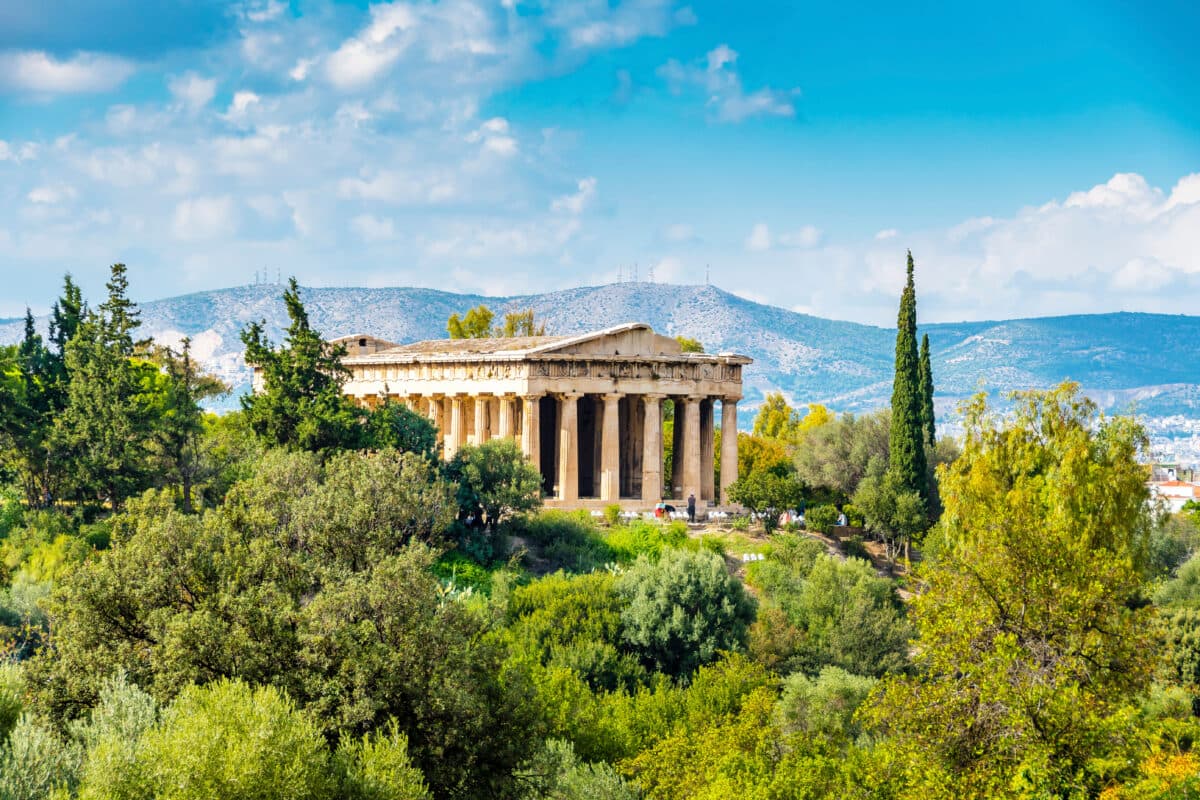
The Temple of Hephaestus is one of the best-preserved ancient Greek temples in the world and the most complete building in the Ancient Agora of Athens. It stands on Agoraios Kolonos, the low hill on the Agora’s west side, and you visit it with the standard Ancient Agora ticket (€20 full, €10 reduced). Locals still call it the Thisio, and the surrounding neighborhood and metro station take their name from it.

Who built it and when
According to the Greek Ministry of Culture’s description of the monument, the temple was probably built between 460 and 420 BC by an architect whose name is unknown. The same architect is credited with other temples of similar design in Attica. A study of the temple’s sculpture published by the American School of Classical Studies places the start of work around 450 BC, probably in 449 BC following the archaeologist William Dinsmoor’s date. Some visitor guides name Iktinos, one of the Parthenon’s architects, as the designer, but the Ministry does not back that attribution.
The ancient travel writer Pausanias records that two deities shared the temple: Hephaestus, god of the forge and protector of metalworkers, and Athena Ergane, protector of potters and craft workshops. Excavations on the hill uncovered metalworking workshops, which confirmed the identification. Bronze cult statues of both gods by the sculptor Alkamenes stood inside, probably made between 421 and 415 BC.
Why it is worth visiting
Most of the Agora survives as foundations, column stumps, and reconstructed plans. The Temple of Hephaestus still has its full outer colonnade, its entablature, and much of its roof structure, so you can read the whole shape of a classical Doric temple from the steps to the pediments. A paper on the temple’s Ionic friezes describes it as the best-preserved Doric temple from antiquity.
It also balances the rest of the site well. The civic and commercial ruins below show how Athenians ran their city, while the temple shows the religious architecture that overlooked them. The reconstructed Stoa of Attalos on the opposite side of the Agora gives you the other fully standing building on the site, and the two make a natural pair. For a wider plan, see our guide to the best things to do in Athens.
What to look for
The Ministry’s description lists the details below. Most of them can be picked out from the path that runs around the temple.
- The Doric colonnade has 6 columns across each short end and 13 along each long side.
- The building, from the stepped base to the roof, is Pentelic marble from Mount Pendeli in Attica. The architectural sculpture was carved from Parian marble.
- The 10 metopes on the east front face the Agora and show nine of the labors of Herakles.
- Four of the feats of Theseus appear on metopes on the north and south sides. These scenes probably explain why the building became known as the Theseion, or Thisio.
- The sculpted frieze runs only over the front porch and the back porch, not around the whole inner building. The front shows Theseus fighting the fifty sons of Pallas, with six gods present. The back shows the battle of the Centaurs.
- Inside, a two-story colonnade formed a Π shape around the pedestal that held the bronze statues of Hephaestus and Athena.
Excavators also found planting pots arranged in rows around the temple. They show that shrubs or small trees were grown around it in the Hellenistic period.
Why it survived so well
The Ministry credits the temple’s condition partly to its conversion into a Christian church. In the 7th century AD it became the church of St. George Akamas, and it stayed in use until Greek independence. In the 18th century, a number of Protestants who died in Athens were buried inside. In 1834 the building hosted the official reception for King Otto, the first king of modern Greece, and it later served as an archaeological museum until 1930. The American School of Classical Studies began systematic excavation of the Agora in 1931.
Tickets and opening hours
There is no separate ticket for the temple. The Ministry of Culture’s Ancient Agora page lists admission at €20 full and €10 reduced. The ticket covers the whole archaeological site, including the temple, and the Museum of the Ancient Agora in the Stoa of Attalos. You can buy tickets at the site ticket offices or on the Ministry’s official e-ticketing service, hhticket.gr.
Opening hours get shorter through the autumn as the days shorten. The Ministry’s site listing and the official e-ticketing page give the following times for the rest of the 2026 season:
| Period | Opening hours | Last entry |
|---|---|---|
| 16-30 September | 08:00-18:30 | 18:00 |
| 1-15 October | 08:00-18:00 | 17:30 |
| 16-31 October | 08:00-17:30 | 17:00 |
| Winter (from 1 November) | 08:00-16:30 | 16:10 |
Ancient Agora hours from the Ministry of Culture site listing, checked September 2026.
Official sources don’t agree on every time. The Hellenic Heritage page for the Agora lists each autumn period 30 minutes later than the table above and gives 08:00-17:00 for winter, so check the day before you go. The site is closed on 1 January, 25 March, 1 May, Easter Sunday, and 25 and 26 December. On Good Friday it opens 12:00-17:00, and on Holy Saturday 08:30-15:30.
Getting in and site rules
The main Agora entrance at 24 Adrianou Street is closed while it is being redeveloped. Since 1 July 2025, visitors have entered and left through the gate at Thiseio Square (Jacqueline de Romilly), and that arrangement stays in place until the works are finished. This gate is on the temple’s side of the site, so the temple is one of the first monuments you reach.
Site rules ban food, drinks, and smoking, and ask visitors to stay on marked paths and not touch the monuments. The Ministry also recommends proper walking shoes. Since 1 November 2025, the upper-floor exhibition in the Stoa of Attalos and the Church of the Holy Apostles inside the site have been closed to the public. The Ancient Agora is run by the Ephorate of Antiquities of the City of Athens, and you can reach it at +30 210 3210185 or [email protected].
Local tip: Walk around the whole temple rather than looking at it only from below. The Herakles metopes are on the east front facing the Agora, and the Theseus scenes that gave the building its popular name are along the north and south sides.
Frequently asked questions
Why is the Temple of Hephaestus called the Thisio?
For centuries people thought the temple honored Theseus, probably because metopes on its north and south sides show his feats. Excavations later found metalworking workshops around the hill, which confirmed that the temple belonged to Hephaestus and Athena Ergane. The old name stuck, and the Thiseio neighborhood and metro station are named after it.
Is entry to the Temple of Hephaestus ever free?
Yes. Entry to the Ancient Agora, including the temple, is free for everyone on 6 March, 18 April, 18 May, 28 October, and the last weekend of September for European Heritage Days (26 and 27 September in 2026). It is also free on the first and third Sunday of each month from 1 November to 31 March.
Is the Temple of Hephaestus wheelchair accessible?
The Ministry of Culture says wheelchair users can reach the temple area through the Thiseion Square entrance on Apostolou Pavlou Street if they arrange it in advance by calling +30 210 3214824 or +30 210 3210180. Both floors of the Museum of the Ancient Agora in the Stoa of Attalos are wheelchair accessible.
Can I buy Temple of Hephaestus tickets online?
Yes. Buy the Ancient Agora ticket on hhticket.gr, the Ministry of Culture’s official e-ticketing site. The same ticket covers the temple, the rest of the archaeological site, and the Museum of the Ancient Agora.
Reviews
Loading traveler reality-check data for Temple of Hephaestus.
Amenities & Features
- Tourist Attraction