Stoa of Attalos – Museum of the Ancient Agora
Reconstructed Hellenistic colonnade in the Ancient Agora of Athens housing the Museum of the Ancient Agora with democracy artifacts and Roman sculptures.
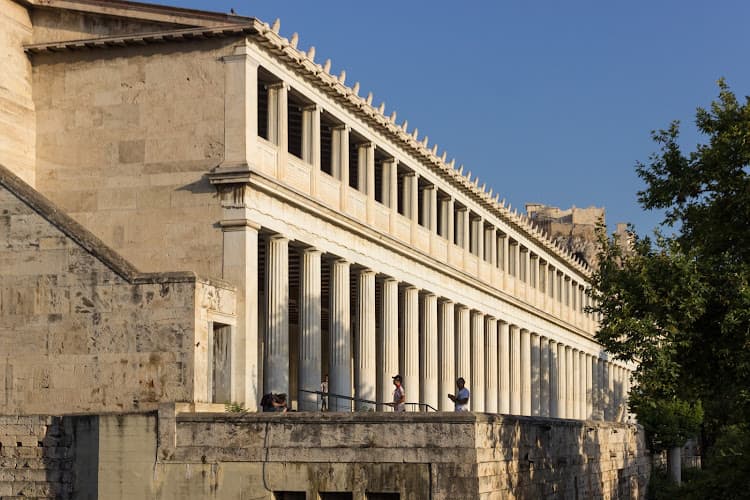
About Stoa of Attalos – Museum of the Ancient Agora
The Stoa of Attalos is a two-storey Hellenistic colonnade on the eastern edge of the Ancient Agora in Athens. The American School of Classical Studies rebuilt it in 1953–1956, and since 1957 it has housed the Museum of the Ancient Agora. The standard €20 Ancient Agora ticket covers both the archaeological site and the museum, so the two work best as one visit. Walking its long marble portico is one of the clearest ways to picture how a major public building in ancient Athens looked and worked.

Stoa of Attalos at a glance
- Location: east side of the Ancient Agora; museum address 24 Adrianou Street, Athens 10555
- Original building: a gift to Athens from King Attalos II of Pergamon in the 2nd century BC
- Reconstruction: 1953–1956, by the American School of Classical Studies at Athens, funded by John D. Rockefeller Jr.
- Museum: open in the rebuilt Stoa since 1957, with finds from the Neolithic to the post-Byzantine and Ottoman periods
- Ticket: €20 full, €10 reduced, valid for the Ancient Agora site and the museum
- Nearest metro: Monastiraki (Lines 1 and 3) or Thiseio (Line 1)
History of the Stoa of Attalos
A fragmentary inscription on the lower colonnade names the donor: “King Attalos, son of Attalos and of Queen Apollonis.” Attalos II, ruler of the Hellenistic kingdom of Pergamon in Asia Minor, gave the building to Athens, where he had studied as a young man. Stoas were covered public walkways, and this one gave Athenians a place to meet, stroll and do business, with rows of shops set behind the columns.
The Heruli, a Germanic people who raided Athens, destroyed the Stoa in AD 267, and its stones were later built into the Late Roman fortification wall. Enough of the original survived for the American School of Classical Studies to rebuild the structure between 1953 and 1956, working from studies by the architect Yannis Travlos and with financial support from John D. Rockefeller Jr. The rebuilt Stoa was designed to hold the excavation finds, and the museum opened inside it in 1957.
How the building is laid out
The Greek Ministry of Culture describes the Stoa as 120 metres wide and 20 metres deep. Each of its two floors has two aisles divided by an inner row of columns, with 21 shop rooms along the back wall. On the ground floor, the outer columns are Doric and the inner ones are unfluted Ionic. Upstairs, the outer colonnade is Ionic and the inner columns carry capitals in a style from Pergamon. Mixing the column orders by floor was typical of grand Hellenistic stoas.
Why it is worth visiting
The Stoa gives structure and context to the wider Ancient Agora of Athens. Outside, the Agora shows the open civic space, the Temple of Hephaestus and the foundations of council and court buildings. Inside, the museum shows the objects Athenians used in politics, trade, religion and daily life. Few stops in Athens are more useful for understanding how the ancient city worked, as opposed to how its monuments looked.
What you see inside
Ground-floor gallery
The main gallery is arranged in chronological and thematic sections. The earliest pieces are pottery, vases, terracotta figurines and weapons from Neolithic, Bronze Age, Iron Age and Geometric-period wells and tombs around the Agora. The most important exhibits relate to the institutions of Athenian democracy in the Classical period.
- Allotment machine: a fragment of a marble kleroterion, used to choose citizens at random for public duties, shown with jurors’ bronze identification tags
- Water clock: a clay klepsydra that timed speeches in the law courts
- Ballots and ostraka: official bronze jurors’ ballots and potsherds scratched with the names of prominent 5th-century BC politicians, used as votes in ostracism
- Law against tyranny: a marble stele from 336 BC with a relief of Democracy crowning the People of Athens
- Official measures: clay measures and bronze weights used to regulate trade in the marketplace
- Everyday life: black-figure and red-figure pottery, kitchen and table ware, lamps, coins, jewellery and Roman portrait busts
Upper Stoa sculpture exhibition
The first-floor exhibition opened in 2012 and presents Athenian sculpture from the Agora excavations, with a focus on portraits. Its six sections run from idealised Late Classical and Hellenistic figures, through Roman copies of Classical works, portraits of wealthy citizens and herms of state officials, to sculptures from the private philosophical schools of late antiquity. The upper colonnade also looks out over the Agora, the Pnyx and the Acropolis, which helps you place the ruins you have just walked through.
The colonnade itself
Much of the experience is the building. Larger sculptures line the ground-floor portico, and walking its full length gives a much clearer sense of ancient urban architecture than an ordinary gallery room can. The deep, covered walkway is also one of the few shaded places on the Agora site.
Opening hours and tickets
Hellenic Heritage, the Greek Ministry of Culture’s official visitor and ticketing platform, lists the following hours for the Ancient Agora archaeological site and museum. Last admission is 20 minutes before closing.
| Period | Daily opening hours |
|---|---|
| 1 April – 31 August | 08:00–20:00 |
| 1–15 September | 08:00–19:30 |
| 16–30 September | 08:00–19:00 |
| 1–15 October | 08:00–18:30 |
| 16–31 October | 08:00–18:00 |
| 1 November – 31 March | 08:00–17:00 |
Official listings do not fully agree. The museum’s page on the Ministry of Culture museums portal gives summer hours of 08:00–19:00 and winter hours of 08:00–16:30, and says the museum opens at 10:00 on Tuesdays. If you are visiting on a Tuesday or in winter, plan for the museum opening later or closing earlier than the site, and check the listing close to your visit.
- Tickets: €20 full or €10 reduced, one combined ticket for the site and the museum, sold at the gate or online through hhticket.gr
- Reduced and free admission: eligibility rules are set nationally; see the Ministry of Culture’s free and reduced admission page
- Closed: 1 January, 25 March, 1 May, Greek Orthodox Easter Sunday, and 25 and 26 December
- Holy week: Good Friday and Holy Saturday have shortened hours
If you are also planning the Acropolis, compare single and combined options in our Acropolis tickets guide before buying.
Getting there and the temporary entrance
The Agora is about four minutes on foot from Monastiraki Square. Take Metro Line 1 or 3 to Monastiraki, or Line 1 to Thiseio. The main entrance on Adrianou Street is being rebuilt, and since 1 July 2025 visitors have entered and left through the site gate at Thiseio Square (Jacqueline de Romilly) until the work is finished. Once through the gate, walk across the site to the Stoa on its eastern side.
For questions, the museum lists +30 210 3210180 and [email protected], the Ephorate of Antiquities of the City of Athens. Hellenic Heritage lists the site guardhouse separately at +30 210 3210185.
Local tip: Treat the Stoa as part of a full Agora visit, not a separate stop. Walk the site first, then use the museum to make sense of what you have just seen on the ground. Finish on the upper floor, where the view across the Agora to the Acropolis pulls the whole visit together.
Nearby sights to pair with it
The Agora sits directly below the Acropolis of Athens, and the Acropolis Museum covers the sculpture that the Agora museum does not. Plaka is a short walk east for lunch. For a fuller day plan, see our guide to the best things to do in Athens.
Frequently asked questions
Is the Museum of the Ancient Agora wheelchair accessible?
Yes. The Greek Ministry of Culture states that both levels of the museum in the Stoa of Attalos are wheelchair accessible. Ask the guards to use the lift to the upper floor. Accessible toilets are inside the building, and tactile site plans and Braille brochures in Greek and English are available at the information desk.
When is entry to the Stoa of Attalos free?
Entry to the Ancient Agora and its museum is free for everyone on 6 March, 18 April, 18 May, the last weekend of September and 28 October. Between 1 November and 31 March, the museum’s official page lists free entry on the first Sunday of each month, while Hellenic Heritage lists the first and third Sundays, so confirm before relying on a third-Sunday visit.
How long do you need for the Stoa of Attalos?
As a planning estimate, allow about an hour for the ground-floor gallery, the colonnade and the upper-floor sculpture exhibition. For the whole Ancient Agora, including the Temple of Hephaestus, two to three hours is more realistic.
Reviews
Loading traveler reality-check data for Stoa of Attalos – Museum of the Ancient Agora.
Amenities & Features
- Tourist Attraction