Temple of Athena Nike
Compact classical Ionic temple perched on the southwest bastion of the Acropolis entrance, dedicated to the victorious goddess Athena.
About Temple of Athena Nike
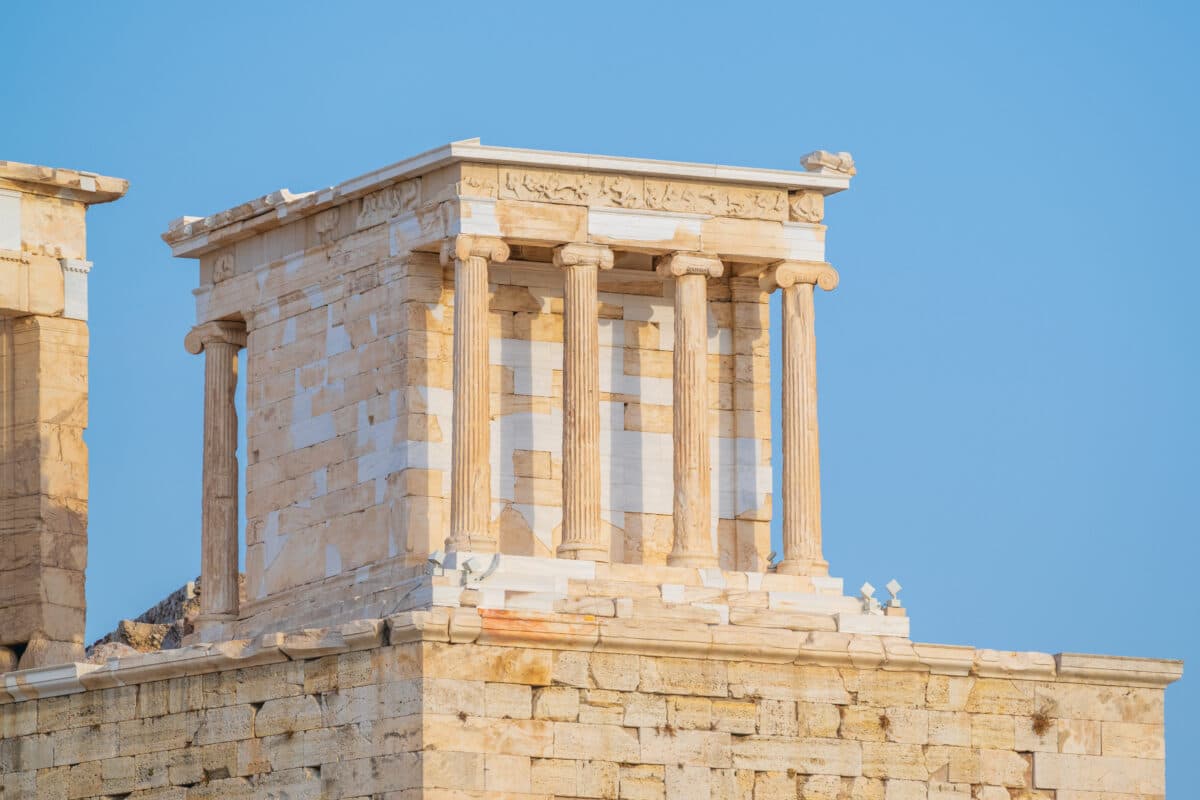
The Temple of Athena Nike is the small Ionic temple on the bastion at the southwestern corner of the Acropolis, on your right beside the Propylaia as you climb to the entrance. Designed by the architect Kallikrates and built between 426 and 421 BC, it was dedicated to Athena Nike, Athena in her role as goddess of victory. It is the first temple most visitors pass on the way up to the Parthenon.

The Acropolis Museum and the Greek Ministry of Culture both date the building to 426–421 BC and say it replaced older temples whose remains survive inside the bastion. The Acropolis restoration service (YSMA) gives 427–424 BC, so both ranges appear in reliable sources. Either way, the temple belongs to the later phase of the Periklean building programme, after the Parthenon was completed in 438 BC.
Temple of Athena Nike at a glance
| Detail | Temple of Athena Nike |
|---|---|
| Location | Bastion at the southwestern edge of the Acropolis, beside the Propylaia |
| Dedicated to | Athena Nike (Athena as goddess of victory) |
| Architect | Kallikrates |
| Built | 426–421 BC (Acropolis Museum and Ministry of Culture); 427–424 BC (YSMA) |
| Order and plan | Ionic, tetrastyle, amphiprostyle: four monolithic columns at the front and back, none along the sides |
| Material | Pentelic marble |
| Approximate size | About 8 m long, 5.5 m wide and 7 m high |
| Sculpture | Continuous Ionic frieze, pediments and the Nike parapet (around 410 BC) |
| Original sculpture today | Acropolis Museum, with parts of the frieze in the British Museum; casts are on the temple |
| Ticket | Included in the Acropolis and Slopes ticket (€30 full, €15 reduced) |
History of the bastion and sanctuary
The site was sacred long before Kallikrates. The bastion began as a Mycenaean defence guarding the southwest approach to the Acropolis, and the Ministry of Culture records a Mycenaean double-apsed shrine on its west side, plus pre-Classical shrines of the Graces and of Hekate Epipyrgidia on its east side.
The first temple of Athena Nike, a wooden building from the mid-6th century BC, was destroyed by the Persians in 480 BC. Around 468 BC, under Kimon, the Athenians built a small tufa temple around the base of the cult statue, with a new altar outside. For the Classical temple, builders encased the old bastion in neatly fitted isodomic tufa walls, making it larger and more regular. The foundations of the earlier temples and altars are still inside the bastion, below the floor of the temple you see today.
The temple’s later history was rough. It became a church in the 5th century AD and an Ottoman munitions store. In 1686, ahead of Francesco Morosini’s Venetian siege, the Ottomans dismantled it down to its stepped base and reused the blocks in a fortification in front of the Propylaia. Lord Elgin’s agents removed sculpture from the temple in 1801–1802. When the Ottoman fortification was demolished in 1835, the temple’s blocks were found again, and reconstruction began almost at once.

Architecture and sculpture
A compact Ionic temple
The temple is amphiprostyle, with a porch of four columns at the front and back and plain side walls. Each column is monolithic, cut from a single block of marble rather than stacked in drums like the Parthenon’s columns. The columns are also unusually stocky for the Ionic order, with a height-to-diameter ratio of about 7:1 instead of the more common 9:1 or 10:1. Between the side walls and a pair of pillars at the east end, metal railings once closed off a small front porch.
Frieze and pediments
A continuous relief frieze ran around all four sides. According to the Acropolis Museum, the east side showed the gods gathered around an enthroned Zeus, while the other sides showed battles between Greeks and Persians or between Greeks. The south frieze depicts the Athenian-led victory over the Persians at Marathon in 490 BC. The Ministry of Culture attributes the frieze to the sculptor Agorakritos; the museum’s own labels are more cautious and give “Agorakritos’ workshop (?)”. Little survives of the pediments, which are thought to have shown the Gigantomachy on the west and the Amazonomachy on the east.
The Nike parapet and the Sandal-binder
Around 410 BC (the Ministry gives 409 BC), a marble parapet about one metre high was built along the dangerous edge of the bastion to protect visitors. Its reliefs show Athena seated and resting after battle while winged Nikai (Victories) lead bulls to sacrifice and decorate trophies with Greek and Persian armour. The best-known slab, the “Sandal-binder”, shows a Nike bending to adjust her sandal. It is on display in the Acropolis Museum.
The original frieze was taken off the temple in 1998 and is now in the Acropolis Museum on the first floor, west side. Other frieze slabs are in the British Museum. The frieze you see on the temple today is a cast in artificial stone.
Three restorations
The temple you see today has been taken apart and rebuilt three times since 1835.
- 1835–1845: L. Ross, E. Schaubert, Ch. Hansen and K. Pittakis reassembled the temple from the recovered blocks. This was the first restoration of any monument on the Acropolis.
- 1935–1940: N. Balanos and A. Orlandos dismantled and rebuilt it because the Classical bastion underneath was at serious risk of collapse.
- 2000–2010: the Acropolis Restoration Service took down all 319 members, following a study by the architect M. Giraud. The team replaced Balanos’ concrete slab with a stainless steel grid, returned misplaced blocks to their original positions and fitted artificial-stone casts of the frieze. The work was finished in summer 2010.
The YSMA page on completed interventions explains the most recent project in more detail.
Why it is worth noticing
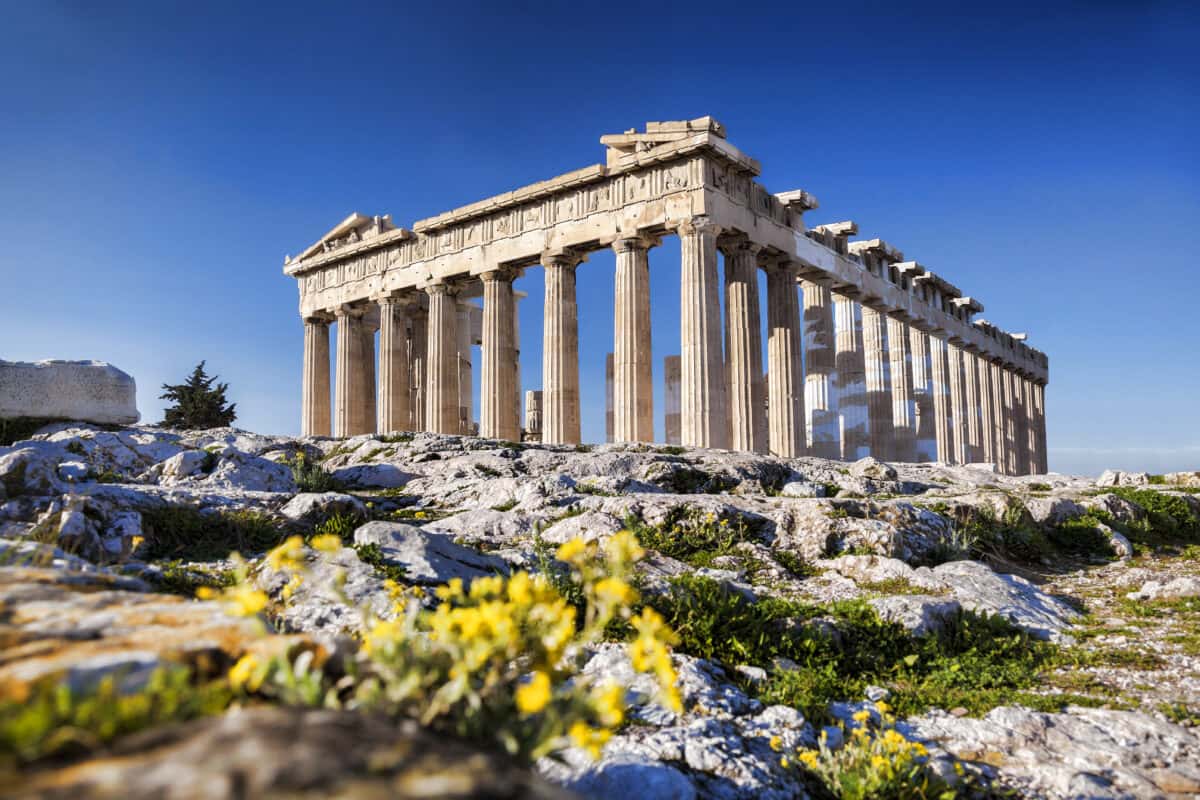
Visitors often rush past the Temple of Athena Nike on the way to the Parthenon, but it deserves attention in its own right. Its small scale, exposed position and Ionic design contrast with the Doric exteriors of the Parthenon and the Propylaia. The bastion setting also shows how the Athenians wrote victory and protection into the entrance to the Sacred Rock, with a shrine to Victory greeting every procession that climbed the hill. For the rest of the site, see our guides to the Acropolis of Athens and the Parthenon, and plan time at the Acropolis Museum, where the original frieze and parapet reliefs are displayed.
Visiting the Temple of Athena Nike
What to expect
The temple has no separate ticket; it is part of the Acropolis visit. You see it from the ascent path and the Propylaia rather than as a long standalone stop, and because it stands at the entrance, it comes into view within the first few minutes of your visit. Its impact comes from the bastion setting and the Ionic proportions rather than from time spent at it.
Tickets and timed entry
Entry is on the Acropolis and Slopes ticket: €30 full and €15 reduced, according to the Ministry of Culture. Tickets are sold at the on-site ticket offices and on the official Hellenic Heritage e-ticketing site. Since 1 April 2024, all visitors must choose a time slot, and Acropolis tickets are valid only from 15 minutes before to 15 minutes after that slot. The ticket is single-entry: once you leave the Acropolis or the South Slope, you cannot re-enter either site with it.
Opening hours
The temple follows the Acropolis site’s hours, as published by the Ministry of Culture. Hours shorten in steps through September and October as the days get shorter.
| Period | Opening hours | Last entry |
|---|---|---|
| Summer | 08:00–20:00 | 19:30 |
| 1–15 September | 08:00–19:30 | 19:00 |
| 16–30 September | 08:00–19:00 | 18:30 |
| 1–15 October | 08:00–18:30 | 18:00 |
| 16–31 October | 08:00–18:00 | 17:30 |
| Winter | 08:00–17:00 | 16:30 |
| Good Friday | 12:00–17:00 | Not specified |
| Holy Saturday | 08:30–15:30 | Not specified |
The site is closed on 1 January, 25 March, 1 May, Easter Sunday, 25 December and 26 December. The Ministry also posts temporary notices on its Acropolis information page, such as the rerouted visitor paths during filming preparations on 1–6 September 2026, so check it shortly before your visit.
Getting there and contact details
The nearest metro station is Acropolis, from where you walk along Dionysiou Areopagitou to the main entrance. From Monastiraki station, you can walk up through the Ancient Agora or Plaka. The Official Athens Guide lists the address as Acropolis, Athens 105 58 and the phone number as +30 210 321 4172. The Ministry of Culture lists +30 210 923 8747 and the Acropolis Chief Guards’ Office on +30 213 131 7762.
Small backpacks and handbags are allowed. The cloakroom north of the main entrance does not accept large luggage. Food, drink, smoking and pets (except assistance dogs) are not allowed on the site, and the Ministry recommends shoes suited to walking on uneven ground.
Local tip: Stop at the temple on the way in, not just on the way out. It makes much more sense when you notice how it frames the entrance to the Acropolis, before the Parthenon takes over your attention.
Frequently asked questions
Why is the Temple of Athena Nike linked to Wingless Victory?
The ancient travel writer Pausanias called it the temple of Apteros Nike, or Wingless Victory. He wrote that the cult statue of the goddess had no wings so that Victory could never leave Athens.
Are there free admission days at the Acropolis?
Yes. The Ministry of Culture lists free admission on 6 March, 18 April, 18 May, 28 October and the last weekend of September during the European Heritage Days. Check the official Acropolis information page before you go.
Can wheelchair users see the Temple of Athena Nike?
The Acropolis has an elevator for visitors with reduced mobility, reached by a 350 m route from a separate entrance north of the main entrance. It rises about 25 m to the area north of the Erechtheion, and the marked route towards the Propylaia has a gradient of more than 6 percent. Ticket validation for visitors with disabilities takes place only at the main entrance. The elevator does not run in severe weather or strong winds, so call the Chief Guards’ Office on +30 213 131 7762 about an hour before arriving.
Reviews
Loading traveler reality-check data for Temple of Athena Nike.
Amenities & Features
- Tourist Attraction