Museum of Cycladic Art
World-class Athens museum dedicated to the minimalist marble figurines and pottery of the 3rd-millennium BC Cycladic Aegean civilization.
About Museum of Cycladic Art
The Museum of Cycladic Art is a private museum in the Kolonaki district of Athens built around a world-renowned collection of Early Cycladic marble figurines from the Aegean islands. Its permanent galleries hold about 3,000 Cycladic, ancient Greek and ancient Cypriot artefacts spanning the 4th millennium BC to around the 6th century AD. It is open every day except Tuesday, general admission to the permanent exhibitions costs €12, and while the main building is being renovated you enter through the Stathatos Mansion on Vasilissis Sofias Avenue.

The museum grew out of the private collection of Nicholas and Dolly (Aikaterini) Goulandris, who began acquiring Cycladic and ancient Greek art in the 1960s and opened the museum in 1986. The figurines are the reason most people come. Carved in the 3rd millennium BC, their flat faces, folded arms and pared-down bodies look startlingly modern, and the museum credits them with influencing 20th- and 21st-century artists including Brancusi, Modigliani, Giacometti, Hepworth, Henry Moore and Ai Weiwei. That crossover makes the museum work for archaeology fans and design-minded travelers alike, including visitors who usually skip museums.

Museum of Cycladic Art at a glance
| Detail | Current information |
|---|---|
| Current entrance | Stathatos Mansion, corner of Vasilissis Sofias Avenue and 1 Irodotou Street (the 4 Neophytou Douka Street entrance is under construction) |
| Postal address | 4 Neophytou Douka Street, Athens 106 74 |
| Opening hours | Mon, Wed, Fri, Sat 10:00-17:00; Thu 10:00-20:00; Sun 11:00-17:00; closed Tuesday |
| Last entry | 15 minutes before closing |
| Permanent exhibitions ticket | €12 general, €9 reduced, free for under-18s |
| Time needed | About 1.5 to 2 hours for the permanent galleries |
| Nearest metro | Evangelismos (Line 3), about 500 m; Syntagma (Lines 2 and 3), about 600 m |
| Contact | +30 210 722 8321-3, [email protected] |
Is the Museum of Cycladic Art worth visiting?
Yes, especially if you have already seen the Acropolis and the National Archaeological Museum and want something shorter and more focused. The museum fills four compact floors of a modern building, so you can see the whole permanent collection in a couple of hours without museum fatigue. The labels are clear, the galleries are arranged by theme, and the museum’s visitor-guide app includes audio tours of the permanent exhibitions.
It suits travelers heading to the Cyclades, because the figurines on the first floor come from the same islands you may be about to visit. It also works well on a hot afternoon or a rainy day, and it slots easily into a Kolonaki itinerary with other museums on Vasilissis Sofias Avenue. If you are building a wider plan, see our guide to things to do in Athens.
It is a weaker choice if you only have one day in Athens and want the big-ticket classical sculpture. For that, the Acropolis Museum and the National Archaeological Museum come first.
What to see, floor by floor
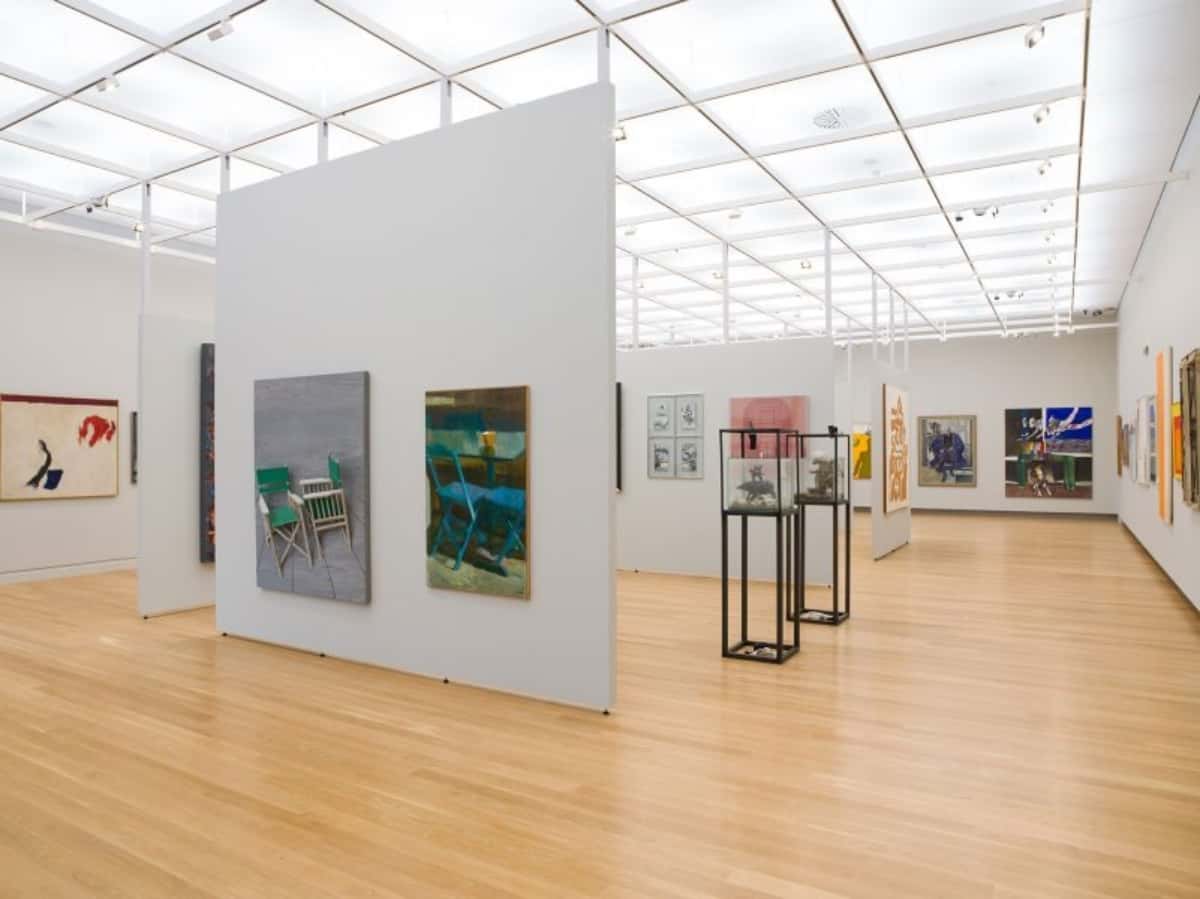
The permanent exhibitions are in the main building, designed by architect Ioannis Vikelas and completed in 1985, with four floors and 2,300 square metres of exhibition space. Temporary exhibitions are held in the Stathatos Mansion next door, and the two buildings are connected by a corridor.
First floor: Cycladic Art
This is the core of the museum. More than 350 objects in six sections trace every phase of the Early Cycladic culture that developed on the Aegean islands in the 3rd millennium BC (c. 3200-2000 BC). Marble figurines lead the display, alongside marble and clay vessels, bronze tools and weapons. Look for the seated figurine known as the “cup bearer” (2700-2400/2300 BC) and the canonical female figurines of the Dokathismata variety. Start here while you are fresh.
Second floor: Ancient Greek Art, a history in images
Around 400 objects running from 2000 BC to the 4th century AD tell the story of Aegean societies, from early city-states through democracy to empire. Highlights include a lidded pyxis from 760-750 BC, a marble statue of a boy holding a hare, a marble statuette of Aphrodite and a bronze Corinthian helmet from the 7th century BC.
Third floor: Ancient Cypriot Art
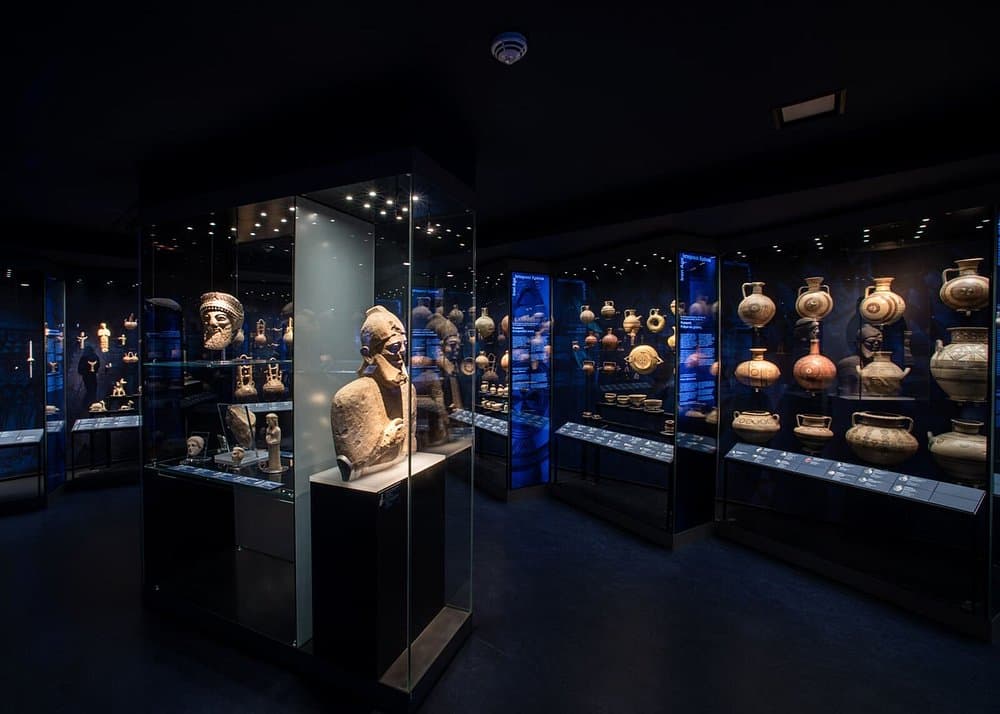
The Thanos N. Zintilis Collection covers Cyprus from the 4th millennium BC to medieval times, with figurines, sculpture, bronzes, coins, jewellery and pottery grouped by themes such as worship, weaving, perfumery, burial customs and writing. Few Athens museums cover ancient Cyprus in this depth, so give this floor more time than its low profile suggests.
Fourth floor: Scenes from daily life in antiquity
This floor displays 142 objects from the permanent collections, mostly from the 5th to 1st centuries BC, grouped around themes such as gods and heroes, women’s lives, the symposium, the gymnasium, war and the underworld. Two short films follow a fictional Athenian named Leon from birth to burial, which makes this the easiest floor to enjoy with children.
Stathatos Mansion: temporary exhibitions
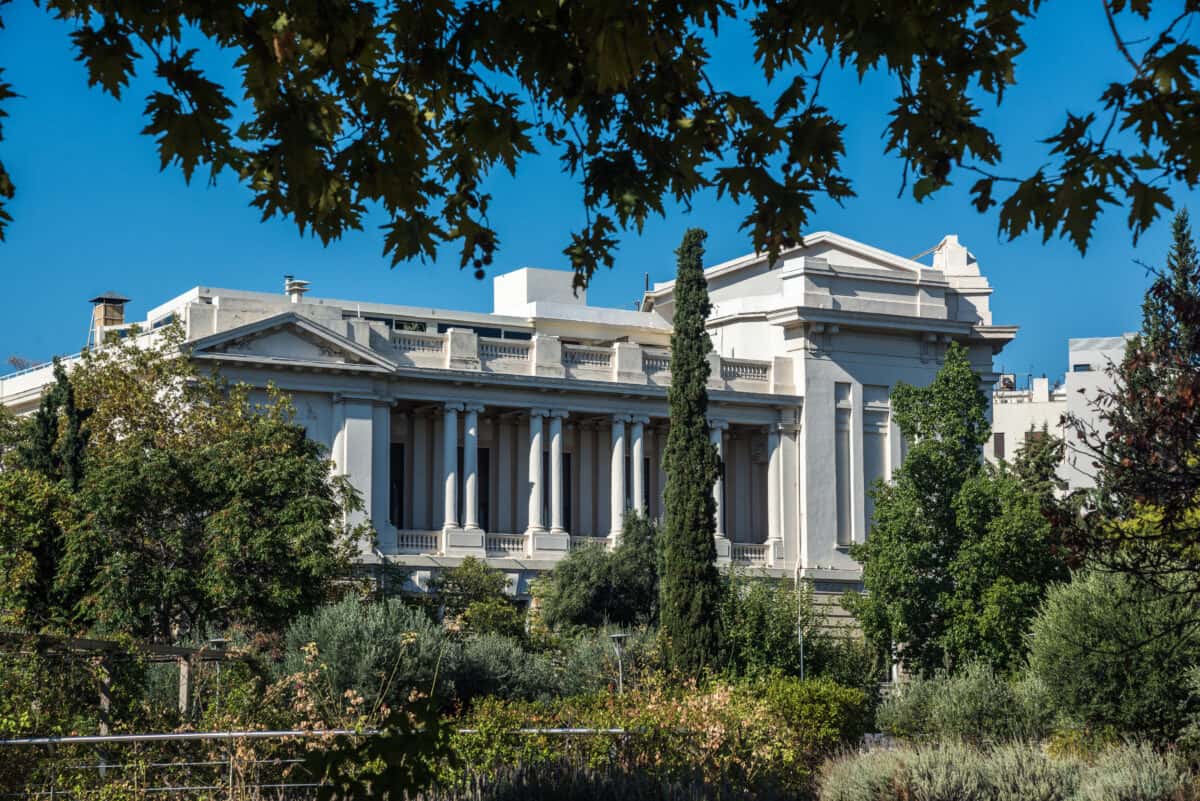
The neoclassical Stathatos Mansion was designed by Ernst Ziller in 1895 and became part of the museum in 1991. It now hosts the temporary exhibitions and, during the renovation, the only entrance. Recent shows have paired ancient material with contemporary artists: Marlene Dumas’ Cycladic Blues ran until November 2025, and Jeff Koons: “Venus” Lespugue runs until 28 September 2026.
Tickets and opening hours
The museum keeps the same timetable all year, with a late opening on Thursday and a later start on Sunday. The exhibitions, the Cycladic Shop and the Cycladic Café all follow these hours.
| Day | Opening hours | Last entry |
|---|---|---|
| Monday | 10:00-17:00 | 16:45 |
| Tuesday | Closed | – |
| Wednesday | 10:00-17:00 | 16:45 |
| Thursday | 10:00-20:00 | 19:45 |
| Friday | 10:00-17:00 | 16:45 |
| Saturday | 10:00-17:00 | 16:45 |
| Sunday | 11:00-17:00 | 16:45 |
The museum is also closed on 1 January, Clean Monday, 25 March, Orthodox Easter Sunday and Easter Monday, 1 May, Holy Spirit Monday, 15 August, and 25 and 26 December.
| Ticket | General | Reduced / group |
|---|---|---|
| Permanent exhibitions | €12 | €9 |
| Jeff Koons: “Venus” Lespugue only (until 28 September 2026) | €10 | €7 |
| Koons show + permanent exhibitions combo (until 28 September 2026) | €16 | €10 reduced, €12 group |
| English guided tour of the Koons show and permanent exhibitions (Mondays at 12:00, until 28 September 2026) | €20 | €14 |
Reduced admission applies to visitors aged 65 and over, students, people aged 19 to 25, Chamber of Fine Arts cardholders and groups of 12 or more. Admission is free for children under 18, visitors with disabilities and one companion, Cycladic Friends members, archaeology and art history students, ICOM and ICOMOS members, journalists, licensed tour guides and Greek citizens with a current unemployment card. Bring ID if you are claiming a reduced or free ticket. Temporary exhibitions are priced individually, so check the official Plan your Visit page for the show running when you travel.
Getting there and the current entrance
The museum is undergoing a phased renovation while staying open. Since 19 May 2025, the entrance at 4 Neophytou Douka Street has been under construction, so all visitors enter through the Stathatos Mansion at the corner of Vasilissis Sofias Avenue and 1 Irodotou Street. Every gallery, the shop and the café remain open and are reached through the connecting corridor.
- On foot, it is about 10 minutes from Syntagma Square and 3 minutes from Filikis Etairias Square in Kolonaki.
- By metro, Evangelismos station (Line 3) is about 500 m away and Syntagma station (Lines 2 and 3) about 600 m away.
- By bus or trolleybus, use the Rigilis stop, served by lines including 3, 203, 211, 214, 220, 221, 224, 235, 608, 622, 815, A5, E14 and X95.
- By car, there is no museum car park, only a temporary drop-off space at 4 Neophytou Douka Street. The nearest private garages include Ipsilantou 20, Polis Park at Rizari 4, Lemos Parking at Karneadou 25 and Filikis Etaireias Square 14.
For step-free access, there is a wheelchair ramp at the Stathatos Mansion entrance and elevators to the upper floors. Guide and assistance dogs are welcome throughout the museum.
Tips for your visit
- Avoid Tuesdays. Most Athens museums are open that day, which catches out a lot of visitors here.
- Go on Thursday afternoon for the only late opening, then have dinner in Kolonaki.
- Photos without flash or a tripod are allowed for personal use, but video and audio recording are prohibited.
- Handbags are allowed in the galleries, but backpacks and small luggage go in the lockers provided.
- Take a break at the Cycladic Café in the main building, under a floating sculptural ceiling by Stelios Kois.
- Pair your visit with the Byzantine and Christian Museum or the Benaki Museum, both a short walk away along Vasilissis Sofias Avenue.
Local tip: The Museum of Cycladic Art makes an excellent second museum in Athens. Once you have seen the headline sites, it gives you a focused, very Aegean counterpoint in about two hours. If Santorini is next on your trip, the museum’s co-organised exhibition Kykladitisses: Untold Stories of Women in the Cyclades runs at the Archaeological Museum of Thera in Fira until November 2026. It brings together 180 works from across the Cyclades, including figurines from the Athens collection.
Frequently asked questions
Is the Museum of Cycladic Art included in the Athens combined ticket?
No. It is a private museum run by the Nicholas P. Goulandris Foundation, so it is not covered by the state combined ticket for the Acropolis and other archaeological sites. You buy a separate ticket at the museum.
Does the Museum of Cycladic Art have free admission days?
The museum publishes no fixed free-entry days, and the Ministry of Culture free days for state museums do not apply. Children under 18 and several other groups, including visitors with disabilities and one companion, get free entry all year.
Can I visit the Cycladic Café or Cycladic Shop without a ticket?
Yes. According to the museum, the Cycladic Shop and Cycladic Café can be visited without an entrance ticket during museum opening hours.
Is the Museum of Cycladic Art good for children?
Yes. Under-18s enter free, the fourth-floor gallery on daily life in antiquity includes two short films, and the museum offers a family kit and runs children’s programmes such as the Cycladic Kids Festival.
Reviews
Loading traveler reality-check data for Museum of Cycladic Art.
Amenities & Features
- Cultural Experience
- Indoor Activity