Akrotiri Archaeological Site
World-class archaeological site on southern Santorini preserving an advanced Bronze Age city buried intact beneath volcanic pumice and ash.
About Akrotiri Archaeological Site
Akrotiri Archaeological Site is a Bronze Age port town on the southern tip of Santorini. Earthquakes damaged it and ash from the Thera eruption then buried it, probably in the late 17th century BC. Streets, squares, drains and houses two and three storeys high survived under that ash. That is why people call it the Pompeii of the Aegean. It is the island’s most important archaeological site and the best place to learn about Santorini’s history before classical Greece.

Akrotiri at a glance
- What it is: a Late Bronze Age Cycladic town that ash from the Thera eruption buried and preserved
- Location: near Akrotiri village on Santorini’s south coast, about 15 km from Fira
- Tickets: €20 full, €10 reduced
- Time needed: about 1.5 to 2 hours
- Getting there: KTEL bus from Fira (€2.20, about 20 to 25 minutes), car, or taxi
- Managed by: Ephorate of Antiquities of the Cyclades, Hellenic Ministry of Culture
Why Akrotiri matters
People lived at Akrotiri long before its best years. Finds from deep layers go back to about 4500 BC. Over time the place grew from a Neolithic village into an Early Cycladic settlement and then a Middle Cycladic town. The city you walk through today was rebuilt after an earthquake around 1650 BC. It was busy, well planned and wealthy. Its houses had fine furnishings and wall paintings that are the oldest large-scale paintings found in Greece.
The Pompeii comparison only goes so far. Excavators have found no bodies at Akrotiri. They did find signs that people cleared rubble after the earthquakes. This suggests most residents left before the final eruption. Scholars still argue about the date. Most radiocarbon studies point to the late 17th century BC, while some tree-ring research supports a date in the 16th century BC.
Large-scale digging began in 1967 under the Greek archaeologist Spyridon Marinatos, and work still continues. In 2005 part of a new protective roof collapsed and killed a visitor. The site stayed closed until 11 April 2012, when it reopened under the bioclimatic shelter you see today.

What you will see
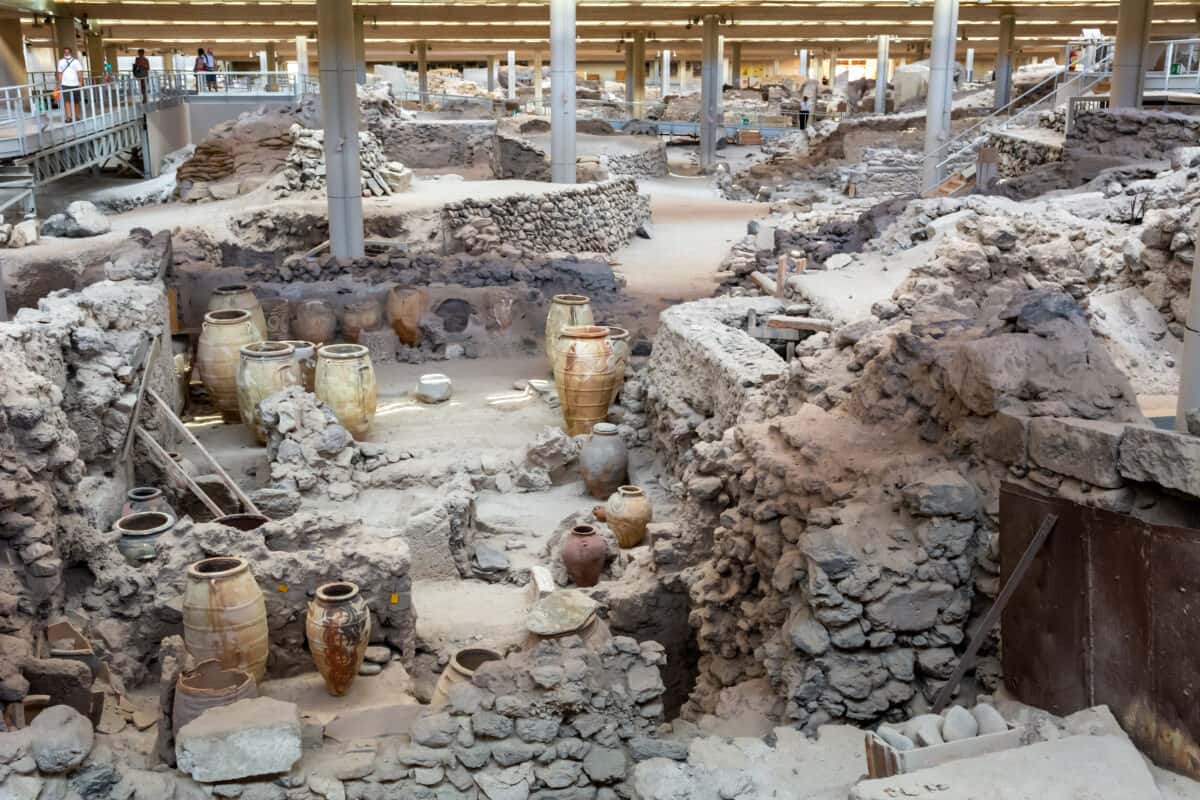
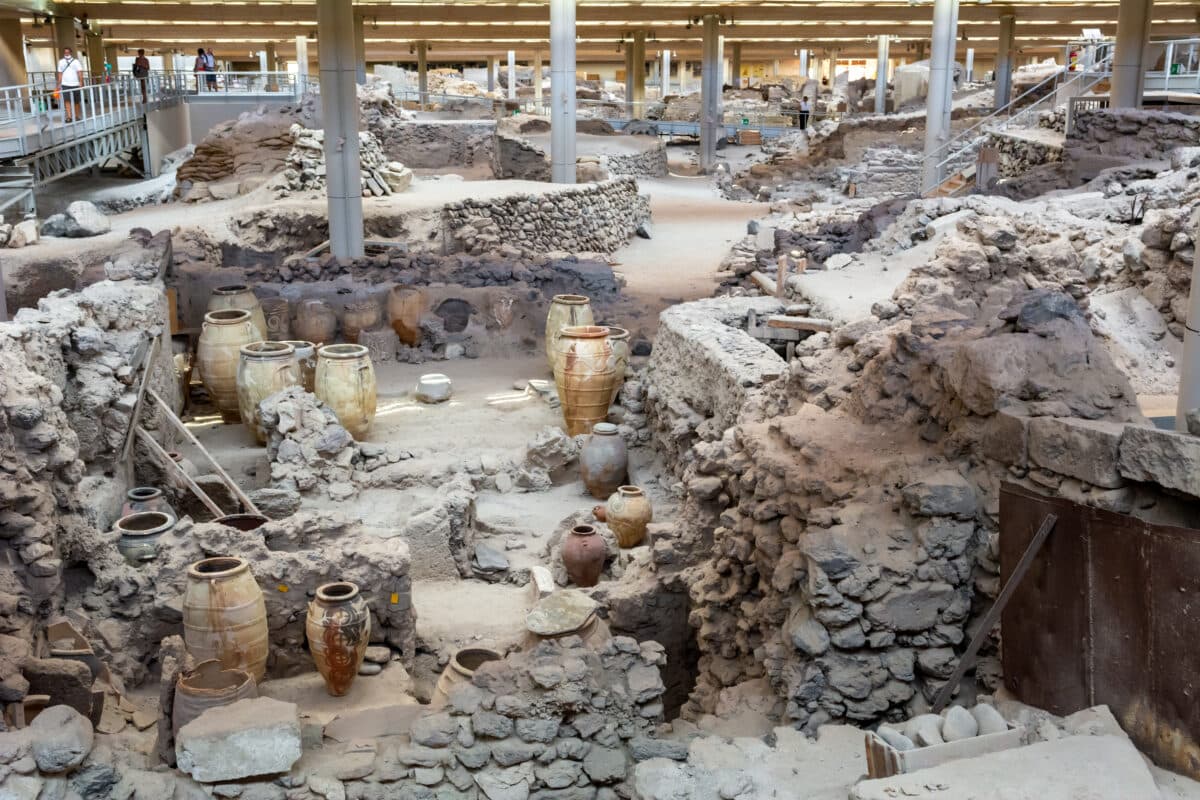
A huge shelter covers the whole excavation, and earth on its roof helps it blend into the hillside. It keeps out the midday sun far better than the open sites elsewhere in Greece. Walkways take you above and between the buildings. Along the way you can see paved streets with drains beneath them, walls still standing to upper floors, stairways, workshops and storerooms. The storerooms still hold large clay jars (pithoi) that once stored food and oil.
Excavators have named several buildings after their finds. The West House gave up the Fisherman frescoes and the long Ship Procession frieze. Xeste 3, probably a building for rituals, held paintings of women gathering saffron. The House of the Ladies is named after its paintings of women.
Know before you go: none of the original frescoes are on the walls at the site. Conservators removed them for safekeeping. Many are at the Museum of Prehistoric Thera in Fira. Others, including the Spring Fresco with its lilies and swallows, are at the National Archaeological Museum in Athens. At Akrotiri itself, you come for the buildings and the town plan.
Opening hours for 2026
Akrotiri has shorter hours on Mondays and Thursdays. On other days, closing time gets earlier every two weeks in September and October. Last entry is 20 minutes before closing unless the table shows another time.
| Period | Days | Hours |
|---|---|---|
| 1 April to 31 October | Monday and Thursday | 08:30–15:30 |
| 1 April to 31 August | Tuesday, Wednesday, Friday to Sunday | 08:00–20:00 |
| 1 to 15 September | Tuesday, Wednesday, Friday to Sunday | 08:00–19:30 (last entry 19:00) |
| 16 to 30 September | Tuesday, Wednesday, Friday to Sunday | 08:00–19:00 (last entry 18:30) |
| 1 to 15 October | Tuesday, Wednesday, Friday to Sunday | 08:00–18:30 (last entry 18:00) |
| 16 to 31 October | Tuesday, Wednesday, Friday to Sunday | 08:00–18:00 (last entry 17:30) |
| 1 November to 31 March | Every day except Tuesday | 08:30–15:30 |
| 1 November to 31 March | Tuesday | Closed |
The site is closed on 1 January, 25 March, 1 May, Easter Sunday, 25 December and 26 December. The Ephorate of Antiquities of the Cyclades publishes changes on its official hours and admission page. Check it before you go, especially in the shoulder season.
Tickets and free entry
- Full ticket: €20
- Reduced ticket: €10. Categories include EU seniors over 65, from 1 October to 31 May only, with ID
- Where to buy: at the entrance, or online through the official Hellenic Heritage ticketing site
- Free-admission days: 6 March, 18 April, 18 May, the last weekend of September, and 28 October
- Winter Sundays: official listings disagree. The Ministry listing gives the first Sunday of each month from November to March. Hellenic Heritage gives the first and third Sundays
Children and young people can often get in free with ID, but the rules depend on age and nationality. Ask at the ticket office before you pay. The Museum of Prehistoric Thera sells its own separate ticket.
How to get to Akrotiri
KTEL runs a public bus from Fira bus station to Akrotiri. The fare is €2.20 and the trip takes about 20 to 25 minutes. The bus stops near the site entrance before it goes on to Akrotiri beach. Timetables change with the season, so check our Santorini bus schedule for the latest departures and return times. By car or taxi from Fira, allow about 25 to 30 minutes. There is parking at the site.
Facilities and site rules
The site has toilets, a café, a shop, Wi-Fi and parking. The shop sells books about the dig and copies of finds. The Ephorate’s rules for its sites include the following:
- No entry in swimwear or clothing staff consider inappropriate
- No eating or smoking inside the site
- No pets, except guide dogs and assistance dogs
- No drones, and no professional photography or filming, without permission
- No climbing on the ancient remains
Bring water in summer. The shelter gives shade, but the walk from the car park and the bus stop is in full sun.
Plan the rest of your day
Local tip: Visit Akrotiri before the Museum of Prehistoric Thera if you want to understand the town layout first. Visit the museum first if you want to see the frescoes and finds before you walk the streets. Either way, the two work best together.
Many people pair the site with Red Beach, just along the coast. The cliff path has been officially closed since the February 2025 rockfalls. The safer way there is the water taxi from Akrotiri harbour. If you want more ancient history, Ancient Thera on Mesa Vouno covers a much later period. For photos, the full visit and a longer history of the dig, read our Akrotiri prehistoric city guide. For more ideas across the island, see our best things to do in Santorini.
Contact
Akrotiri of Thera site guardhouse: +30 22860 81939 or +30 22860 81969. Email: [email protected]. Ephorate of Antiquities of the Cyclades: [email protected].
Frequently asked questions
Do I need to book Akrotiri tickets in advance?
No, booking is optional. You can buy tickets at the entrance or online through the official Hellenic Heritage ticketing site. Book ahead only if you want a fixed entry time or are joining a guided tour.
How long should I spend at Akrotiri?
Plan on about 1.5 to 2 hours inside the site. Allow more time if you hire a guide, browse the shop, or continue to Akrotiri harbour for the boat to Red Beach.
Can I visit Akrotiri straight from the beach?
Change first. The Ephorate of Antiquities of the Cyclades does not allow entry in swimwear or inappropriate clothing, and eating and smoking are not allowed inside the site.
Is Akrotiri the lost city of Atlantis?
There is no evidence that it is. Some people think the Thera eruption inspired the story of Atlantis told by Plato, but that is still only a theory. Akrotiri is best understood as a real Bronze Age Cycladic port town.
Is Akrotiri accessible for visitors with limited mobility?
Hellenic Heritage lists accessibility facilities for the site, and the visitor route follows walkways under the shelter. Call the site guardhouse on +30 22860 81939 to confirm current access before you travel.
Reviews
Loading traveler reality-check data for Akrotiri Archaeological Site.
Amenities & Features
- Tourist Attraction