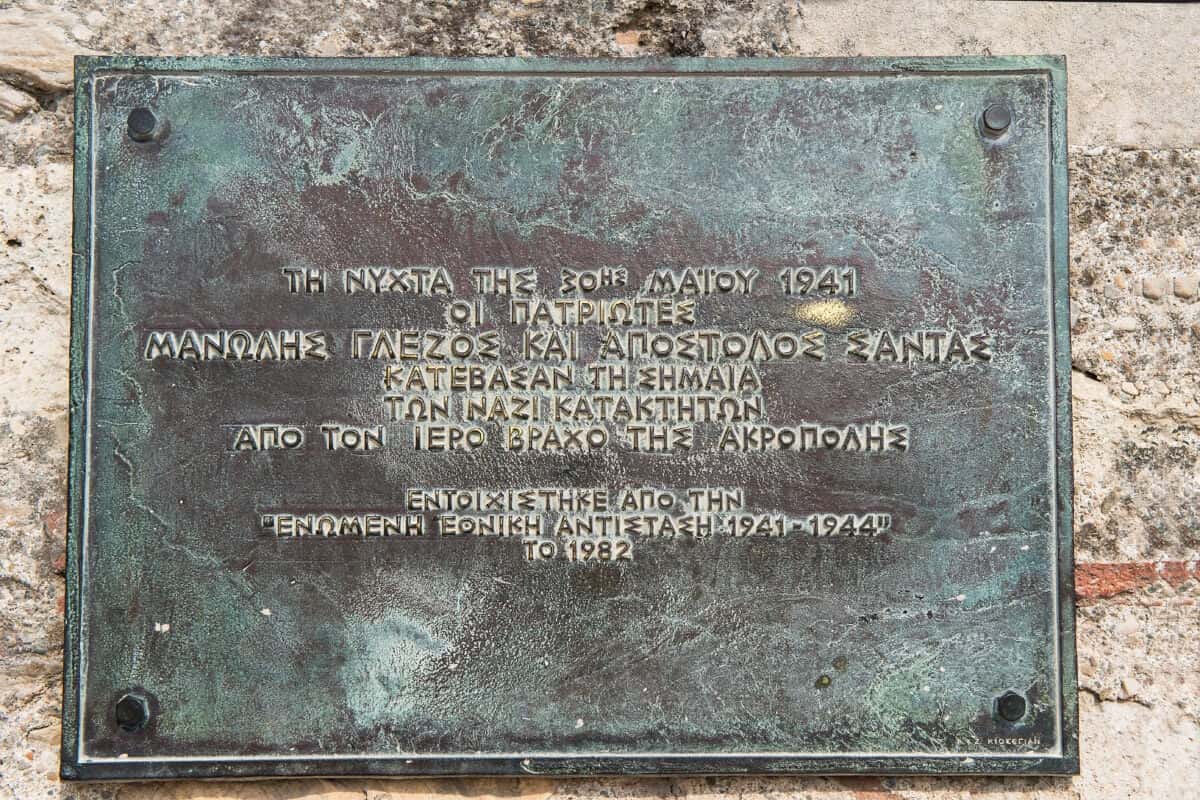
Millions of people visit the famous rock of the Acropolis in Athens every year — it’s easily one of the best things to do in Athens. But almost no one notices the small bronze plaque they walk past at the eastern edge of the rock: a monument to one of the most daring resistance acts of World War II.
The plaque is written only in Greek (I’ve never understood why it was never translated), so most visitors stroll right past it. You’ll find it on the stone base of the Greek flagpole at the edge of the Acropolis rock.
Manolis Glezos was a Greek resistance fighter and left-wing politician who, on the night of 30 May 1941, climbed the Acropolis with his friend Apostolos Santas and tore down the Nazi swastika flag flying over occupied Athens. It became the first great symbol of Greek resistance in WWII. Glezos died in 2020, aged 97.
| Who | Manolis Glezos (1922–2020) & Apostolos “Lakis” Santas (1922–2011) |
| Famous for | Tearing down the Nazi flag from the Acropolis on 30 May 1941 |
| Ages at the time | Both teenagers — Glezos was 18, Santas 19 |
| The climb | 34 metres (111.5 ft) up the rock, at night, under curfew, armed with a knife and a lantern |
| Where to see it | Bronze plaque at the base of the Greek flagpole, eastern edge of the Acropolis (Greek text, installed 1982) |


If you read Greek, you can make it out easily. Here is my translation:
“On the night of the 30th of May 1941
the patriots
Manolis Glezos and Apostolos Santas
took down the Nazi flag
from the Acropolis rock”
READ ALSO:
Acropolis Tickets: Best Tips & Options
Acropolis vs Parthenon: What’s the Difference?
Where to Stay in Athens
Best Hotels in Athens
Best Greek Islands near Athens
Best Greek Island Tours From Athens
The Night Two Teenagers Took Down the Nazi Flag
German forces had entered Athens on 27 April 1941 and raised the swastika over the Acropolis — the ancient symbol of the city now flying the flag of the occupier. Just over a month later, two university students decided to do something about it.

Manolis Glezos and Apostolos “Lakis” Santas were close friends and students — Glezos just 18, Santas 19. The day before, they studied the rock’s topology and found a way up through its secret tunnels and paths.
On the night of 30 May 1941, they jumped the wire fences and crawled through the cave at the Pandroseion sanctuary. They climbed the archaeologists’ scaffolding and came within a few metres of the flagpole — without being spotted by a single guard.
Armed with nothing but a small knife, a lantern, and a ton of courage, they did what seemed impossible. They had climbed 34 metres (111.5 feet) up the Acropolis in the dark, under a strict curfew, and now they cut the hated Nazi flag down.
The two friends cut two pieces from the swastika’s black cross, each keeping a fragment as a memento, then bundled up the rest and buried it in a nearby ditch under dirt and stones. Then they made their way 34 metres back down, crossed the empty streets of central Athens, and slipped quietly home before dawn.
On 1 June 1941, the German commander published a proclamation: the “unidentified culprits” had been sentenced to death in absentia. The sentence was never carried out — Glezos and Santas weren’t publicly identified for years. Their act electrified occupied Greece and is widely remembered as the first great act of the Greek Resistance, an inspiration to resistance movements across occupied Europe.
Who Was Manolis Glezos? His Life After the Acropolis
Manolis Glezos was born on 9 September 1922 in the village of Apeiranthos on the island of Naxos. The flag was only the beginning of a lifetime of resistance. He became a journalist, author, and one of the most enduring figures of the Greek left — arrested dozens of times and sentenced to death three times by Nazi, Italian, and later Greek authorities.
His imprisonment in the late 1950s sparked an international outcry; he was awarded the Lenin Peace Prize and finally released in December 1962. He went on to serve in the Greek Parliament and was twice elected to the European Parliament. In 2014, at the age of 91, he became the oldest person ever elected to the European Parliament — running for Syriza as the most-voted-for candidate in Greece — before breaking away in 2015 to help found the Popular Unity party.
Manolis Glezos died on 30 March 2020 in Athens, aged 97. His friend Apostolos Santas — who joined the ELAS resistance during the war and later lived abroad before returning to Greece — had died on 30 April 2011, aged 89. Greece mourned them both as national heroes.
Back in the 1980s, Manolis was asked to recreate the whole operation inside that secret tunnel on the Acropolis for a Greek TV documentary (in Greek only):

Where to Find the Plaque on the Acropolis
While the crowds head for the Parthenon, the plaque sits quietly at the far edge of the rock. Here’s exactly where to look:
- Location: The eastern belvedere (the viewing platform), on the stone base of the main Greek flagpole — see it on Google Maps.
- Language: The plaque is written entirely in Greek, so look for the bronze sign rather than English text.
- Cost: Free — it’s part of the main archaeological site, included with your Acropolis ticket.
- Insider tip: The flagpole area has the best panoramic views of the Plaka neighbourhood and Mount Lycabettus — well worth the walk to the edge of the site.
If you’re still planning the visit, our guides to Acropolis tickets and tours and the difference between the Acropolis and the Parthenon will help you make the most of it.
Frequently Asked Questions
When did Manolis Glezos take down the Nazi flag from the Acropolis?
On the night of 30 May 1941, Manolis Glezos and Apostolos Santas climbed the Acropolis and tore down the Nazi swastika flag that had flown over Athens since the German occupation began on 27 April 1941.
How old were Glezos and Santas when they removed the flag?
They were teenagers: Manolis Glezos was 18 and Apostolos Santas was 19. Both were university students in Athens at the time.
When did Manolis Glezos die and how old was he?
Manolis Glezos died on 30 March 2020 in Athens at the age of 97. Apostolos Santas had died earlier, on 30 April 2011, aged 89.
Where is the Manolis Glezos plaque on the Acropolis?
It’s a bronze plaque on the stone base of the Greek flagpole at the eastern edge of the Acropolis rock (the belvedere viewing platform). It was installed in 1982 and is written only in Greek.
So when you visit the Acropolis in Athens, walk to the eastern edge — you’ll be standing exactly where two teenagers once changed the course of Greek history.