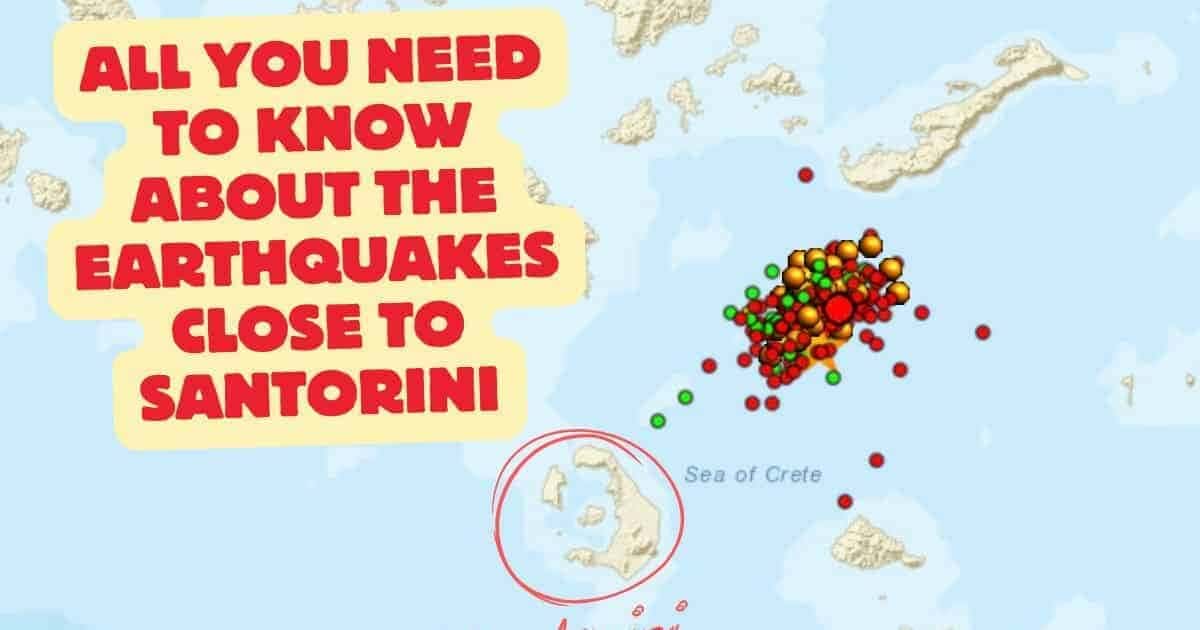
Santorini is safe to visit. The island sits on one of the most closely monitored volcanic systems in the world, and the earthquakes that made global headlines in early 2025 were a tectonic “earthquake swarm” centred in the sea roughly 20–30 km (12–19 mi) northeast of Santorini, near the uninhabited islet of Anydros and the Kolumbo submarine volcano.
That seismic crisis released pressure through thousands of small-to-moderate tremors, caused no major damage, and ended without a volcanic eruption. Here is the evidence-based reality check every traveller should read before worrying about a trip to Santorini.
Is Santorini Safe From Earthquakes Right Now?
Yes. As of 2026, seismic activity around Santorini has returned to normal background levels and the main volcano remains stable. Greece is the most seismically active country in Europe, so small tremors are a routine part of life across the Aegean — the vast majority are never felt by visitors.
- Current status: The 2025 earthquake swarm has long subsided; seismicity is back to background levels.
- Main volcano (Nea Kameni): Stable, with no magma ascension detected.
- Monitoring: ISMOSAV operates a 24/7 network of around 10 permanent seismic stations on and around the island.
- Travel impact: Flights, ferries, hotels, and tours are all operating as normal.
The 2025 Santorini–Amorgos Earthquake Swarm Explained

The activity in early 2025 was an “earthquake sequence” (or swarm), in which built-up energy is released slowly through many small-to-moderate quakes over days and weeks rather than a single large event. Crucially, the epicentres were offshore and deep below the seafloor — not under the towns on the caldera rim.
- Location: Seafloor between Santorini and Amorgos, near the Anydros islet and the Kolumbo submarine volcano — about 20–30 km (12–19 mi) northeast of Santorini.
- Timeline: Began in late January 2025, peaked in early February, and faded by early March 2025.
- Scale: More than 28,000 earthquakes were recorded, the great majority small to moderate.
- Strongest quake: Magnitude 5.3, on 10 February 2025.
- Cause: A rising sheet of magma (a dike intrusion) deep in the Earth’s crust stressed nearby tectonic faults — not a pressure build-up inside Santorini’s main caldera.
- Outcome: No eruption, no fatalities, and no major structural damage. The state of emergency (6 February–3 March 2025) was a precaution.

Volcano Status: Nea Kameni And Kolumbo
Santorini’s volcanic field has two systems travellers ask about. Both are monitored continuously, and neither showed signs of an imminent eruption during or after the 2025 swarm.
- Nea Kameni (main volcano): The young lava islet in the centre of the caldera. It last erupted in 1950 and is currently stable, with no magma ascension detected.
- Kolumbo (submarine volcano): Sits on the seafloor about 8 km (5 mi) northeast of Santorini and last erupted in 1650. The 2025 magma movement was linked to this deeper system but stayed far below the surface.
- Palea Kameni: The older volcanic islet beside Nea Kameni, home to the famous hot springs.
- Risk level: Low. ISMOSAV’s permanent seismic and ground-deformation network would detect magma rising toward the surface long before any eruption.
How Santorini’s Buildings Handle Earthquakes

Santorini’s infrastructure is built to withstand significant seismic events. After the major 1956 Amorgos earthquake, Greece progressively adopted some of the most demanding building codes in the world, and the island’s traditional architecture is naturally resilient.
- Regulation standard: The Greek Anti-Seismic Code (EAK), aligned with the European Eurocode 8 (EN 1998) framework.
- Modern buildings: Hotels and homes built or renovated since the 1990s use reinforced-concrete frames engineered to flex rather than crack.
- Cave houses (yposkafa): Carved directly into soft volcanic pumice and tuff, their rounded ceilings spread stress evenly and the elastic rock resists fracturing during tremors.
A Caldera Shaped By Eruptions And Earthquakes
The dramatic caldera that makes Santorini famous is itself the product of volcanic and seismic forces — which is exactly why the island is studied so closely today.
- The Minoan eruption (~1600 BCE): One of the largest eruptions in human history (VEI 7). It created the caldera you see today and buried the Bronze-Age town of Akrotiri, often called the “Pompeii of the Aegean”.
- The 1956 Amorgos earthquake: A magnitude 7.7 quake and tsunami struck the same Santorini–Amorgos zone — the strongest earthquake in Greece in the 20th century. The 2025 swarm occurred along this same active fault system.
Visiting Santorini’s Volcano
For most travellers, the volcano is a highlight rather than a hazard. The active crater of Nea Kameni is one of the few volcanoes in Europe you can actually walk on, and it pairs perfectly with the island’s volcanic history.
- Boat tours: A Santorini boat tour drops you on Nea Kameni to hike the crater and swim in the Palea Kameni hot springs.
- What to wear: Closed-toe shoes are essential — the volcanic rock is sharp and gets very hot in summer.
- Make a day of it: Combine the volcano with the Red Beach and Akrotiri — see our full guide to the best things to do in Santorini.
Should You Cancel Your Trip To Santorini?
No. There is no scientific or governmental indication of a catastrophic event, and travellers do not need to cancel their holidays because of past offshore seismic activity. If anything, periods of lower demand can mean the best hotel prices in Santorini you will ever find.
- Evacuation status: None. Locals and tourists remain on the island.
- Travel advisory: Normal operations for flights and ferries.
- Sensible precaution: Near steep caldera cliffs — such as Ammoudi Bay or the Red Beach — watch for loose rocks regardless of seismic activity. Our Santorini hikes guide covers the safer trails.
Ready to plan with confidence? Start with our complete guide on how to plan a trip to Santorini.
Frequently Asked Questions About Santorini Earthquakes
Is the Santorini volcano going to erupt soon?
There are currently no scientific indications that the main Santorini volcano (Nea Kameni) is going to erupt. It is monitored 24/7 by the Institute for the Study and Monitoring of the Santorini Volcano (ISMOSAV), and all data shows the system is stable. Nea Kameni last erupted in 1950.
Are buildings in Santorini safe during an earthquake?
Yes. Buildings constructed or renovated in Greece since the 1990s follow strict anti-seismic regulations (the Greek EAK code, aligned with Eurocode 8). Traditional Santorini cave houses (yposkafa) are carved directly into soft volcanic pumice and tuff, which flexes rather than cracks, making them highly resilient to tremors.
Should I cancel my trip to Santorini due to earthquakes?
No. The 2025 seismic activity consisted of offshore tectonic tremors located about 20-30 km northeast of Santorini and ended in March 2025. There are no evacuation orders, flights and ferries operate normally, and scientists confirm the island is safe for visitors.
How strong was the 2025 Santorini earthquake swarm?
The 2025 Santorini-Amorgos swarm produced more than 28,000 earthquakes, most of them small to moderate. The strongest quake was magnitude 5.3 on 10 February 2025. It caused no major damage and no eruption, and the seismic crisis subsided by early March 2025.
Is there a tsunami risk in Santorini?
Day-to-day tsunami risk in Santorini is very low. The region last experienced a tsunami after the magnitude 7.7 Amorgos earthquake in 1956. Greece operates a national tsunami warning system, and the Santorini volcanic field is continuously monitored by ISMOSAV and university seismology networks.