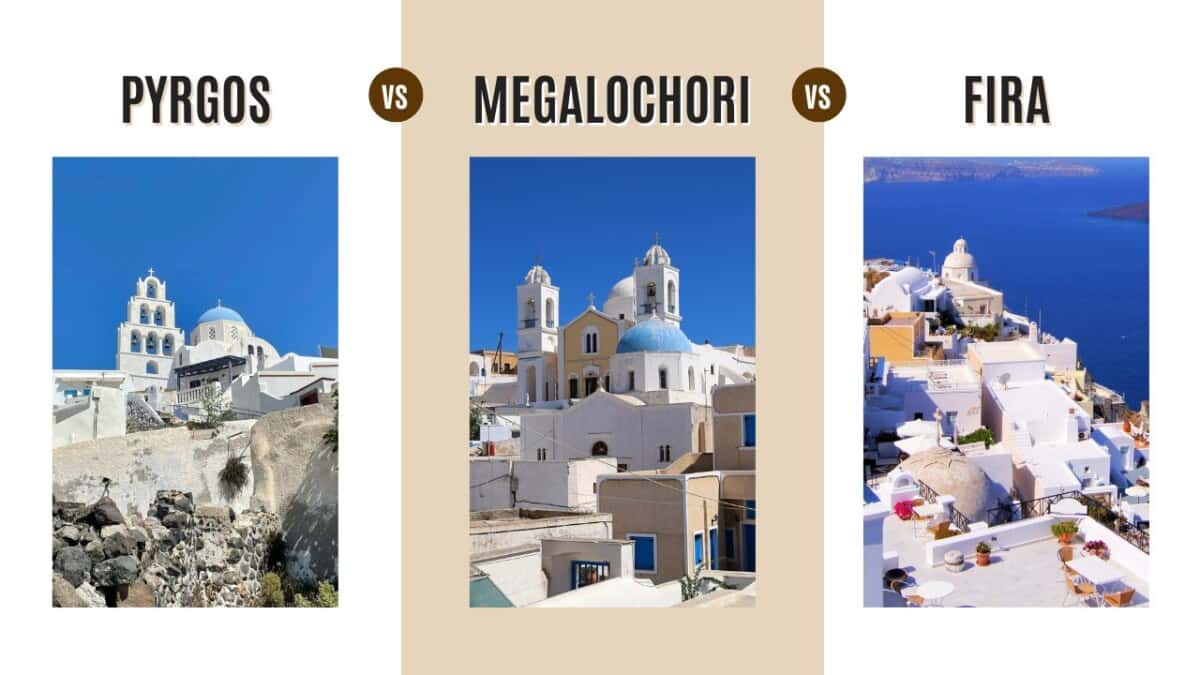
Stand in Fira at noon. Count the cruise ships in the caldera below — usually four to seven on a high-season Tuesday.
Listen, and you’ll hear four languages on every step of the cable car queue. Twenty minutes inland, in a Pyrgos church courtyard at the same hour, the only sound is a cat stretching in the shade and the bell tower of Panagia Eisodia marking the half-past. That’s the gap this article is about.
Santorini is famous for whitewashed houses tumbling over a caldera cliff, but the island has a very different story to tell once you step away from the crowds. Pyrgos, Megalochori, and Fira sit only a few kilometers apart on the same Greek island, yet each offers a wildly different version of what a village in Santorini can feel like. If you’re planning a trip — or trying to fit all three into one itinerary — this guide breaks down what makes each one worth a visit, who each is best for, and exactly how to weave them into a single day.
Pyrgos vs Megalochori vs Fira at a Glance

| Village | Distance from Fira | Elevation | Vibe | Best For |
|---|---|---|---|---|
| Fira | — (capital) | ~260m on the caldera cliff | Bustling, panoramic, social | First-timers, nightlife, cable car, museums |
| Pyrgos | ~5 km southeast (10 min by car) | 327m hilltop | Historic, elevated, quiet | Caldera views without crowds, medieval kasteli, sunset |
| Megalochori | ~5.8 km southwest (15 min by car) | Inland plateau | Traditional, slow, leafy | Wineries, authentic Greek life, boutique suite stays |
All three villages sit within a 15-minute drive of each other. None requires a hike. And none are interchangeable — locals will tell you the personality of each is the personality of three different islands.
Fira: The Capital and Beating Heart of Santorini

Fira is the capital of Santorini and the island’s busiest village. Perched on the caldera cliff above the Aegean Sea, it’s where the cable car from the old port docks (a four-minute ride down the cliff face), where the airport bus terminates, and where most travelers begin their first day on the island.
What you find in Fira:
- Blue-domed churches breathtaking against the sky — the Three Bells of Fira (officially the Catholic Church of the Dormition, built in 1757) sits between Fira and Firostefani, a 10–15 minute walk from the main square. Combined with the Catholic Cathedral on Erythrou Stavrou street, these are the two most photographed angles in the village.
- Panoramic views straight across the caldera to the island of Thirassia and the smoking volcano of Nea Kameni.
- Museums — the Museum of Prehistoric Thera, the Archaeological Museum, and the Megaron Gyzi Museum sit within a five-minute walk of each other.
- Nightlife — the only real nightlife on the island, concentrated along the cliff bars and clubs that stay open until sunrise.
- Bus connections — Fira’s KTEL bus station is the main hub for every traditional village on the island. Every public route on Santorini eventually passes through Fira.
Fira is loud. From late morning until evening, the marble lanes get shoulder-to-shoulder with cruise passengers, tavernas push their menus into the street, and donkey caravans creak up the cliff stairs from the old port.
That bustle is exactly the appeal for some travelers — Fira is social, easy, and full of options. It’s also why a lot of locals will quietly tell you they live anywhere but Fira.
The trade-off: in Fira, you pay caldera prices. A Greek salad and grilled fish that costs €18 in Pyrgos costs €40 here. A boutique suite with a hot tub averages €450 a night in July; the same room twenty minutes inland is €220.
Fira is the obvious base if it’s your first time visiting Santorini, you want the cable car (€10 one-way for adults, €5 for children, paid on-site only), museums (the Museum of Prehistoric Thera is genuinely worth two hours of your life and houses the Akrotiri frescoes), and the easiest bus access on the island. It’s not a hidden gem, but Fira is still the simplest way to experience Santorini in one place.
Pyrgos: The Highest Village and a Hidden Gem Beyond Oia

Drive ten minutes inland from Fira and you arrive in Pyrgos Kallistis — the highest village on the island, sitting at 327 meters on a hill in the center of Santorini. Pyrgos was the capital of Santorini until 1800, and you can still feel that history in the layout.
Pyrgos was built around the kasteli, a Venetian-era fortified settlement constructed around 1580 — the youngest of Santorini’s five medieval kasteli and the best-preserved. The whole village radiates outward from the fortress in concentric rings of narrow streets, traditional houses, and small whitewashed houses stacked on volcanic rock.
Walking the upper alleys, you’re tracing the same lanes where the island’s history was decided for the better part of three centuries. Pyrgos is far from Fira in feel, even on a map where the two villages sit a short drive apart.
From the top of the kasteli, you get panoramic views across the entire island of Santorini: caldera views, vineyards rolling toward the sea, the black beach far below, and on a clear day a string of hidden Cyclades islands tourists miss. There’s a reason photographers post up here at dusk — the sunset over the caldera from Pyrgos rivals Oia’s, with maybe one-fifth of the crowd. These are great views by any honest measure, and entry to the castle ruins is free.
A few specific details that make Pyrgos worth the excursion:
- Blue-domed churches at every turn — there are over 30 churches in Pyrgos itself, and 48 religious sites if you include the surrounding Profitis Ilias area. The most important is Panagia Eisodia, the largest church on Santorini and the focal point of the village’s Easter ceremony.
- Tavernas with no view-tax pricing — Penelope’s Santorini Restaurant is a relaxed family-run ouzeri serving home-style Greek “Mama” cooking (try the fluffy tomato balls and homemade dolmades). Cava Alta, a few alleys away, is housed in a 1922 traditional Canava where local winemakers used to crush grapes; the Spanish-Cycladic fusion menu (oxtail-filled donuts, fish ceviche) is one of the best meals on the island. Lunch for two with wine: €40–€55.
- Holy Week in Pyrgos — on Good Friday evening, before the Epitaph procession, thousands of small tin can lanterns (“kanestria”) are lit on rooftops, walls, paddocks, and church facades across the village. Guinness has called it the most beautiful Good Friday in Greece. If you’re on the island in April, this is the single most memorable cultural event you’ll witness.
- Profitis Ilias Monastery — a 2.5 km marked trail from Pyrgos’s main square climbs to Mount Profitis Ilias (565 meters), the highest point on the island. The monastery, founded in 1711, sits at the summit. Allow 90 minutes round-trip on foot, or drive up if your knees disagree.
- Hatzidakis Winery — just outside Pyrgos on the Pyrgos–Emporio road, this small organic winery is built into a volcanic-rock cave at 330m. Their 100% Assyrtiko (Santorini Familia) is one of the best on the island.
For travelers who want authentic Santorini beyond Oia and Fira, Pyrgos is in a category of its own — around 600 year-round residents, a working monastery on the hill, and a slower pace of life that the island’s flagship villages have long since traded away.
Megalochori: An Authentic Greek Village Surrounded by Vineyards

Megalochori sits about 5.8 km southwest of Fira, surrounded by vineyards and at the heart of Santorini’s wine region. It’s one of the largest villages on this side of the island, and also the best-preserved — its old square, traditional houses, blue-domed bell towers, and Cycladic architecture have been left almost untouched by tourism. Around 600 permanent residents live here year-round.
This is a working village. People live here. You’ll see kids on bicycles, old men playing backgammon outside the kafeneio at 11 a.m., and the baker pulling fresh bread out at 7.
The pace is genuinely slower — slower pace of life isn’t a marketing line here, it’s the actual pace. Local culture in Megalochori isn’t performed for visitors; you just happen to be standing in it.
Look up almost anywhere in the village and you’ll see one of the bell towers that have become Megalochori’s symbol — they’re built taller and more ornate than anywhere else on the island. The high stone walls, inner courtyards, and heavy wooden doors that line the alleys were built for privacy and for safety against marauding pirates in the 17th century, when Megalochori first appeared in records as a wealthy merchant village exporting Vinsanto wine.
Pyrgos and Megalochori are often paired on the same excursion because together they capture the slower pace of life that Santorini is famous for but rarely delivers in Fira and Oia. Spend an afternoon wandering the alleys, stop at a tavern for lunch, and finish at one of the wineries before sunset:
- Boutari Winery — Greece’s most historical wine company (founded 1879) opened its Santorini operation in 1990 and was the first winery in Greece to open its doors for organized public tastings.
- Gavalas Winery — a family-run winery that has produced wine in Megalochori for five generations and is one of the oldest on Santorini.
Megalochori is also where you find some of the island’s best boutique stays. A boutique suite in a 200-year-old captain’s home, with a vine-covered terrace and a hot tub looking at vineyards instead of cruise ships, runs about half what you’d pay for a similar room in Oia.
Properties like Vedema, a Luxury Collection Resort (built around a 400-year-old vineyard in the heart of the old village) and Athermi Suites have made Megalochori a quiet contender for the best base on the island for travelers who want comfort without the noise. This is what authentic Greek village life looks like on a Greek island that usually keeps it hidden.
How to Choose Between Pyrgos, Megalochori, and Fira

Here’s the simple rule:
- Choose Fira if it’s your first time visiting Santorini, you want the cable car, museums, and nightlife, you need easy bus access, and you don’t mind crowds.
- Choose Pyrgos if you want panoramic caldera views without the Oia mob, a medieval castle, and the essence of Santorini away from the crowds.
- Choose Megalochori if you want traditional villages, vineyards, an authentic Greek experience, and a boutique suite at a fair price.
If you can spend three days, do all three. The villages are 10–15 minutes apart and you’ll leave feeling like you actually saw the island instead of one cliff face.
How to Get Around Santorini Between the Three Villages

Renting a car is the easiest way to get around Santorini if you want to combine all three villages in a single day. The main road from Fira to Megalochori takes about 15 minutes; Pyrgos sits between them, ten minutes from each. A small ATV is fun in May or October but miserable in August traffic — get a real car.
If you’d rather not drive:
- KTEL public bus — buses from Fira’s bus station run to Pyrgos and Megalochori roughly every 30–60 minutes on the Fira–Perissa route, which stops at Karterados, Messaria, Vothonas, Pyrgos, Megalochori, Emporio, Perivolos, and Perissa. Day fare to Pyrgos is €1.80; to Megalochori (on the same route) it’s €2.50. Night routes are slightly higher.
- Private driver — about €120–€180 for a half-day with stops at all three villages and a winery.
- Guided excursion — most operators run a “traditional villages” half-day tour for €60–€90 per person, often with a winery tasting included.
If you’re staying in one of the lesser-known villages, expect fewer tourists, especially in the early morning before the day-trippers arrive. You can walk Pyrgos to Megalochori in about 45 minutes if you don’t mind a hot road and a steep return — it’s one of the most underrated short walks on the island.
A Sample One-Day Itinerary: All Three Villages

Want all three in one day? Here’s the itinerary locals actually recommend:
- 8:30 a.m. — Fira. Walk the caldera path from Fira toward Firostefani before the cruise ships dock. Stop at the Three Bells of Fira for the iconic shot — empty at this hour. Coffee at Galini Café with the volcano view to yourself.
- 10:30 a.m. — Drive to Pyrgos (10 min, 5 km). Climb to the kasteli, explore the narrow streets, and shoot the blue-domed churches against the open caldera.
- 12:30 p.m. — Lunch in Pyrgos. Penelope’s or Cava Alta. Order the fava and the chickpea balls.
- 2:30 p.m. — Drive to Megalochori (10 min via vineyard back roads). Walk the village square, look up at the bell towers, and visit Boutari or Gavalas Winery. €15–€25 for a flight of four wines with food pairings.
- 5:30 p.m. — Sunset. Drive back up to the Pyrgos kasteli and watch the sun set over the caldera with twenty other people instead of two thousand. The view from the kasteli toward Akrotiri turns gold-pink for about 25 minutes.
- 8:00 p.m. — Dinner. Back to Megalochori for a quiet last meal at Raki, or to Fira if you want energy and nightlife.
You will have driven about 35 kilometers total and seen three completely different sides of the island.
Traditional Villages Worth the Excursion: Beyond Pyrgos and Megalochori

If you fall in love with the authentic Santorini you find in these villages, add Emporio, Vothonas, and Karterados to your itinerary. These are the spots in Santorini that most travelers genuinely never reach.
- Emporio (sometimes spelled Emborio) is one of the oldest fortress villages on the island, with kasteli walls still standing and a windmill on the southern hill, and is one of the few places where you can still see a fully intact medieval village layout.
- Vothonas is a tiny canyon village built into volcanic rock, where many of the houses are literally caves carved into the cliff. Genuinely off the beaten path.
- Karterados sits between Fira and the airport — easy to overlook, but the captains’ mansions and small church squares hold their own.
- Imerovigli sits just north of Fira with the most dramatic caldera views on the island, the Astra Suites cliff hotel, and the Skaros Rock walking trail (a 650m hike from Imerovigli’s edge to the Theoskepasti chapel — about 45 minutes one-way, free, sunset gold).
- Perissa and the black beach south of Megalochori give you a beach day after village hopping. Sun loungers are €10–€15 for two.
- Akrotiri and the red beach, on the southwestern tip near Megalochori, are another must-visit if you want a volcanic rock landscape with your swim, plus the Bronze Age archaeological site (€20 entry; open 8 am – 8 pm April–October).
These hidden gems in Santorini are ideal for travelers who want the heart of Santorini, not the postcard. Add them to your itinerary if you have four days or more on the island.
Travel Tips for an Authentic Greek Excursion

A few practical things that will make your day better:
- Visit early. Tour buses arrive at Pyrgos around 11 a.m. Get there by 9:30, and you’ll have the kasteli almost to yourself.
- Wear shoes with grip. The narrow streets and volcanic-rock alleys in both Pyrgos and Megalochori are charming but slick after rain.
- Book your winery tasting in advance during high season (July–August). Walk-ins generally work in May, June, September, and October.
- Bring cash. Smaller tavernas in both villages still prefer it, and the village ATM in Megalochori sometimes runs dry on weekends.
- For the best sunset on the island, finish your day at the Pyrgos kasteli rather than chasing Oia with everyone else. The views across the island from there beat the cliff in Oia, with a fraction of the crowd.
- Stay hydrated. Both inland villages bake at lunchtime — there’s less sea breeze than in Fira.
- Skip Pyrgos in cruise-port hours if you can. Most ships dock 9 a.m.–5 p.m.; the village empties fast after that.
- If you’re on the island for Greek Easter, plan your week around Good Friday in Pyrgos. It’s the single most memorable Greek Orthodox event you’ll see, and the village is closed to traffic from late afternoon onward.
The Verdict: It’s a Spectrum, Not a Battle

Pyrgos vs Megalochori vs Fira isn’t really a battle — it’s a spectrum. Fira gives you energy. Pyrgos gives you history.
Megalochori gives you quiet. Together, they show why Santorini, even after decades of mass tourism, still hides some of the most authentic Greek villages in the Cyclades.
If you have one day, pick the village that matches your mood. If you have three, walk all three and discover the best of Santorini’s traditional villages — the side of the island most travelers never see, and the one most worth coming back for.
Frequently Asked Questions

Is Pyrgos better than Oia for sunset?
For sunset and views, Pyrgos arguably wins — same caldera, fewer tourists, free entry to the kasteli. Oia still has the more iconic blue-domed churches photo, but you’ll fight several thousand people for the angle.
Can you visit Pyrgos and Megalochori on the same day?
Yes — Pyrgos and Megalochori are about 10 minutes apart by car. Most travelers do both as a half-day excursion, with lunch in one village and a winery in the other. Many guided tours include a final stop in Fira or Oia for sunset.
How long should I spend in Fira vs Pyrgos vs Megalochori?
A half day in Fira (cable car, museum, lunch), 2–3 hours in Pyrgos (kasteli, lunch or sunset), and 2–3 hours in Megalochori (square, winery). All three fit comfortably in a long day or split across two days at a slower pace.
Is there a cable car in Pyrgos or Megalochori?
No — the Santorini cable car runs only between Fira and the old port at the bottom of the caldera cliff. Adult tickets are €10 one-way (children €5, free under 5), paid on-site only.
Where should I stay: Fira, Pyrgos, or Megalochori?
Fira for first-timers and convenience. Pyrgos for the best sunset views and history. Megalochori for boutique suites, vineyards, and quiet — and the best value for boutique luxury on the island.
Is Megalochori worth visiting if I only have one day?
Yes, if you’re willing to skip a beach. A 90-minute walk plus a winery tasting will give you a more memorable hour than another café in Fira. Pair Megalochori with Pyrgos for the highest return on a single afternoon.
What’s the highest village on Santorini?
Pyrgos is at 327 meters above sea level. Above Pyrgos, on Mount Profitis Ilias (565m), sits the Profitis Ilias Monastery — the highest point on the island, founded in 1711.
How do I get from Pyrgos to Megalochori without a car?
Both villages sit on the same KTEL bus route (Fira–Perissa). The bus runs every 30–60 minutes; the fare between the two villages is under €2. A taxi will run you €10–€15.
Are there wineries in Pyrgos or only Megalochori?
Both. Megalochori is the larger wine hub with Boutari and Gavalas, but Pyrgos has Hatzidakis Winery (built into a volcanic cave just outside the village) and other small producers. Most “Santorini wine country” tours combine wineries from both villages.