Roman Forum of Athens (Roman Agora)
First-century commercial marketplace in Athens featuring the marble Tower of the Winds and the monumental Gate of Athena Archegetis.
About Roman Forum of Athens (Roman Agora)
The Roman Agora of Athens is a marketplace in Plaka, just north of the Acropolis, built between 19 and 11 BC with donations from Julius Caesar and Augustus. A full ticket costs €10 (€5 reduced). Its best-known monument is the Tower of the Winds, an octagonal marble tower that once held sundials, a water clock, and a weather vane.

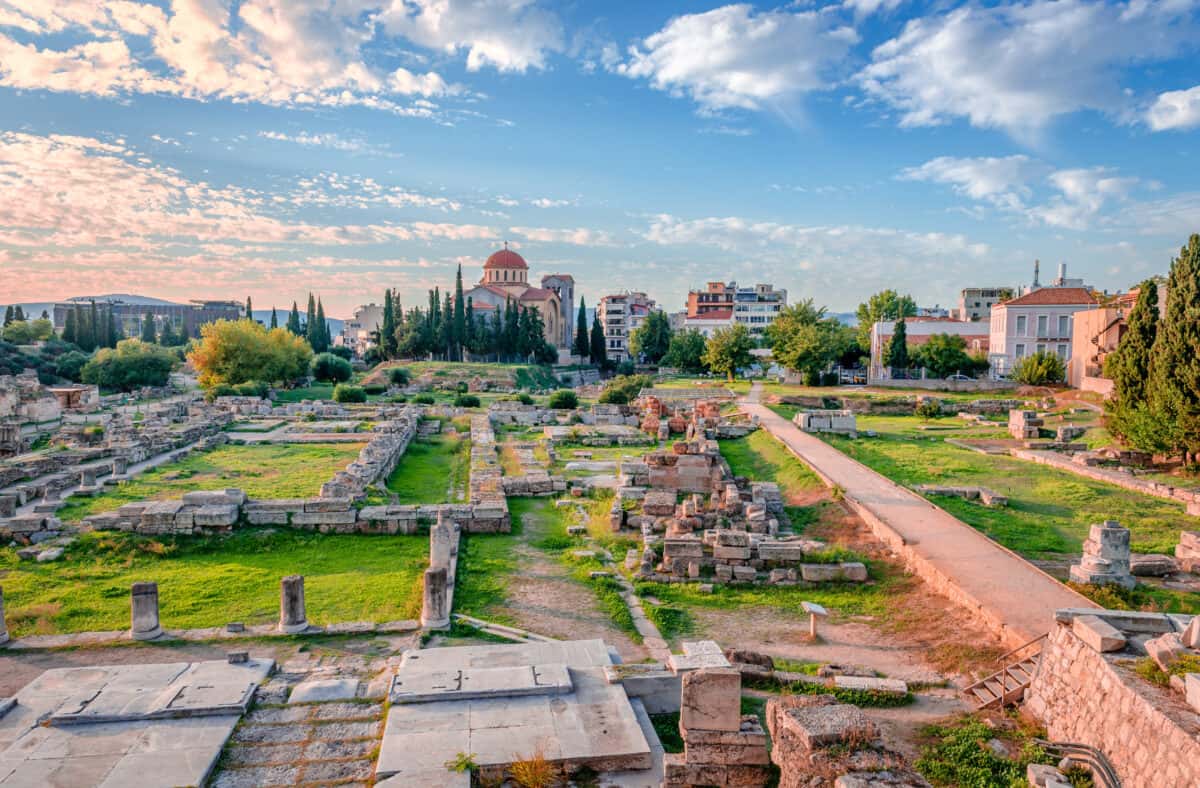
Greece’s Ministry of Culture describes the site as a large rectangular building measuring 111 by 98 meters, with an open courtyard surrounded by stoas, shops, and storerooms. It pairs well with the Ancient Agora of Athens, a short walk to the west. The Ancient Agora was the civic center of classical Athens. The Roman Agora shows where much of the city’s trade moved once Rome was in charge. Only about half of the original complex has been excavated, and the rest still lies under the houses of Plaka.
Roman Agora at a glance
| Location | Plaka, central Athens. Entrance on Polygnotou Street (3 Polignotou, 105 55) |
| Built | 19 to 11 BC, funded by Julius Caesar and Augustus |
| Tickets | €10 full, €5 reduced, sold on site and online |
| Summer hours | April 1 to August 31: 08:00 to 20:00, with shorter hours in September and October |
| Winter hours | November 1 to March 31: 08:00 to 15:00 (last entry 14:40) |
| Closed | January 1, March 25, May 1, Easter Sunday, December 25 and 26 |
| Free entry | March 6, April 18, May 18, the last weekend of September, October 28, and the first and third Sunday of each month from November to March |
| Nearest metro | Monastiraki (lines 1 and 3), about 2 minutes on foot |
| Phone | +30 210 324 5220 (site guardhouse) |
| Accessibility | Listed as wheelchair accessible by the official Athens city guide; restrooms on site |
A short history of the Roman Agora
The Roman Agora went up between 19 and 11 BC, mainly as a commercial market. Under Emperor Hadrian in the 2nd century AD, the courtyard was paved with marble slabs. Some of those slabs had been used for something else first and still carry texts by Marcus Aurelius.
The site became more important after the Herulian invasion of AD 267. Athens shrank to the area inside a new Late Roman wall, and the city’s administrative and commercial center moved from the Ancient Agora to the Roman Agora and the neighboring Library of Hadrian. Through the Byzantine and Ottoman centuries, the area filled with houses, workshops, and churches, and the Fethiye Mosque was built on its north side.
For a long time, the only visible part was the western gate, and many people thought it was a temple. The British architects James Stuart and Nicholas Revett identified it correctly, using inscriptions about the tax duties of oil merchants. Houses were bought and demolished to make room for digs, which started under the Greek Archaeological Society in 1837 and carried on at intervals through 1991.
What to see inside
Gate of Athena Archegetis
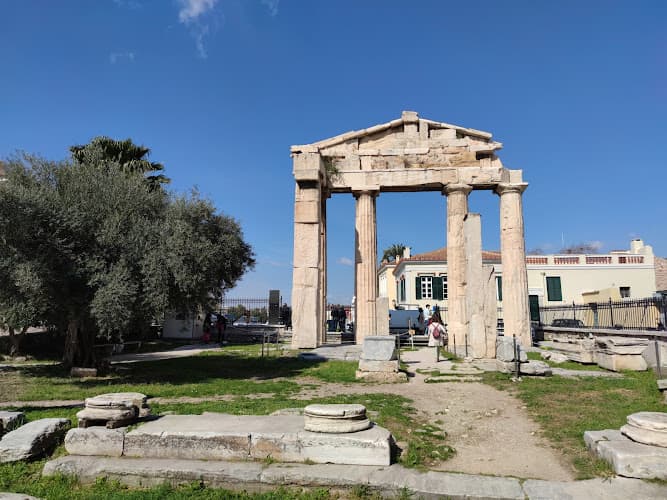
This was the main western entrance, and it is the best-preserved piece of the marketplace itself. Four Doric columns of Pentelic marble hold up an architrave and pediment. The Ministry of Culture dates the gate to 11 BC. Its inscription records that it was paid for by Julius Caesar and Augustus and that the people of Athens dedicated it to Athena Archegetis, “Athena the Leader.”

Tower of the Winds (Horologion of Andronikos Kyrristos)
The Tower of the Winds stands at the eastern edge of the marketplace. It is an eight-sided tower of white Pentelic marble, each side about 3.2 meters wide, set on three steps with a conical roof. The astronomer Andronikos of Kyrrhos designed it as a public timekeeper. It had sundials on the outside, a water clock inside, and a weather vane on top. The name comes from the eight wind gods carved around the top of the walls. Each one is a male figure with his name cut into the stone.
Nobody is sure exactly when it was built. The Ministry of Culture dates it to the first half of the 1st century BC, but the Stoa Consortium’s Athens resource says many archaeologists now prefer the mid-2nd century BC. That would make it older than the Roman marketplace next to it. The building was later used as a church or baptistery, and in the 18th century it served as a tekke (lodge) for dervishes.
East Propylon
The second entrance faced the Tower of the Winds. It had four Ionic columns of gray Hymettian marble. It does not line up with the western gate. Instead it sits at an angle on the east side, so check its position against the Gate of Athena Archegetis as you walk through.
Fethiye Mosque
On the north side of the courtyard stands the Fethiye Mosque. The Ministry dates it to 1456 and notes that it was built on the ruins of an Early Christian basilica. This is one of the few spots in Athens where Roman, Christian, and Ottoman layers are all visible from the same place.
Agoranomion and public latrines
East of the courtyard are two 1st-century AD buildings. The Agoranomion keeps a facade with three arched doorways and a wide stairway. Its inscription dedicates it to the deified emperors and Athena Archegetis, and it may have been a place of emperor worship. Nearby are the public latrines (Vespasianae), a square hall with benches along all four walls and a drain running underneath.
Why it is worth visiting
The Roman Agora works best for travelers exploring the historic center on foot. It fits easily into an Athens route that also includes the Acropolis Museum, the Ancient Agora, and the rest of your best things to do in Athens plans. Because it sits right in Plaka, you can combine it with museums and a walk through the old-city streets without planning extra transport.
It also offers something the bigger sites don’t: a compact site with Hellenistic, Roman, Byzantine, and Ottoman remains all close together. The €10 ticket is half the price of the Ancient Agora’s.
Tickets, hours, and getting there
According to the official Ministry of Culture page, tickets cost €10 full and €5 reduced and are sold at the site and online. The Hellenic Heritage site page has links for booking. The price is the same all year.
Summer hours are 08:00 to 20:00 from April 1 to August 31, and the Ministry lists last entry at 19:30. After August, closing time moves earlier as the days get shorter:
- September 1 to 15: 08:00 to 19:30, last entry 19:10
- September 16 to 30: 08:00 to 19:00, last entry 18:40
- October 1 to 15: 08:00 to 18:30, last entry 18:10
- October 16 to 31: 08:00 to 18:00, last entry 17:40
- November 1 to March 31: 08:00 to 15:00, last entry 14:40
Easter changes the schedule. The site closes on Easter Sunday, opens 12:00 to 17:00 on Good Friday, and opens 08:30 to 15:30 on Holy Saturday. Greek archaeological sites can also change their hours at short notice, for example during heatwaves or strikes. Check the official page on the day of your visit.
The easiest way to get there is the metro to Monastiraki (lines 1 and 3). The entrance is about a 2-minute walk from the station. Buses 025 and 026 also stop at Monastiraki.
Local tip: Treat the Roman Agora as part of a wider Plaka and Agora walk instead of a standalone trip. It is close enough to the bigger sights that you can fit it in between them without adding much travel time.
Frequently asked questions
What is the difference between the Roman Agora and the Ancient Agora of Athens?
The Ancient Agora was the civic and political center of classical Athens. The Roman Agora is a later marketplace a short walk to the east, built between 19 and 11 BC, and the two were once linked by a paved street. They are separate archaeological sites, and each needs its own ticket.
Is the Roman Agora included in the Acropolis ticket?
No. The Acropolis ticket covers the Acropolis only. The former €30 five-day combined ticket, which included the Roman Agora, was discontinued in April 2025. You now need a separate €10 ticket for the Roman Agora.
Is Hadrian’s Library part of the Roman Agora?
No. Hadrian’s Library is a separate archaeological site next door with its own ticket. After the Herulian invasion of AD 267, the two areas together became the administrative and commercial center of Athens, which is why they are often visited together.
Reviews
Loading traveler reality-check data for Roman Forum of Athens (Roman Agora).
Amenities & Features
- Tourist Attraction