Botanical Museum of the National Gardens
Historic stone pavilion in the Athens National Garden displaying botanical specimens, archival sketches, and Queen Amalia’s horticultural legacy.
About Botanical Museum of the National Gardens
The Botanical Museum of the National Garden is a small, free museum hidden among the trees of the National Garden of Athens, the historic park behind the Greek Parliament building on Syntagma Square. It occupies a 19th-century royal hunting pavilion and uses dried plant specimens, archival photographs, and botanical watercolors to tell the story of how Queen Amalia’s private Royal Garden became the green oasis in the heart of Athens that locals and visitors enjoy today.

Botanical Museum at a glance
| Detail | Information |
|---|---|
| Greek name | Βοτανικό Μουσείο Εθνικού Κήπου |
| Location | Inside the National Garden (Ethnikos Kipos), behind the Greek Parliament building |
| Garden address | 1 Vasilissis Amalias Avenue, Athens |
| Nearest metro | Syntagma |
| Admission | Free |
| Museum hours | Morning to early afternoon, most often listed as Tuesday to Sunday |
| Garden hours | Sunrise to sunset, daily |
| Building | 1840s royal hunting pavilion; museum since 1984 |
From royal hunting pavilion to museum
The museum building is a small two-story neoclassical structure from the 1840s. When Queen Amalia was planning the Royal Garden, King Otto, a keen hunter, noticed that the far end of her design was close to an area where he had hunted birds, so he had a hunting pavilion added to the plans. After Otto was deposed in 1862, the building sat largely unused for more than a century.
In 1984, the pavilion reopened as the Botanical Museum of the National Garden. Its location near the Parliament, the former royal palace, is a reminder that this whole park began as the private grounds of Greece’s first king and queen.
The Royal Garden behind the museum
Queen Amalia, the first queen of modern Greece, commissioned the Royal Garden in 1838. German agronomist Friedrich Schmidt designed the grounds and imported more than 500 species of plants, along with peacocks, ducks, and turtles. Many of the imported plants could not survive the dry Mediterranean climate, and the planting has changed many times since.
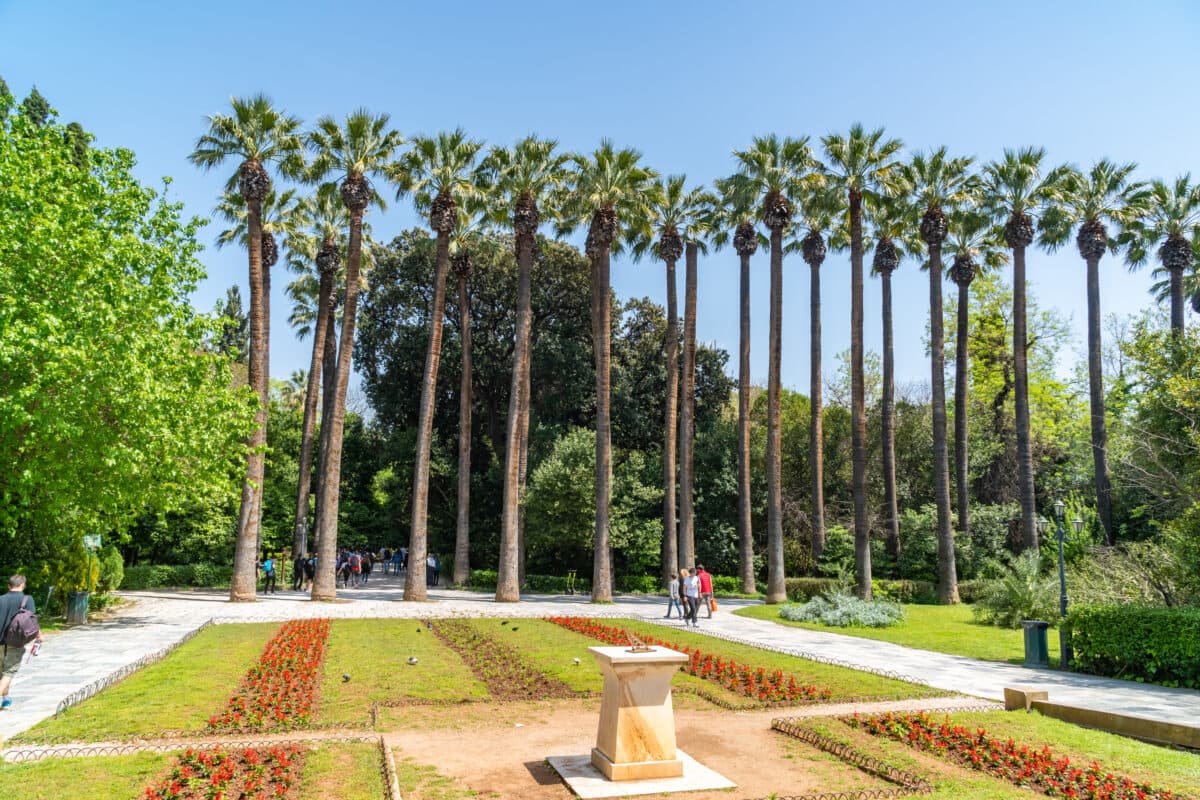
Today the former Royal Garden, known in Greek as Ethnikos Kipos, is a free public park covering 15.5 hectares (38 acres) in the city center. Its shaded paths, ponds, and mature trees make it one of the coolest places to walk in central Athens during the summer.
What to see inside the museum
The ground floor holds a classified collection of dried foliage from the roughly 520 plant varieties that have been planted in the garden. Only about 100 of them are native to Greece; the rest come from around the world. Texts, drawings, and archival photographs in the same space trace the garden’s history from its creation in 1839 to the public park of today.
Upstairs, look for decorative plant specimens and a set of plant watercolors painted by botanist P. Kantartzis in 1856. Together, the two floors work as a compact introduction to the plants and trees you will pass on the garden’s paths, so it makes sense to visit the museum early in your walk.
How to visit the Botanical Museum
Admission is free. Published opening hours vary between sources, but the museum generally opens in the morning and closes in the early afternoon, and Tuesday to Sunday is the most commonly listed schedule. Because it is so small, it can close without notice for maintenance, on public holidays, and on days of national significance, so plan to arrive before lunch and keep your plans flexible.
The museum has no separate street entrance; you reach it through the National Garden, which is open daily from sunrise to sunset. Use one of these gates:
- Vasilissis Amalias Avenue: the main entrance, beside the Parliament and a short walk from Syntagma Square and Syntagma metro station
- Vasilissis Sofias Avenue: the northern side of the garden
- Irodou Attikou Street: the eastern side, near the Presidential Mansion
- Zappeion: the southern side, connecting to the Zappeion gardens
The building looks more like a small house than a museum, so keep an eye out as you walk. On the hottest summer days, the garden gates are sometimes closed because of fire risk, so check conditions before you set out in July or August.
What to see nearby
The museum is one stop in a garden full of small attractions. Pair it with the duck pond and its turtles, the small zoo, the café, the children’s library and playground, and the Roman ruins along the paths, including column drums and the mosaic floor of a Roman villa.

At the garden’s southwest corner, where Vasilissis Amalias meets Vasilissis Olgas Avenue, stands the marble statue of Greece crowning Lord Byron, unveiled in the mid-1890s to honor the English poet’s support for Greek independence. Hadrian’s Arch and the Temple of Olympian Zeus are at the same intersection, about 100 meters away.
On the southern side of the garden, the Zappeion exhibition hall sits in its own landscaped grounds, and the Panathenaic Stadium, host of the first modern Olympic Games in 1896, is directly opposite across Vasileos Konstantinou Avenue. From Hadrian’s Arch, the old Plaka neighborhood and the slopes below the Acropolis are an easy walk.
Not to be confused with the Diomidis Botanical Garden
If you are looking for a full botanical garden rather than a museum, head to the Diomidis Botanical Garden in Haidari, about 8 km west of central Athens. Covering around 186 hectares, it is the largest botanical garden in Greece and the Eastern Mediterranean, and it is run as an endowment of the University of Athens. The Botanical Museum in the National Garden is a much smaller, city-center stop focused on the history of a single royal garden.
Frequently asked questions
Is the Botanical Museum in the National Garden free?
Yes. Admission to the Botanical Museum is free, and so is entry to the National Garden itself, which is open from sunrise to sunset.
Is the Botanical Museum of the National Garden worth visiting?
It is worth a short stop if you are already walking through the National Garden, especially if you like plants, garden history, or botanical art. It is a small museum, so it works best as part of a garden visit rather than as a standalone trip.
Does the Botanical Museum have its own street entrance?
No. The museum sits inside the National Garden, so you reach it through one of the garden gates, such as the main entrance on Vasilissis Amalias Avenue near Syntagma Square.
Why do online opening hours for the museum differ?
Published schedules vary between sources, and the museum can close without notice for maintenance or holidays. Plan to visit in the morning, Tuesday to Sunday, and treat any hours listed on maps apps as a guide rather than a guarantee.
Is the Botanical Museum the same as the Athens Botanical Garden?
No. The Botanical Museum is a small museum inside the National Garden in central Athens. The Diomidis Botanical Garden is a separate, much larger botanical garden in Haidari, about 8 km west of the city center.
Reviews
Loading traveler reality-check data for Botanical Museum of the National Gardens.
Amenities & Features
- Tourist Attraction