Athens National Garden
Historic central Athens park and former royal garden, offering shaded walking paths, botanical collections, and a quiet retreat near Syntagma Square.
About Athens National Garden
The Athens National Garden (Ethnikos Kipos) is a free public park of about 16 hectares directly behind the Hellenic Parliament on Syntagma Square. It is open every day from sunrise to sunset, and the main gate at 1 Vasilissis Amalias Avenue is a few minutes’ walk from Syntagma metro station (lines 2 and 3). Old trees, ponds, and shaded paths make it the easiest break from the heat and traffic of central Athens, and it sits between the Acropolis area, Plaka, and the Panathenaic Stadium.

The Official Athens Guide counts more than 7,000 trees, 40,000 shrubs, and 519 plant species across 158,000 square meters, around 100 of them native to Greece, along with hundreds of birds, fish, and turtles. Queen Amalia commissioned it as the private Royal Garden in 1838. It was declared a public space and renamed the National Garden in 1927.
National Garden quick facts
| Detail | Information |
|---|---|
| Location | Behind the Hellenic Parliament, between Syntagma Square and the Zappeion |
| Main entrance | 1 Vasilissis Amalias Avenue, Historic Centre, 105 57 Athens |
| Other gates | Vasilissis Sofias Avenue, Herodou Attikou Street, and the Zappeion side |
| Opening hours | Daily, sunrise to sunset; gates are locked overnight |
| Admission | Free, no ticket or booking needed |
| Nearest metro | Syntagma (lines 2 and 3) |
| Phone | +30 210 721 5019 |
| Accessibility | Step-free main entrance; stone paving, fine gravel, and a mix of stepped and step-free paths |
| Time to allow | 20–30 minutes to walk through; an hour or more to explore |
From royal garden to public park
The garden was laid out between 1838 and 1840 behind the new royal palace, which is now the Hellenic Parliament. German agronomist Friedrich Schmidt designed it and brought in more than 500 plant species, plus peacocks, ducks, and turtles, though many of the plants did not survive the dry Athenian summers. Later botanists, including Theodor von Heldreich and Spyridon Miliarakis, continued his work.
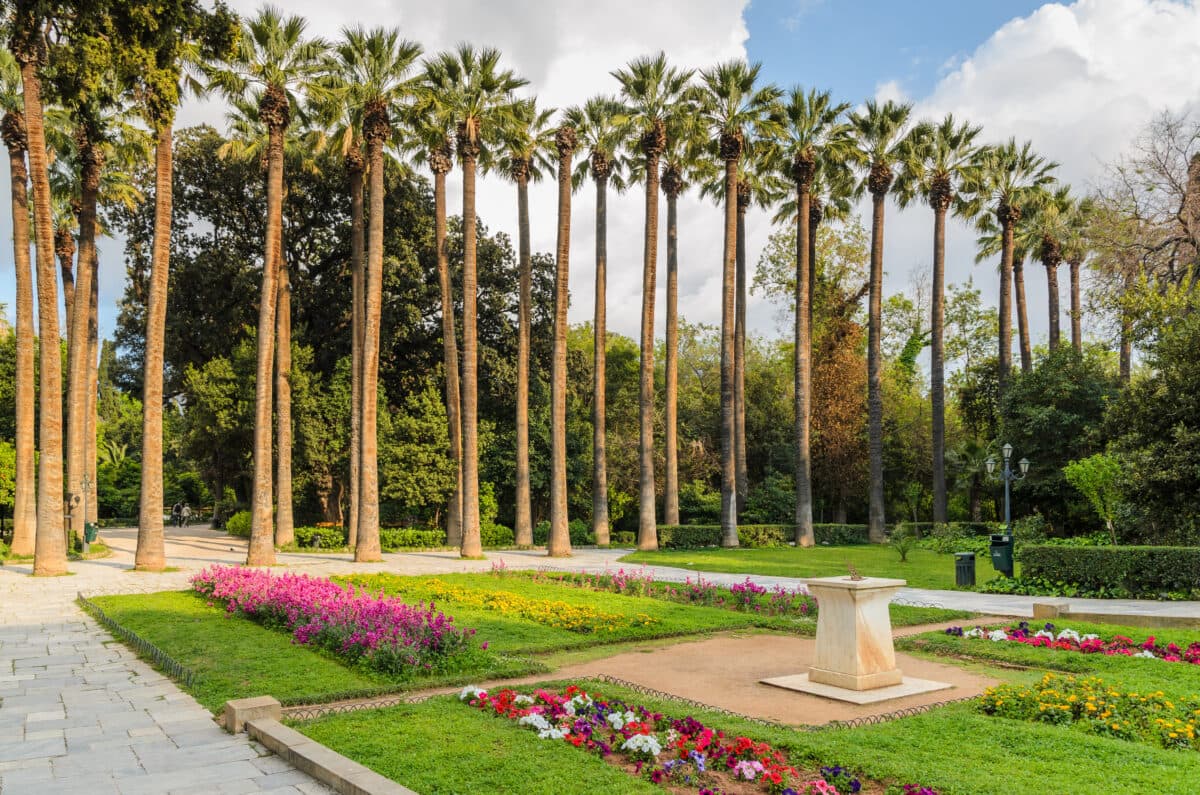
Queen Amalia planted the tall Washingtonia (California fan) palms at the Amalias Avenue entrance herself in 1842. For decades the Royal Garden opened to the public only in the afternoons. The garden also has an odd place in Greek history: in 1920, King Alexander was bitten by a pet monkey while walking here and died of sepsis about three weeks later, a death that helped reshape Greek politics during the war in Asia Minor.
In 2004 the Greek state handed the garden to the City of Athens for 90 years. A regeneration program started in 2022 and is renovating the park section by section, so parts of it stay open while work continues.
What to see inside the garden
The garden is designed for wandering rather than a checklist, but a few features are worth seeking out:
- The palm avenue: Amalia’s Washingtonia palms line the main entrance on Vasilissis Amalias Avenue.
- Roman mosaic: the floor of an ancient Roman villa, decorated with geometric plant and leaf patterns, lies at the northern end of the park.
- Other ruins: column drums, Corinthian capitals, and other fragments, most of them Roman, are scattered along the paths.
- Ponds: the duck and turtle ponds are the liveliest spots for children.
- Busts: Ioannis Kapodistrias, the first governor of modern Greece, and the philhellene Jean-Gabriel Eynard stand on the southeast side; the poets Dionysios Solomos, who wrote the national anthem, and Aristotelis Valaoritis stand on the south side.
- Botanical Museum: a small neoclassical building near the central area houses a collection on the garden’s plants. It has been closed for refurbishment for long periods, so treat it as a bonus if it happens to be open.
- Plant nursery: said to be the first greenhouse in modern Greece, it still raises saplings that are later planted in the park.
- Children’s Library and playground: the library’s books are mostly in Greek. The shaded playground is split into sections for different age groups and includes a ramp so children who use wheelchairs can reach the equipment.

Entrances, getting there, and accessibility
The main entrance is on Vasilissis Amalias Avenue, next to the Tomb of the Unknown Soldier. From Syntagma metro station, use the Amalias/National Garden exit and you are a couple of minutes from the gate. The other gates open onto Vasilissis Sofias Avenue to the north, Herodou Attikou Street on the east side by the Presidential Mansion, and the Zappeion to the south, so you can leave on whichever side suits your next stop.
The Official Athens Guide lists the garden as wheelchair accessible and gives more detail in its accessible route guide. The main entrance has no step. Paths start as stone paving and turn into soil with fine gravel, and although some spots have steps, step-free routes are available. Visitor guides report that the Vasilissis Sofias gate and the gate by the bust of Jean Moréas are not step-free, so use the Amalias Avenue entrance if you are visiting with a wheelchair or stroller.
Hours, closures, and the best time to go
The gates follow daylight, opening at sunrise and closing at sunset, so closing time is much later in June than in December. There is no fixed published timetable, and the gates are locked overnight.
Weather can close the garden without much notice. The garden’s management closes it as a precaution when wind speeds go above 55 km/h, because many of its trees are more than 20 meters tall and falling branches are a real risk. The Municipality of Athens has also shut it on high fire-risk days during heatwaves, as it did in June 2024. On windy or extreme-heat days, check the gate notices before planning a shaded walk here.
Local tip: The National Garden is best used strategically — after an exposed archaeological site, before a museum, or in the hotter middle part of the day when central Athens feels least forgiving.
How to fit it into a walk
The garden’s location is what makes it so useful. You can step into it between bigger-ticket sights such as the Temple of Olympian Zeus, the Acropolis area, and the central squares, and it adds a different kind of stop to the things to do in Athens: less monument-heavy, more restorative, and ideal for a walking route that needs breathing space.
One easy, mostly flat route follows the order below. The Official Athens Guide’s accessible loop around the garden and nearby sights, starting and ending at Syntagma, covers about 3 km.
- Start at Syntagma Square and watch the Evzones change guard at the Tomb of the Unknown Soldier, which happens every hour on the hour.
- Enter through the palm avenue on Vasilissis Amalias Avenue and walk south past the ponds.
- Leave through the Zappeion gate to see the Zappeion Hall, the neoclassical building that served the 1896 Olympic Games.
- Head east to the Panathenaic Stadium, or southwest to the Temple of Olympian Zeus and Hadrian’s Arch.
- Finish at the air-conditioned Acropolis Museum, just beyond Hadrian’s Arch.
Frequently asked questions
Are the National Garden and the Zappeion the same park?
No, they are neighbors. The National Garden is the wooded park behind Parliament, while the Zappeion Hall and its gardens sit at its southern edge. A gate connects the two, so most visitors walk straight from one into the other.
How long do you need at the Athens National Garden?
Walking from the Amalias Avenue gate to the Zappeion takes about 20 to 30 minutes at an easy pace. Allow an hour or more if you want to find the Roman mosaic, stop at the ponds, or rest in the shade.
Can you picnic in the National Garden?
Yes. The Official Athens Guide points to shaded, secluded corners that suit a picnic, and there is also a small café inside. Take your rubbish with you when you leave.
Reviews
Loading traveler reality-check data for Athens National Garden.
Amenities & Features
- Tourist Attraction