


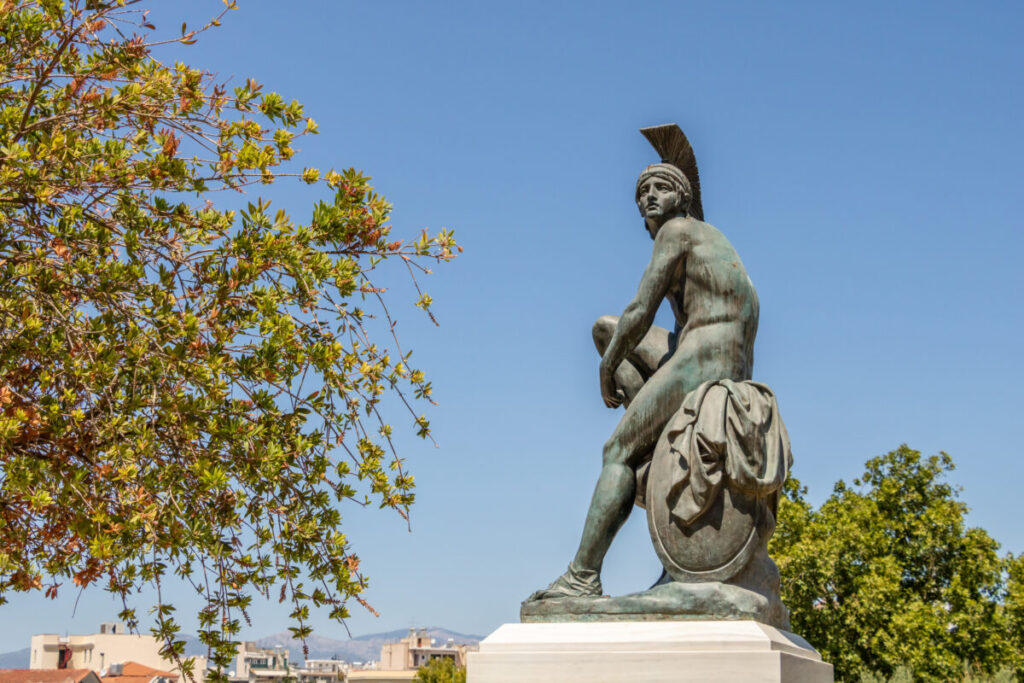
The Statue of Theseus stands in Thissio Square in Athens, opposite Thissio metro station and a few minutes on foot from the Ancient Agora. It is a brass sculpture made in 1868 by Georgios Vitalis, a sculptor from the island of Tinos, and it was placed in its present spot in 2002.

What you will see
Theseus is shown seated and nude in the neoclassical style, wearing a helmet and sandals, with a shield and a length of cloth beside him. The figure rests on a marble pedestal at the top of the square, which the city has recently relandscaped with new planting.
Who Theseus was
In Greek myth Theseus was the son of Aegeus, king of Athens. He is best known for killing the Minotaur in the labyrinth on Crete with the help of Ariadne, and he was credited with uniting the communities of Attica into a single city. The neighbourhood of Thissio takes its name from him: the nearby Temple of Hephaestus was long mistaken for his shrine and called the Theseion.
Visiting
The statue is outdoors, free to see and accessible at any hour. Allow five to ten minutes. It fits naturally into a walk along the pedestrian street of Apostolou Pavlou, between the Ancient Agora, the Temple of Hephaestus and the Acropolis.
The Statue of Theseus is a small but resonant civic landmark at the upper edge of Thissio Square, where the modern transport hub meets one of Athens’s richest archaeological walking districts. Created by Tinian sculptor Georgios Vitalis in 1868, the neoclassical bronze gives a mythic face to a neighbourhood shaped by the long-standing association between Theseus and nearby ancient monuments.
It is not a destination that demands a dedicated excursion; its appeal lies in the pause it creates between larger sights. From the square, the routes toward the Ancient Agora, the Temple of Hephaestus, Apostolou Pavlou and the Acropolis begin to open out. The statue’s elevated marble pedestal, surrounding planting and constant flow of walkers make it a useful orientation point as well as a concise introduction to Athenian myth and nineteenth-century public sculpture.
Key Highlights & What to Expect
Expect a brief, open-air encounter rather than a museum-style visit. The figure is best appreciated by taking a moment to look beyond the familiar Minotaur story and notice how the sculpture uses an idealised classical vocabulary to present Athens’s legendary founder in a modern city square.
- A nineteenth-century work: Georgios Vitalis’s bronze dates from 1868 and reflects the neoclassical taste that strongly shaped public art in modern Greece.
- Theseus at rest: The hero is portrayed seated, nude and helmeted, with sandals, shield and drapery forming a deliberately classical arrangement rather than a scene of action.
- A mythic neighbourhood connection: Thissio takes its name from Theseus because the nearby Temple of Hephaestus was once thought to be the Theseion, or sanctuary of Theseus.
- An easy route marker: The monument is close to the principal walking links between Thissio, the Ancient Agora and the Acropolis slopes, making it simple to fold into a wider itinerary.
- A people-watching setting: The square offers a distinctly local contrast to ticketed antiquities, with commuters, café-goers and walkers passing through throughout the day.
Practical Planning Snapshot
| Planning Factor | What to Expect | Local Tip |
|---|---|---|
| Best Time / Timing | Early morning and the later afternoon generally bring softer light and a less hurried square. | Pause here before or after the Ancient Agora, when the sculpture can act as a calm transition between stops. |
| Typical Duration | Most visitors need around five to fifteen minutes to view the work, read the scene and take photographs. | Allow longer only if using the square as a meeting point or beginning a walk through Thissio. |
| Crowd & Booking Reality | This is an unticketed public-space sight, so there is no separate visit to reserve; pedestrian traffic can be busy. | Build flexibility into a central Athens day rather than treating it as a timed attraction. |
| Getting There & Terrain | The statue sits by Thissio Square near public transport and mostly level paved approaches, with busier streets nearby. | Wear comfortable shoes for the onward walk, as routes toward the Acropolis and surrounding sites can become uneven or sloped. |
| Ideal Pairing Nearby | The Ancient Agora and Temple of Hephaestus are the most natural historical companions, followed by the pedestrian promenade. | Continue along Apostolou Pavlou for views toward the Acropolis, then choose a museum or café break according to your pace. |
Who It Suits Best & Honest Trade-Offs
This stop suits first-time visitors assembling a logical Acropolis-and-Agora walk, mythology-minded travellers, architecture and sculpture enthusiasts, and anyone who enjoys noticing the quieter layers between headline sights. It also works well for families as a quick visual prompt for discussing Theseus before encountering the wider ancient landscape. The trade-off is scale: this is a single monument in an active urban square, not a major archaeological exhibit, and it can be visually overshadowed by its celebrated surroundings. Visitors seeking extensive interpretation, a concentrated collection of ancient art or a dramatic viewpoint should make it one thoughtful element of a broader Thissio visit. Its reward is precisely that modesty—a short encounter with how modern Athens has continued to place its founding myths in everyday public space.