Thirassia Island
Peaceful volcanic island facing Santorini’s caldera, known for quiet village lanes in Manolas, hiking trails, and traditional seaside tavernas.
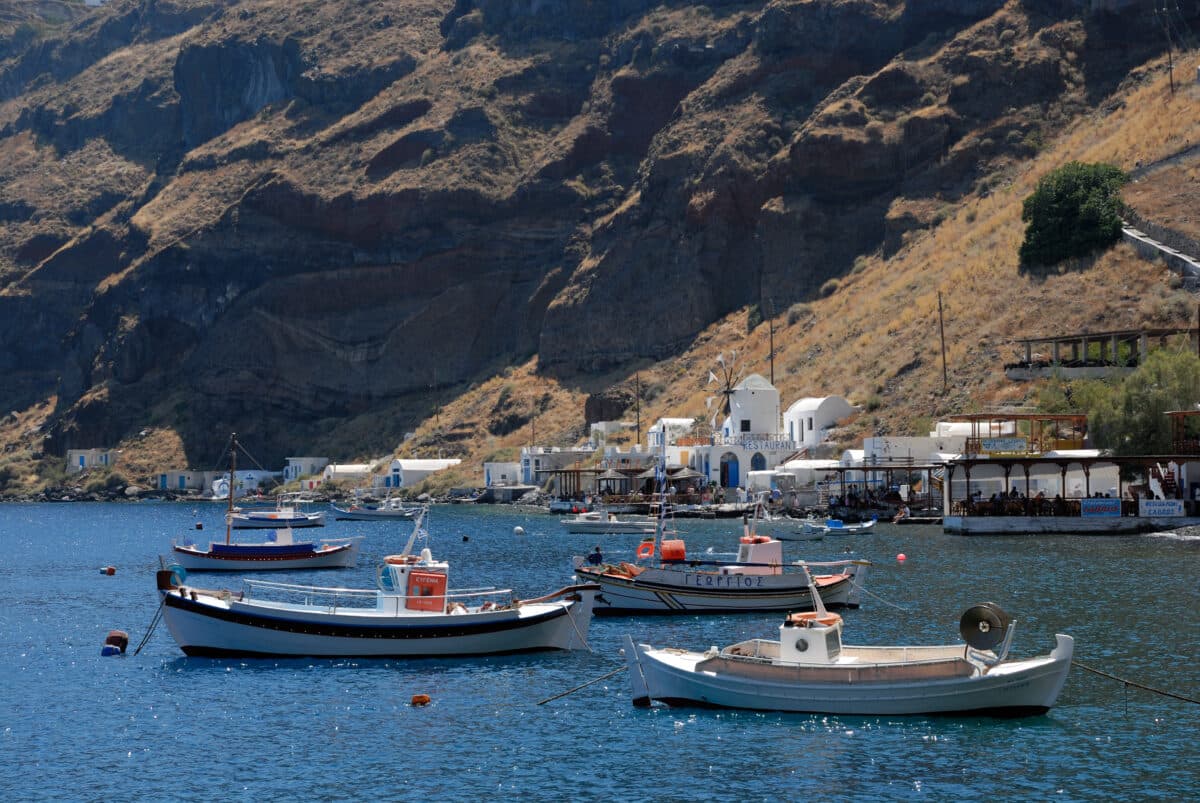
About Thirassia Island
Thirassia (also spelled Therasia or Thirasia) is the small inhabited island on the western rim of the Santorini caldera, about a 10-minute boat ride from Ammoudi Bay below Oia. It has five small settlements, a few family tavernas, one winery, and wide caldera views back toward Santorini with a fraction of the crowds. If you want a caldera day trip that feels slower and more local, Thirassia is one of the easiest add-ons to a Santorini stay, either as a stop on a volcano boat tour or on the 1-euro local ferry.

Thirassia at a glance
| Location | Western side of the Santorini caldera, about a mile across the water from Oia |
| Size | About 9.3 sq km, roughly 9 km long and under 3 km wide |
| Population | 249 residents in the 2021 census (319 in 2011) |
| Main village | Manolas, on the caldera cliff |
| Ports | Riva (Agia Irini) in the north; Korfos directly below Manolas |
| How to get there | Local ferry from Ammoudi (Oia), ferry from Athinios port, caldera boat tours, or a private taxi boat |
| Getting around | On foot, a free local bus from Riva, one island taxi, or a rented e-bike |
| Time needed | 1 to 2 hours on a boat-tour stop; a full day to see the villages properly |
| Best for | Quiet day trips, walking, photography, caldera views, and volcanic wines |
Population figures vary by source. The Santorini Port Authority guide lists an area of 9.246 sq km and 319 residents from the 2011 census. The 2021 census counted 249, with about 140 people in the village of Manolas and 74 in Potamos, and a National Geographic Traveller feature published in August 2026 put the permanent year-round population at 168. Every count points the same way: this is a small living community with a bakery, a grocery, a regional clinic, and working vineyards, so visit it as a village where people live rather than an empty excursion stop.

Where Thirassia is and how it formed
Thirassia is a volcanic island and the second-largest in the Santorini group after Thira itself. It belongs to the Municipality of Thira in the Cyclades. Before the Minoan eruption of around 1600 BC, Thirassia, Santorini, and the islet of Aspronisi were parts of a single round island usually called Strongyli. The eruption emptied the magma chamber beneath it, the centre collapsed, and the Aegean Sea flooded in to create the caldera. Thirassia was left on the western edge of the crater, which is why its cliffs mirror the ones below Oia and Fira. The dark islands in the middle, Nea Kameni and Palaia Kameni, formed much later from continuing volcanic activity.
The island has an unusual place in Aegean archaeology. In 1866 and 1867, workers quarrying the volcanic ash known as Theran earth, which was shipped to Egypt for the construction of the Suez Canal, uncovered prehistoric walls, pottery, and a human skeleton. The French geologist Ferdinand Fouqué excavated the site in 1867 and dated it to the Late Bronze Age. Those finds came before the famous excavations at Akrotiri on Santorini and helped draw scholars to the region.
Later history shaped the island you see today. Under Venetian rule, it passed with Santorini into the Duchy of the Aegean, and pirate raids in the 1500s pushed villages up onto the cliff tops, away from the shore. Agrilia, in a gorge in the south, once housed an agricultural community of up to 700 people. Its decline followed the closure of the tomato-paste factories it supplied after the Second World War and the severe earthquake of 1956. While Santorini turned into a global destination, its smaller neighbour kept losing residents, and that is largely why it still looks the way Santorini did decades ago.
Is Thirassia worth visiting?
Yes, if you want the caldera without the crowds. The Port Authority guide highlights the island’s natural relief, unchanged folk architecture, picturesque coastline, the waterfront tavernas at Korfos, and the views toward Santorini, Palaia Kameni, and Nea Kameni. Discover Greece describes a visit as a glimpse of what Santorini was like 50 years ago. The main draw is contrast: the same volcanic setting you see from Oia, but with quiet lanes, traditional villages, and working farmland instead of cruise-ship queues.
Set your expectations honestly, though. Beaches are small and pebbly, services are limited, and a typical boat-tour stop gives you time for lunch and a swim at Korfos but not much more. To see Manolas, Potamos, and the walking trails, take the local ferry and give yourself most of a day.
Who it suits best
- Repeat Santorini visitors who have already done Oia, Fira, and the main beaches
- Walkers and photographers who want caldera views without tour groups in the frame
- Travelers already booking a volcano and hot springs cruise, since most of those include a Thirassia stop
- Wine lovers who want to taste volcanic Assyrtiko at the island’s only winery
- Anyone who wants a long, simple lunch by the water on a slower day
It suits you less if you want sandy beaches, nightlife, shopping, or a wide choice of restaurants. For that kind of day, Santorini’s east coast or a larger neighbouring island is a better fit. Our guide to Greek islands near Santorini compares the day-trip options.
How to get to Thirassia from Santorini
The island can only be reached by sea. You have four practical options: the local passenger ferry from Ammoudi Bay, the larger ferry from Athinios port, a caldera boat tour, or a private taxi boat. Every crossing depends on the weather, and strong summer meltemi winds can change or cancel sailings, so confirm departure and return times with the Santorini Port Authority (+30 22860 22239) on the day you travel.
| Option | Departs from | Crossing time | Typical cost | Best for |
|---|---|---|---|---|
| Local passenger ferry | Ammoudi Bay, Oia | About 10 minutes | 1 euro per person | Independent day trips |
| Car and passenger ferry | Athinios port | About 25 to 45 minutes | Varies by operator | Travelers staying in Fira or the south, or bringing a vehicle |
| Caldera boat tour | Athinios, Vlychada, or Ammoudi | Part of a 5 to 8 hour cruise | From about 35 to 40 euros on budget boats | Combining the volcano, hot springs, and Thirassia |
| Private taxi boat | Ammoudi Bay | About 10 minutes | Roughly 40 euros each way | Flexible timing or a missed return |
Ammoudi Bay to Riva: the local ferry
The cheapest and most scenic route is the small passenger ferry from Ammoudi, the fishing harbour below Oia, to Riva, Thirassia’s main port. Tickets cost 1 euro and are bought on the spot, with no need to book. The Mikra Thira winery publishes the timetable below on its visitor page; departures begin at 08:00 all year, according to Discover Greece.
| Season | Ammoudi to Riva | Riva to Ammoudi |
|---|---|---|
| March to October | 08:00, 12:45, 17:35 | 07:45, 12:30, 17:20 |
| High-season extra | None | 21:00 on Mondays, Wednesdays, Fridays, and Sundays (listed until 25 September) |
| December to February | 08:00, 12:35, 16:25 | 07:45, 12:20, 16:15 |
No public bus runs down to Ammoudi. Take the bus to Oia and walk down the roughly 300 steps, or take a taxi, which should cost no more than about 25 euros from Fira. Our guide to things to do in Oia covers the walk down and the tavernas by the harbour, which are handy if you are waiting for the return boat.
Athinios port to Riva
Discover Greece reports that ferries leave Athinios, Santorini’s main port, for Riva on most days of the week. National Geographic Traveller described a daily 15:30 departure except Sundays, taking about 25 minutes, while Discover Greece gives about 45 minutes for the crossing. This is also the route that carries cars. The Port Authority notes that some Piraeus ferries on the Paros, Naxos, Ios, Sikinos, and Folegandros line call at Thirassia before Santorini and Anafi, so you can also arrive directly from the mainland. Be aware that the next return from Riva on this route may not be until the following morning.
Caldera boat tours
Most visitors reach Thirassia as the last stop on a caldera cruise that also includes a hike on the Nea Kameni volcano and a swim at the Palaia Kameni hot springs. Boats usually dock at Korfos, and the stop generally lasts one to two hours, enough for lunch, a swim, or a brisk climb to Manolas. Our volcano and hot springs cruise is a five-and-a-half-hour trip with free time on Thirassia, and our guides to the best Santorini boat tours and the best tours in Santorini compare wooden boats, catamarans, and private charters. If an evening on the water appeals more, our Santorini sunset cruise guide covers routes that sail past Thirassia at golden hour.
Private taxi boat
Local taxi boats run between Ammoudi and Thirassia for roughly 40 euros each way. They must be booked in advance and are paid on the spot; the Mikra Thira visitor page lists current operators. A taxi boat is the backup if you miss the last public ferry or want to stay on for dinner.
Getting around the island
The island is small enough to explore mostly on foot. A single road links Riva with Manolas, Potamos, and the southern settlements, and a free public bus waits near the port at Riva to carry arriving passengers up the hill. The island has one taxi, which should be booked ahead. Explore Thirasia rents e-bikes and runs guided hikes and bike tours, and you can bring a car on the Athinios ferry, although few day visitors need one.
If you arrive at Korfos, the only way up to Manolas is a paved, zigzagging path of roughly 250 to 280 steps, depending on who is counting. Mules are sometimes offered for the climb. We recommend walking, as we do for the steps between Oia and Ammoudi. Allow 15 to 25 minutes, carry water, and avoid the midday heat in summer.
The villages of Thirassia
Manolas
The capital sits on the caldera edge at the top of the island, built high up to stay out of reach of pirates. Its whitewashed lanes, arched houses, and cave dwellings are classic Cycladic architecture, and they look straight across the water to Oia, Imerovigli, and the volcano. The blue-domed church of Agios Konstantinos stands on the main terrace, and the church of Agios Ioannis is nearby. Manolas also has the island’s wood-fired bakery, a grocery, and the regional clinic.
Korfos
This small harbour at the foot of the cliff below Manolas is where most tour boats tie up. It has a strip of fish tavernas, a few old fishermen’s boathouses, and black pebbles where you can swim with views of Santorini. Most day-trippers never leave Korfos, so walking up the steps is the quickest way to leave the crowds behind.
Riva and Agia Irini
Riva, on the northern tip opposite Ammoudi, is the main port for ferries and the local boat. It has a dark-pebble beach, a few waterfront tavernas, and the bus stop for the villages. Nearby is the small church of Agia Irini, built in 1867 at the neck of the caldera. Local tradition holds that sailors returning home shouted “Santa Irini” when they sighted it, one of several stories behind the name Santorini.
Potamos
About 1 km inland from Manolas, Potamos is a farming village built in a ravine; its name means “river”. Look for its courtyard houses and the churches of Agios Dimitrios, Agios Spyridon, and the colourful Panagia Giatrissa. The Mikra Thira winery lies near the village on the northwestern side of the island.
Agrilia and Kera
Agrilia is the island’s oldest settlement and is now an almost abandoned village; the 2021 census recorded five residents. Its houses were dug into the soft volcanic rock of a gorge, and its church of Panagia ton Eisodion dates from 1887. Kera, another old and largely ruined village, lies on the path south toward the monastery. Both are best seen on foot and give you the rawest volcanic scenery on the island.
Best things to do on Thirassia
1. Walk the caldera edge in Manolas
The simplest pleasure here is walking the cliff-top lanes of Manolas and looking back at Santorini’s villages strung along the rim. It is the same view Oia is famous for, reversed, with Nea Kameni and Palaia Kameni in the middle of the bay.
2. Hike to Profitis Ilias and the southern monastery
Continue south from Manolas to the chapel of Profitis Ilias on the island’s highest point, around 295 m above the sea and probably the best viewpoint on the island. The trail carries on past Kera to the Monastery of the Dormition of the Virgin (Kimisis) near Cape Tripiti at the southern tip, whose blue dome sits on the caldera rim. Its festival on 15 August draws the whole island. The full walk is long and unshaded, so start early and carry plenty of water.
3. Explore the cave houses of Agrilia
A roughly 2 km walk from Manolas leads to Agrilia, where you can see abandoned homes carved into the rock and the old village church. The route passes windmills and old pumice workings, and on the way you may spot the peach-and-yellow Church of the Virgin Mary that locals nickname the “Mexican church”.
4. Taste volcanic wine at Mikra Thira
Mikra Thira is the first and only winery on the island, producing PDO Santorini wines from vines trained in low, basket-shaped kouloura that protect the grapes from the wind. Its 90-minute Mikra Thira Experience includes a vineyard and cellar tour with three dry whites for 35 euros per person, or 50 euros with a cheese and cold-cuts platter. The Volcanic Experience adds all five wines, including Mandilaria and Vinsanto, for 50 or 65 euros, and a two-hour Cycladic Experience with a full local food pairing costs 130 euros. In season (2 April to 31 October) the winery opens from 09:00 to 20:00 and is closed on Tuesdays. Advance booking is required. From Riva it is about a 3 km, 35-minute walk, or you can take the free bus.
5. Swim at Riva, Korfos, or Agia Irini
Beaches are not the island’s strength, but the water is clear. Riva has dark pebbles plus the sunbeds and umbrellas Discover Greece lists; Korfos is a pebbly harbour with tavernas steps away; and Agia Irini is a quieter pebble cove beside its chapel. Bring water shoes. For sandy beaches, see our guide to the best beaches in Santorini.
6. Watch the sunrise over Santorini
Because the island faces Santorini from the west, sunrise is the time to see light break over the caldera villages opposite. Evenings in Manolas are also far calmer than the crowded sunset viewpoints in Oia. Either one means staying overnight or catching the first or last boat.
7. Join a guided hike or e-bike tour
Explore Thirasia runs morning and sunset walks as well as mountain-bike and e-bike excursions, and it can include a stop at the winery. With little traffic and short distances, cycling is a practical way to cover Potamos, Agrilia, and the southern trails in one day. For walks on the main island, see our guide to the best hikes in Santorini.
Where to eat on Thirassia
Island food is simple and local, built on what grows in the dry volcanic soil: fava, chickpeas, cherry tomatoes, capers, fresh chloro goat cheese, and sykaminoglyko, a mulberry spoon sweet made by island women. Fresh fish is the draw at the harbours.
- Korfos: a row of seafood tavernas on the waterfront, the easiest choice on a boat-tour stop
- Riva: Agistri is a traditional fish taverna with tables near the water, just to the right as you step off the boat
- Manolas: Fyrgano serves farm-to-table Greek dishes with produce from the owner’s garden and has an upstairs terrace, while Panorama Resto offers more creative plates such as baby calamari moussaka
Opening times are seasonal and many places keep short hours outside summer, so ask locally or call ahead before an off-season visit.
Where to stay on Thirassia
Accommodation is limited to a handful of small properties, so book well ahead for summer. Staying overnight gives you the island after the day boats leave, the sunrise over Santorini, and no pressure to catch the last ferry.
- Santa Irini Retreat, near Riva port: four suites in a restored traditional building with a pool, opened in 2024 and open from May to October, from about 280 euros per night including breakfast, according to National Geographic Traveller
- Zacharo Studios, Manolas: simple rooms at the highest point of the village with caldera views, listed in the Cyclades Chamber of Commerce directory
If nothing is available, stay in Oia or Finikia so you can reach the Ammoudi ferry early.
A one-day Thirassia itinerary
This plan uses the March to October local ferry times. Check them again before you set out.
- Take the 08:00 boat from Ammoudi to Riva, about 10 minutes.
- Ride the free bus or walk up to Manolas for coffee and the caldera view before the heat builds.
- Walk south to Profitis Ilias, or head for the cave houses of Agrilia, about 2 km each way.
- Have lunch in Manolas, or walk down the steps to Korfos for fish and a swim.
- Spend the afternoon on a pre-booked tasting at Mikra Thira near Potamos (closed Tuesdays).
- Return to Riva for the 17:20 boat to Ammoudi and stay for dinner at the harbour as the sun sets.
For a half day, take the 08:00 boat out and the 12:30 boat back, which leaves time for Manolas and a short walk.
Best time to visit Thirassia
You can visit all year, but swimming is best from May to October, and organised boat excursions run mainly in summer. May, June, September, and October are the most comfortable months, with fewer visitors on Santorini and easier walking weather. In July and August there is little shade on the trails, so walk early. The meltemi, a strong northerly wind in summer, can make crossings rough or cancel them. Winter brings a reduced ferry timetable, and some tavernas and rooms close.
Practical tips before you go
- Check your return boat time as soon as you land, because the last public departure is early evening for most of the year.
- Carry some cash for the ferry and small businesses; the island has an ATM, a few shops, and cafés.
- Wear walking shoes with grip for the stepped lanes, pebble beaches, and volcanic trails.
- Bring water, a hat, and sunscreen, as shade is scarce away from the villages.
- If you have limited mobility, arrive at Riva rather than Korfos and use the bus to reach the villages.
- Dress modestly and keep your voice down when visiting churches and the monastery.
Local tip: Do not expect full resort infrastructure. Thirassia works best as a slow island detour with simple pleasures: a boat ride, a village walk, a long lunch, and a different view of the caldera.
Frequently asked questions
Is Thirassia the same as Therasia or Thirasia?
Yes. Thirassia, Therasia and Thirasia are all transliterations of the same Greek name. Ferry companies, maps and tour operators use different spellings, so search all three when you check timetables.
What happens if I miss the last boat back from Thirassia?
You may need to stay overnight, because the next public departure from Riva can be the following morning. Book a private taxi boat, which costs roughly 40 euros each way and must be arranged in advance, or call the Santorini Port Authority on +30 22860 22239 for current sailings.
Is Thirassia suitable for travelers with limited mobility?
Partly. The climb from Korfos to Manolas is a long staircase, so arrive at Riva instead, where a road and a local bus reach the villages. Many lanes in Manolas are stepped and uneven. Mikra Thira winery says its venue is accessible to people with disabilities.
Can you take a car to Thirassia?
Yes, on the larger ferry from Athinios port, but most visitors do not need one. The island has one main road, a free local bus, a single taxi and e-bike rentals, and most sights can be reached on foot.
How long should you spend on Thirassia?
A boat-tour stop of one to two hours covers lunch and a swim at Korfos. To see Manolas, Potamos, a hiking trail and the winery, plan a full day using the 08:00 and 17:20 local ferries, or stay one night.
Reviews
Loading traveler reality-check data for Thirassia Island.
Amenities & Features
- Tourist Attraction