The Porch of the Caryatids
The iconic south porch of the Erechtheion on the Acropolis hill, supported by six meticulously sculpted classical maiden figures.
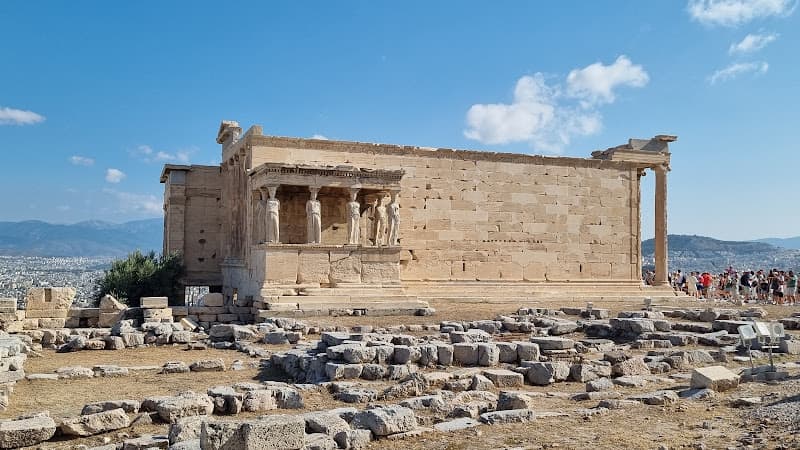
About The Porch of the Caryatids
The Porch of the Caryatids is the south porch of the Erechtheion on the Acropolis of Athens, where six marble female figures stand in place of columns and carry the roof. The figures on the monument today are replicas. Five of the originals are displayed in the Acropolis Museum in Athens, and the sixth is in the British Museum in London. The porch is included in the standard Acropolis ticket, which costs €30 full and €15 reduced.

What the Porch of the Caryatids is
The Erechtheion is the smaller Ionic temple on the north side of the Acropolis, facing the Parthenon. The Official Athens Guide dates it to around 420 BC, describes it as a temple dedicated to both Athena and Poseidon, and singles out the row of Caryatids on its southern porch as its best-known feature. The Acropolis Museum dates one of the original figures, Kore B, to 420-415 BC and records the material as marble from Penteli, the mountain northeast of Athens that supplied much of the marble for the Acropolis buildings.
The six figures are arranged with four across the front and one behind each end. Each stands on a low base and carries a basket-like capital on her head, which takes the weight of the roof. The vertical folds of their drapery echo the fluting of a column, so the figures read as sculpture and as structure at the same time. They were designed as load-bearing supports from the start rather than added to the building as decoration.
You will see two names for the figures. “Caryatid” is the architectural term for a draped female figure used as a support, and the porch is often called the Porch of the Maidens. The Acropolis Museum refers to each figure as a Kore, meaning maiden, and identifies them by the letters A to F.
Where the original Caryatids are now
Five of the originals, Korai A, B, D, E and F, are in Greece. The sixth, Kore C, is in the British Museum. The table below sets out how the figures left the porch and where they ended up.
| Date | What happened |
|---|---|
| 1800-1804 | One figure, Kore C, was removed from the porch for Lord Elgin. The Acropolis Museum gives the date as 1804, while the British Museum’s image record says G.B. Lusieri removed it on Elgin’s behalf between 1800 and 1803. |
| 1816 | The British Museum acquired the figure along with the other sculptures Elgin brought to London. |
| 1979 | The five figures remaining in Athens were taken off the Erechtheion to protect them from air pollution and moved to the old Acropolis Museum. Synthetic stone copies replaced them on the porch. |
| 2009 | The five originals went on display in the new Acropolis Museum below the Acropolis. |
| December 2010-2014 | Acropolis Museum conservators cleaned the five figures in their gallery using laser technology developed with the Institute of Electronic Structure and Laser (IESL) of the Foundation for Research and Technology-Hellas (FORTH), while visitors watched. The project received the International Institute for Conservation’s Keck Award. |
The Greek government does not recognise the British Museum’s claim of ownership over any part of the Acropolis monuments, and the return of the Caryatid is part of the long-running dispute over the sculptures often called the Elgin Marbles or Parthenon Marbles.
How to see the Caryatids in Athens
On the Acropolis, the porch is one stop on the route around the summit, and the replicas are best seen from the open ground between the Parthenon and the Erechtheion. The copies show the porch as it was designed: six figures together, in their original setting, holding up the roof.
To see the originals, go to the Acropolis Museum at the foot of the hill. The Acropolis Museum lists Kore B in the first-floor west gallery, and the five figures are shown together with an empty space for the sixth. You can see details up close that are hard to make out on the rock, including the carved hair falling down each figure’s back and the marble surface revealed by the laser cleaning.
Tickets, hours and location
The details below come from the Ministry of Culture page for the Acropolis and the Acropolis Museum visitor page, checked in September 2026. Prices and hours change, so confirm them before you go.
| Acropolis (replicas on the porch) | Acropolis Museum (five originals) | |
|---|---|---|
| Ticket | €30 full, €15 reduced; covers the Acropolis and its slopes | €20 general, €10 reduced; separate from the Acropolis ticket |
| Booking | At the site ticket offices or through the Ministry of Culture’s official e-ticketing service | General tickets at the museum desk or online; reduced and free tickets only at the museum desk with proof of eligibility |
| Summer hours | 08:00-20:00, last entry 19:30 | 1 April-31 October: Monday 09:00-17:00, Tuesday-Sunday 09:00-20:00, Friday until 22:00 |
| Winter hours | 08:00-17:00, last entry 16:30 | 1 November-31 March: Monday-Thursday 09:00-17:00, Friday 09:00-22:00, Saturday-Sunday 09:00-20:00 |
| Closures | Closed Easter Sunday and 1 May; Good Friday 12:00-17:00, Holy Saturday 08:30-15:30 | Closed 1 January, Orthodox Easter Sunday, 1 May, 25 and 26 December |
| Address | Acropolis, Athens 105 58; phone +30 210 321 4172 | Dionysiou Areopagitou 15, 117 42 Athens; metro Akropoli (Line 2) |
Local tip: See the porch on the Acropolis first, then walk down to the Acropolis Museum on the same day. Seeing the copies in their setting and then the originals up close is the clearest way to understand the Caryatids. For a view back up to the Erechtheion afterward, Areopagus Hill is free and just west of the Acropolis.
Frequently asked questions
Why are they called Caryatids?
The name is usually linked to Karyai (Karya), a town in the Peloponnese. No one knows for certain whom the six Erechtheion figures represent, and the Acropolis Museum refers to them as Korai, meaning maidens.
Which Caryatid is in the British Museum?
Kore C, which stood second from the left in the front row of four. The other five originals are in the Acropolis Museum.
When is the Acropolis Museum free to visit?
The Acropolis Museum lists free admission on 6 March, 25 March, 18 May and 28 October. Some visitors, including EU citizens aged up to 25, qualify for free entry year-round with ID at the ticket desk.
Reviews
Loading traveler reality-check data for The Porch of the Caryatids.
Amenities & Features
- Tourist Attraction