Areopagus Hill
Historic marble outcrop beside the Acropolis where the ancient Athenian high court sat and Apostle Paul addressed classical philosophers.
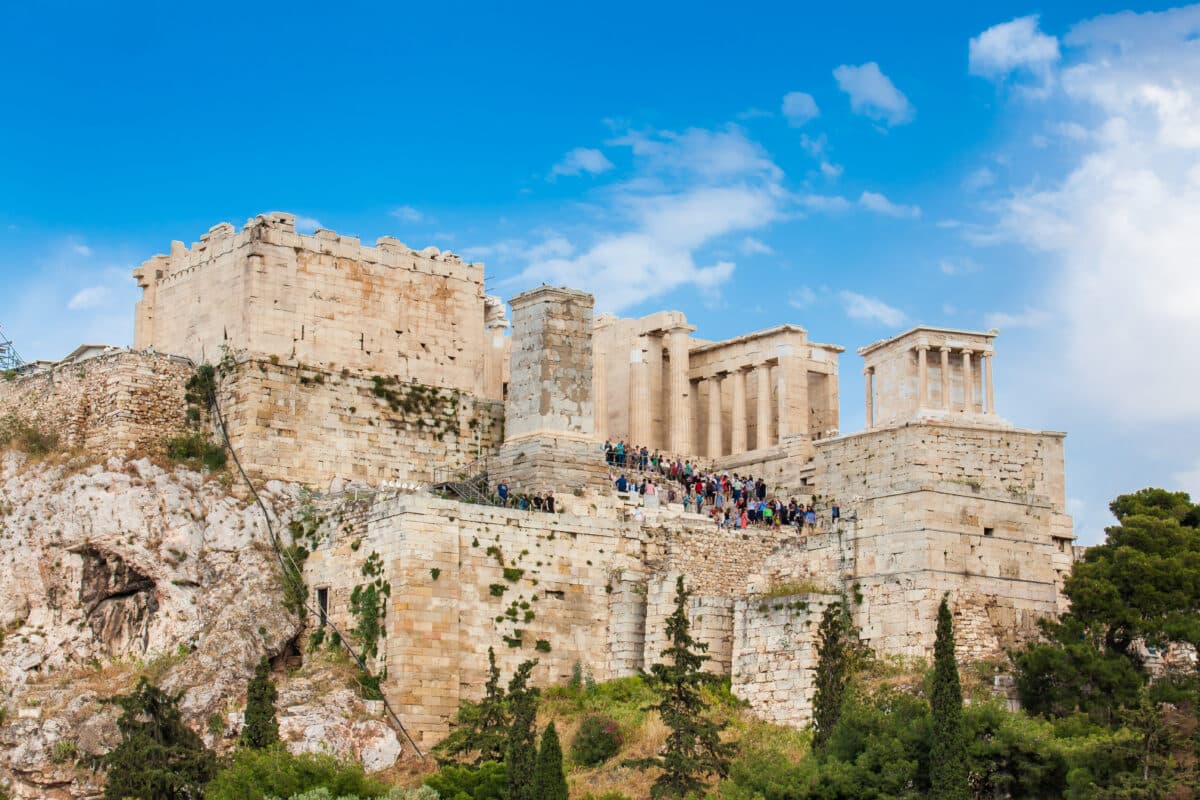
About Areopagus Hill
Areopagus Hill (also called Mars Hill) is a bare rock outcrop just northwest of the Acropolis entrance in Athens, and one of the best free viewpoints in the city. There is no ticket, no gate, and a short metal staircase leads to the top. The name comes from the Greek Areios Pagos, the “rock of Ares”. Ancient Athens held its highest court here, and Christian tradition remembers it as the place where Apostle Paul spoke to the Athenians.

Areopagus Hill at a glance
| Detail | Information |
|---|---|
| Address | 21 Theorias, Acropolis, 105 55 Athens |
| Location | Opposite the main (west) entrance of the Acropolis, above the Ancient Agora |
| Admission | Free, no ticket required |
| Access | Modern metal staircase; the ancient rock-cut steps are badly worn |
| Height | About 115 metres above sea level |
| Nearest metro | Akropoli (Line 2); Monastiraki and Thiseio (Lines 1 and 3) |
| Best time | Morning, late afternoon, or sunset in dry weather |
History of the Areopagus
The hill gave its name to the Areopagus council, the oldest aristocratic council of ancient Athens, which met here. For centuries it was the city’s most respected court, hearing cases of intentional homicide, wounding, poisoning and arson, along with certain religious offences such as cutting down the sacred olive trees. In 462 BC the reformer Ephialtes, working with the young Pericles, removed most of its political powers, but the council kept its role as the murder court. Greece’s modern Supreme Court still carries the name Areios Pagos.
Myth explains the name. In one version, Ares was tried here by the Olympian gods for killing Halirrhothius, a son of Poseidon. In Aeschylus’s play Eumenides, Athena sets up the court on this hill to try Orestes for killing his mother. A sanctuary of the Erinyes (the Furies) stood at the foot of the rock, which is why the hill was also linked with the old goddesses of punishment and vengeance.
Apostle Paul on the Areopagus
Acts 17 describes Paul arguing daily in the Athenian agora with Epicurean and Stoic philosophers, who then brought him to the Areopagus to explain his teaching. His speech opens with the Athenian altar inscribed “to an unknown god” and ends with the resurrection. Most listeners were unconvinced, but Acts names Dionysius the Areopagite, a member of the council, among those who believed. The official Greek tourism route on Paul dates his arrival in Athens to the year 51.
A bronze plaque fixed to the rock at the foot of the hill carries the text of the sermon (Acts 17:22-31) in ancient Greek. Look for it beside the old rock-cut steps before you climb. The link with Paul is still marked by the church: in 1923 Archbishop Chrysostomos Papadopoulos of Athens ruled that the vespers for the feast of Apostle Paul should be held on the Areopagus.
What you see from the top
The view is the main reason most people climb. To the east, the Propylaia gateway and the Parthenon rise directly above you on the Acropolis. Below to the north lies the Ancient Agora, with the Temple of Hephaestus on its far side, and beyond it the modern city stretches toward Mount Lycabettus. The Official Athens Guide calls this rock the best view of the Acropolis and of the city, and it notes that Athenians know it simply as Vrahakia (“little rocks”) and gather here as dusk falls.

Why it is worth visiting
Areopagus gives you a strong sense of how ancient Athens was laid out without buying a ticket or committing to a full museum visit. From one spot you can see the religious centre on the Acropolis and the civic centre in the Agora, and you are standing where the city’s oldest court met. It takes little time, so it fits easily before or after a visit to the Acropolis of Athens, which requires a timed ticket (see the Acropolis tickets guide).
For a full day around the rock, pair it with the Acropolis Museum and the Ancient Agora, then browse the wider list of things to do in Athens. If you want a second free viewpoint, Filopappou Hill to the southwest looks back at the Acropolis from a different angle and has shaded paths through pine trees.
How to get to Areopagus Hill
The Official Athens Guide lists the location as 21 Theorias, Acropolis, 105 55. The easiest way up is the metal staircase on the south side of the rock, close to the main Acropolis entrance.
- From Akropoli metro station (Line 2), walk west along the pedestrian street Dionysiou Areopagitou toward the Acropolis entrance. Allow about 10 to 15 minutes.
- From Monastiraki or Thiseio stations (Lines 1 and 3), walk south and uphill through the lanes below the Acropolis, or follow Apostolou Pavlou past the Agora. Expect some steep streets and steps.
- After an Acropolis visit, the rock is directly in front of you as you leave the main entrance, which makes it the simplest time to add it to your day.
Areopagus is an open rock rather than a fenced archaeological site, so there are no posted opening hours and most guides describe it as accessible at any time. Daylight and sunset are the best choices, because the surface is much easier to judge when you can see it clearly.
Tips for a safe visit
The climb is short, but the rock is the part that catches people out. The Official Athens Guide warns that countless visitors over the centuries have worn the stone smooth, and it recommends sneakers. Rain makes the summit far more slippery.
- Wear flat shoes with a good grip, and avoid smooth leather soles and sandals.
- Use the metal staircase. The ancient steps beside the plaque are heavily worn and slippery.
- Move carefully near the edges of the summit, where the rock surface is uneven.
- In summer, bring water and a hat, because the top has no shade.
- At sunset the summit gets crowded, so arrive early if you want space for photos.
Local tip: Do not wear smooth-soled shoes. Areopagus looks easy from below, but the worn stone can feel surprisingly slick, especially when it is crowded or after rain.
Frequently asked questions
Do you need an Acropolis ticket to visit Areopagus Hill?
No. Areopagus Hill sits outside the ticketed Acropolis site, and entry is free. You only need a timed ticket if you also want to go up to the Acropolis itself.
Why is Areopagus Hill called Mars Hill?
Areopagus comes from the Greek Areios Pagos, meaning the rock of Ares, the Greek god of war. Mars was the Roman equivalent of Ares, so English translations of the Bible and many guidebooks call it Mars Hill.
Is the Areios Pagos court still in session on the hill?
No. The ancient council stopped meeting on the rock long ago. The name lives on in the Areios Pagos, the Supreme Court of modern Greece, which sits elsewhere in Athens.
Is Areopagus Hill or Filopappou Hill better for sunset?
Areopagus is closer to the Acropolis and quicker to reach, with the Ancient Agora below. Filopappou Hill is larger, greener and gives a wider view of the Acropolis from the southwest. Both are free.
Reviews
Loading traveler reality-check data for Areopagus Hill.
Amenities & Features
- Tourist Attraction